Context and challenge
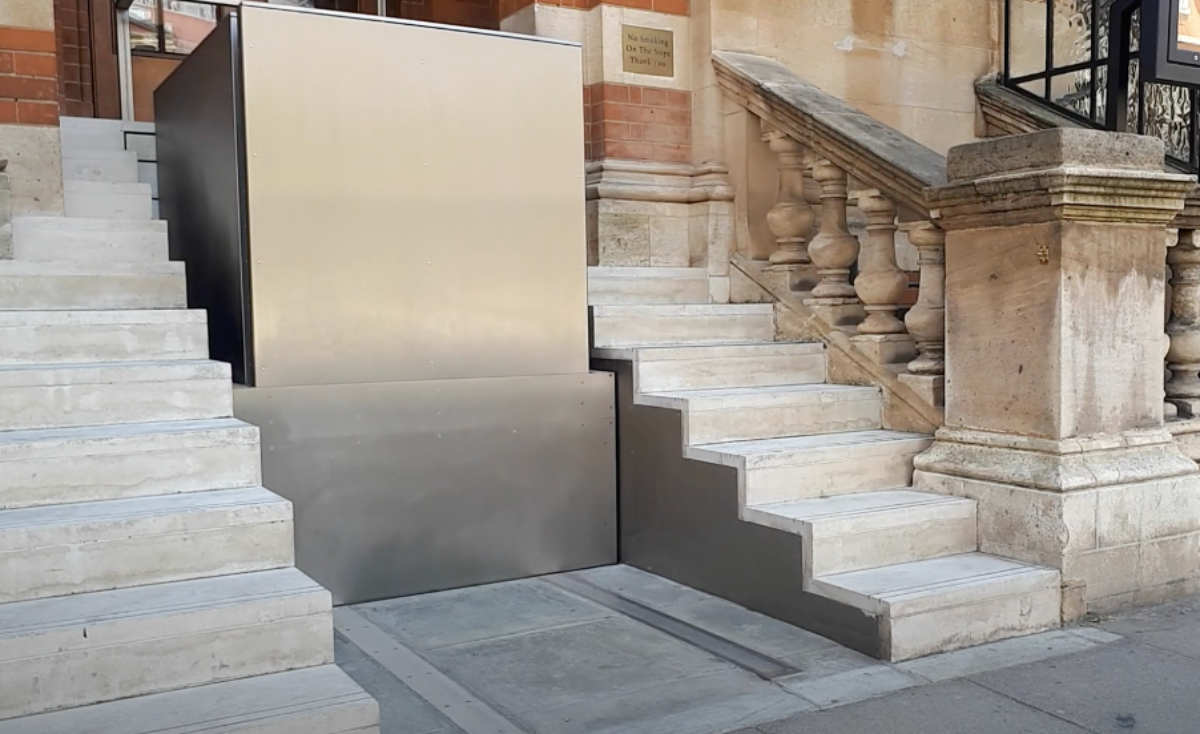
An architect asked whether a Sesame Wellington (https://www.sesameaccess.com/lifts/wellington-lift) hidden stairlift could serve a shallow level difference at a bank entrance while maintaining safety in continuous public footfall. The total rise is around 350 mm across two shallow risers. The proposed solution is a Wellington integrated into the existing staircase so that the top tread drops down to become part of the lift platform. Because this is an always-busy public environment, questions centred on seated-user operation, supervision and the temporary void when the step lowers.
Key insights
-
Platform length and step logic. The Wellington uses one retracting step: when it lowers, the first tread becomes part of the platform, giving about 1.4 m of usable length without needing the bolt-on extension originally sketched.
-
User category. With perimeter toe-guarding rather than 1100 mm full-height barriers, the Wellington is for seated use only. It should be switched off when not in use to avoid misuse and to keep the step flush.
-
Public-area risk control. BS 6440:2011 allows the omission of a top barrier where the rise is under 500 mm. Even so, staff should attend the upper landing whenever the step lowers to act as a human barrier and ensure pedestrians do not walk into the temporary void.
-
Control placements:
-
Upper call: install on a post or wall roughly 400 mm back from the nosing to keep users away from the drop.
-
Lower-level controls: use an on-lift control station with the top row of buttons about 1100 mm above the lower finished floor level (FFL). When the platform rises 350 mm, those buttons sit at approximately 750 mm above the upper landing, within the 400–100 mm seated-user reach range.
-
If the lift is sometimes left raised, install additional lower-landing call buttons so a user can bring it down.
-
-
Width strategy. Initial sketches showed around 925 mm usable width between a removable handhold post and a wheel stop. Space can be tightened to about 800 mm usable width by reducing overall width to roughly 956 mm and storing the handhold post when not required.
-
Pit depth and finishes. An available pit depth of about 1130 mm is more than sufficient. Finish the stair fascia with a stainless-steel skirt.
-
Services and maintenance. As the lift is external, the base must be drained. Provide a machine-room cabinet — ideally in the adjacent basement plant room — and, if permitted by fire/waterproofing, an access hatch from the basement to aid maintenance.
-
Alternative model for standing use. If the client insists on standing passengers and the lift remaining powered on at all times, specify a Sesame Westminster (https://www.sesameaccess.com/lifts/westminster-lift) instead.
Recommended solution
For this enquiry, specify a Wellington (https://www.sesameaccess.com/lifts/wellington-lift) with one retracting tread for seated-user-only operation and staff supervision in public hours:
-
Platform: approximately 1.4 m long, using the upper step as part of the platform.
-
Controls: place the upper call button about 400 mm from the nosing; mount on-lift controls around 1100 mm above the lower FFL (≈750 mm above the upper landing when raised); install additional lower-landing call buttons if needed.
-
Width: target around 800 mm usable width (overall width ~956 mm) with the removable handhold post stowed when not required.
-
Pit and finishes: accept the ~1130 mm pit and finish the stair reveal with a stainless-steel skirt.
-
Drainage and services: ensure the base is drained; locate the machine-room cabinet in the basement plant room; provide an access hatch from the basement where possible.
-
Operational policy: the lift should be switched off when not in use, and a staff member should attend the upper landing when the step retracts to act as a barrier.
-
Contingency: if standing use or continuous operation becomes a requirement, switch to a Westminster (https://www.sesameaccess.com/lifts/westminster-lift).
Why this matters
Hidden platform lifts are common in heritage and public buildings where preserving aesthetics is important. This case illustrates how carefully managing platform length, user category, control positions, pit depth, drainage and staff oversight ensures a safe installation that blends into its surroundings. A solid understanding of BS 6440:2011 and the implications of a small rise helps select the right product and define an operational policy that minimises risk in busy public spaces.
Q&A
Q1. Why seated-only here?
The Wellington has a perimeter toe-guard rather than 1.1 m barriers, so in a public setting it is suitable only for seated use. It should be switched off when idle to avoid misuse.
Q2. Can we omit a top barrier for a 350 mm rise?
BS 6440:2011 permits no fixed barrier for rises under 500 mm, but the risk assessment for this busy site recommends a staff member attends the upper landing whenever the step lowers.
Q3. How should the controls be arranged?
Position the upper call about 400 mm back from the nosing. Mount on-lift buttons about 1100 mm above the lower FFL (≈750 mm above the upper landing when raised), within the 400–100 mm reach range for seated users. Install lower-landing call buttons if the lift may be left raised.
Q4. What if the client later wants standing use and always-on operation?
Switch to a Westminster (https://www.sesameaccess.com/lifts/westminster-lift). This model includes full-height barriers and a control regime suitable for standing passengers.