
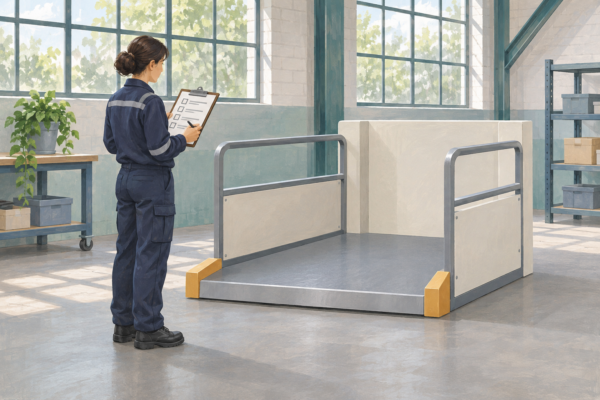
Platform Lift Factory Acceptance Checks
Before a bespoke platform lift leaves the factory, agree what to witness, record assembly and function checks, and assign any checks that depend on installation.

Reduces early-stage uncertainty on complex lift and accessibility projects
Typically shortens approval and decision cycles by several weeks
Helps clients and consultants understand constraints before committing design time
Prevents late-stage redesign caused by regulatory or structural surprises
Builds confidence through clear options, visuals, and honest risk discussion
Complex lift projects rarely fail because of engineering capability.
They fail because risks are discovered too late, expectations are misaligned, or approvals are underestimated.
This article explains how Sesame Access uses structured preparation, design-led client presentations, and disciplined follow-up to reduce those risks. It builds on the internal pre-meeting process described in
https://www.sesameaccess.com/knowledge-hub/how-sesame-prepares-for-client-meetings-2
and shows how that preparation translates into effective, confidence-building conversations with client teams.
Rather than focusing on a single lift product, this page focuses on the presentation methodology itself and why it consistently helps projects move forward.
Before any client presentation takes place, Sesame Access typically completes a focused internal preparation phase lasting around two to three weeks. This phase includes:
Reviewing architectural layouts and structural constraints
Testing more than one lift strategy against known regulations
Producing early 3D visuals and sectional diagrams
Identifying where approvals are straightforward and where risk exists
By the time a client meeting occurs, the conversation is no longer speculative. Options have already been pressure-tested internally.
This approach allows meetings to focus on decision-making rather than discovery.
Lift projects often stall when design intent and regulatory reality collide late in the process.
During the meeting, a client-side participant commented:
“It’s really helpful to see the two solutions actually in place. It’s much easier to understand than imagining it.”
By presenting multiple engineered options side by side, Sesame Access allows teams to understand trade-offs early. This typically reduces approval cycles by several weeks because key questions are resolved before formal submissions begin.
Rather than avoiding regulatory uncertainty, Sesame Access addresses it directly during presentations.
In the meeting discussion, one option was described as already having precedent approval, while another was explained as requiring a fresh approval process. This was communicated clearly:
“This option already has precedent approval, so you can have confidence in it. With the other option, we would need to start that approval process again.”
This level of transparency allows project teams to choose a path that aligns with their programme, risk tolerance, and stakeholder expectations.
One proposed solution presented as a fait accompli
Limited or no visual modelling
Vague answers around approvals and regulations
Risks discovered during planning or construction
Resulting delays, redesign, or cost escalation
Two or more technically viable options presented
Clear visuals showing movement, barriers, and interfaces
Honest discussion of approvals, precedent, and uncertainty
Risks surfaced early when change is still affordable
Faster internal alignment and clearer next steps
This contrast is often why clients describe Sesame meetings as enabling progress rather than adding complexity.
Based on typical projects:
Internal preparation before first client presentation: 2–3 weeks
Time saved by resolving strategy early: often 4–8 weeks later in the programme
Authority engagement following a clear presentation: typically more focused and faster
While every project differs, early clarity consistently reduces downstream friction.
When evaluating lift suppliers, architects and project managers should be cautious if presentations include:
No visual models or movement diagrams
Only one proposed solution with no alternatives
Unclear answers around regulatory approval routes
Reliance on future studies rather than current analysis
These signs often indicate that risks are being deferred rather than addressed.
Effective presentations are only valuable if they are followed by clear documentation.
After meetings, Sesame Access typically issues:
Annotated drawings or sections reflecting the discussion
Written summaries of options, risks, and next steps
Materials suitable for sharing with internal stakeholders or advisors
As one participant noted during the meeting:
“If you can send us what you’ve shown today, we can start presenting this internally.”
This structured follow-up allows client teams to maintain momentum without reinterpretation.
Many Sesame projects involve international teams, where local consultants and authorities must be aligned with a bespoke system.
The same presentation discipline is used to support this, working alongside local partners to ensure clarity and continuity. This delivery model is explained further here:
https://www.sesameaccess.com/about/articles/how-sesame-access-works-with-international-lift-partners-to-sell-sesame-lifts-internationally
Great lift engineering alone does not guarantee project success.
Clear preparation, honest presentation, and disciplined follow-up are what allow complex projects to move forward with confidence.
By treating client presentations as a structured engineering process rather than a sales exercise, Sesame Access helps teams identify risk early, reduce delays, and make informed decisions before commitments are locked in.
If you are at an early stage of a complex lift or accessibility project, a design-led discussion can significantly reduce future risk.
Book a Teams Meeting with a Sesame Access Project Manager:
https://www.sesameaccess.com/book-a-meeting
Udostępnij
Before a bespoke platform lift leaves the factory, agree what to witness, record assembly and function checks, and assign any checks that depend on installation.

A practical guide to deciding when bespoke platform lifts can share a bracket, with checks for movement, tolerances, service access and drawing revisions.

A planning guide for New York City platform lifts covering DOB filings, installer licensing, first inspection and the roles to agree before procurement.