
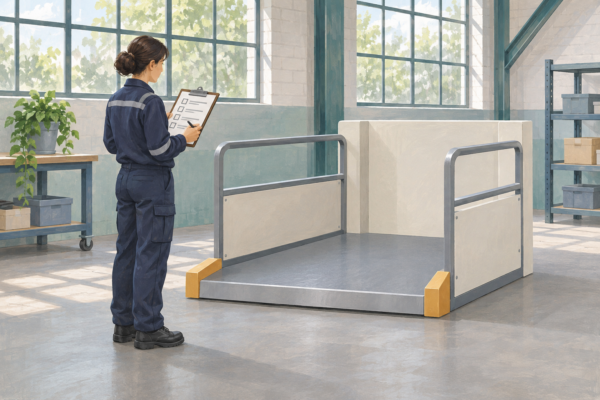
Platform Lift Factory Acceptance Checks
Before a bespoke platform lift leaves the factory, agree what to witness, record assembly and function checks, and assign any checks that depend on installation.

Many wheelchair lifts are removed not because they fail technically, but because they fail the decision process.
Bespoke systems are most vulnerable to late-stage value engineering when access is treated as optional infrastructure.
Long-life performance and service responsibility should be assessed at specification stage, not after handover.
Projects that succeed frame accessibility as a 25-year asset, not a short-term capital item.
Wheelchair lifts are usually discussed in terms of design, compliance, or engineering difficulty. In practice, those are rarely the reasons a lift is removed, downgraded, or quietly abandoned during a project.
What determines success is decision friction: budget pressure, late-stage redesigns, unclear service responsibility, and uncertainty about long-term risk. These pressures are rarely captured on drawings, yet they have more influence than any technical constraint.
This article looks at bespoke wheelchair lifts from the perspective of how they survive a project lifecycle, not just how they are designed. It is written for consultants, developers, and design teams who must defend accessibility decisions long after the concept stage.
When cost savings are demanded late in a project, lifts are often targeted because they appear discrete and self-contained. The underlying issue is not price, but timing.
As one discussion described:
“At the outset there was a solution, but later the project had to save money and the lift was removed.”
When access is introduced early, bespoke lifts can replace ramps, secondary routes, or structural compromises. When introduced late, they compete with already-allocated budgets and are easier to remove.
This is why early-stage conversations are critical. The question is not whether a bespoke lift is technically feasible, but whether it is framed as essential infrastructure or optional equipment.
For a broader comparison of where bespoke systems genuinely outperform standard options, see
bespoke vs standard platform lifts.
Bespoke wheelchair lifts integrate moving staircases, barriers, sensors, safety edges, interlocks, and architectural finishes into a single system. This complexity is intentional, but it changes who can safely maintain the lift.
A recurring issue raised in practice is the false economy of low-cost third-party maintenance. Short-term savings often lead to long-term downtime, because systems fall out of calibration or faults are misdiagnosed.
As observed during one discussion:
“It works for a year or two, then suddenly nobody knows how to fix it.”
This is not a maintenance issue; it is a risk ownership issue. When responsibility is fragmented, lifts are more likely to end up with an “out of order” sign — something most projects are trying to avoid.
For clarity on why specialist servicing matters and who should carry that responsibility, see
does Sesame service the lift.
Most standard platform lifts are replaced within 8–10 years. Bespoke systems are designed to remain serviceable far longer, with technology upgraded inside the original structure rather than discarded.
One long-running example demonstrates this shift clearly:
“The lift lasted 26 years, and then the client upgraded the technology within the same pit.”
This matters for consultants and developers because it reframes the cost conversation. Instead of asking “what does it cost?”, the more useful question becomes “what does it cost over the life of the building?”
That longevity is a core reason bespoke lifts are specified in buildings where access is linked to reputation, bookings, or long-term public use.
From a user perspective, the most important feature of a wheelchair lift is not the mechanism, but the route it enables. Being diverted to a side or rear entrance is often perceived as exclusion, even when access technically exists.
As one comment noted plainly:
“People in wheelchairs really don’t like being sent round the back.”
This is why hidden and retracting systems exist. Products such as the Westminster Equality Act Lift and the Windsor Lift allow steps to function normally while preserving a single, shared entrance route for everyone.
| Project Constraint | Common Outcome | Bespoke Lift Strategy |
|---|---|---|
| Steps required daily | Permanent ramp or diversion | Retracting stair and platform system |
| Architectural finishes | Visible platform lift | Fully clad lift integrated into fabric |
| Long-term use | Replacement cycle | Upgrade within original structure |
| Maintenance risk | Multiple contractors | Single-point service responsibility |
Relevant solutions include:
Because they are often introduced after budgets are fixed, making them vulnerable during value engineering.
They are more complex, which means they require specialised servicing rather than generic maintenance.
Yes. When correctly serviced, bespoke lifts are designed for multi-decade use and technology upgrades.
No. They are best suited to projects where access, longevity, and design integrity all matter.
If you are trying to determine whether a wheelchair lift will survive budget pressure, maintenance risk, and long-term use, an early conversation usually prevents costly redesigns later.
Book a Teams meeting with one of our Project Managers:
https://www.sesameaccess.com/book-a-meeting
Udostępnij
Before a bespoke platform lift leaves the factory, agree what to witness, record assembly and function checks, and assign any checks that depend on installation.
A practical guide to deciding when bespoke platform lifts can share a bracket, with checks for movement, tolerances, service access and drawing revisions.
A planning guide for New York City platform lifts covering DOB filings, installer licensing, first inspection and the roles to agree before procurement.