
Staircases are often the architectural focal point of a building. They define circulation, set spatial proportions, and are frequently integral to the building’s structural and visual identity. In many cases, particularly in listed and heritage contexts, they are protected elements where alteration is tightly controlled.
When accessibility requirements are introduced, these constraints can quickly expose the limitations of conventional design approaches. The challenge for architects is rarely whether inclusive access can be provided, but how to integrate it without undermining the original design intent, disrupting structural logic, or conflicting with planning and conservation requirements.
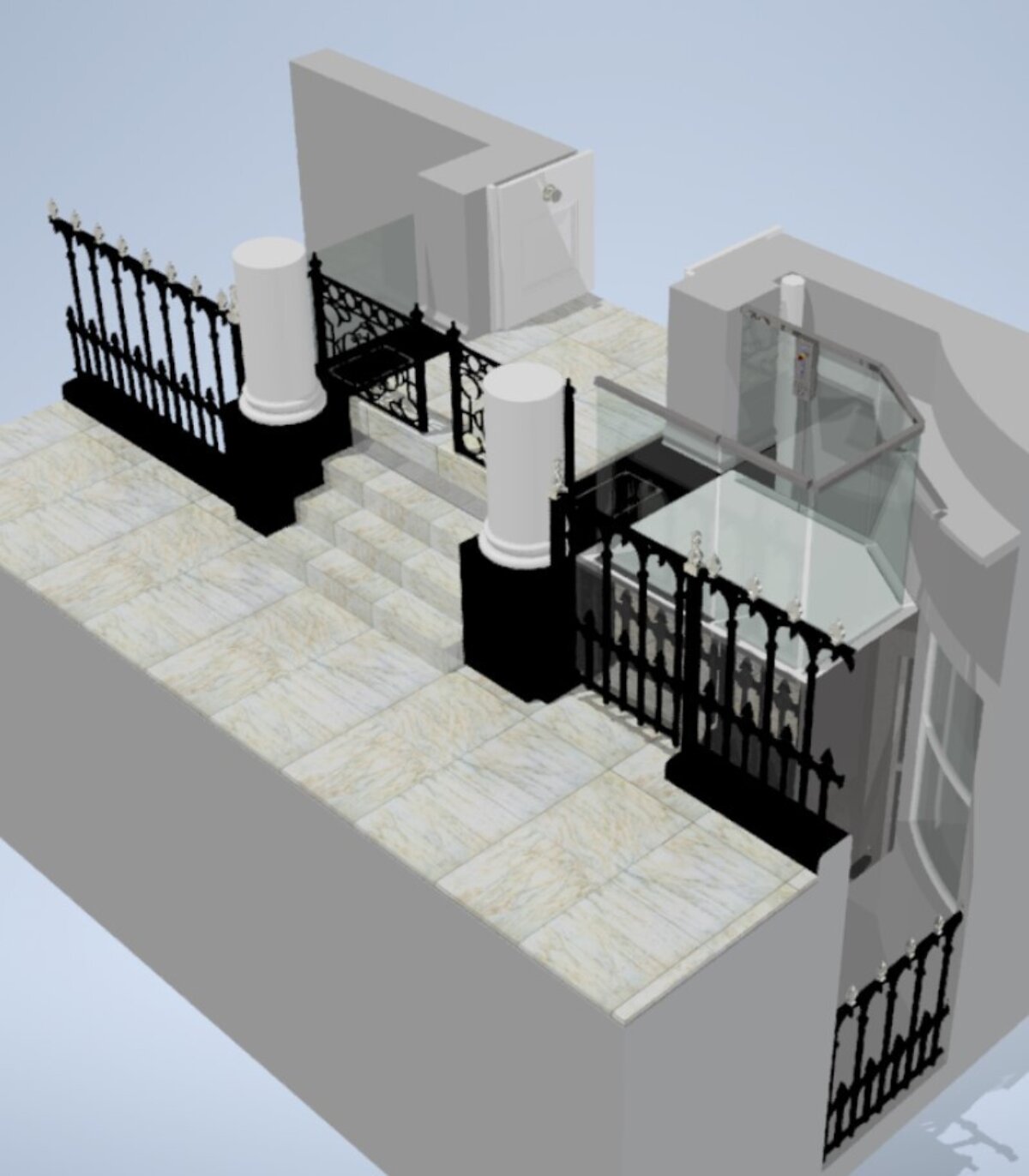
At Sesame, we use 3D staircase visualisation to bridge the gap between concept and technical feasibility. By modelling real lift systems within surveyed stair geometry, design teams can clearly see how an accessible solution functions spatially, structurally and visually, long before construction begins.
Staircases are often the architectural focal point of a building. They define circulation, set spatial proportions, and are frequently integral to the building’s structural and visual identity. In many cases, particularly in listed and heritage contexts, they are protected elements where alteration is tightly controlled.
When accessibility requirements are introduced, these constraints can quickly expose the limitations of conventional design approaches. The challenge for architects is rarely whether inclusive access can be provided, but how to integrate it without undermining the original design intent, disrupting structural logic, or conflicting with planning and conservation requirements.
At Sesame, we use 3D staircase visualisation to bridge the gap between concept and technical feasibility. By modelling real lift systems within surveyed stair geometry, design teams can clearly see how an accessible solution functions spatially, structurally and visually, long before construction begins.
Why staircases are uniquely complex
Unlike open-plan spaces, staircases bring together multiple technical considerations in a very confined footprint:
Tight tolerances for headroom, riser heights and going
Limited pit depths beneath existing stairs
Structural interfaces with slabs, stringers and landings
Fire-exit and evacuation requirements
Heritage constraints on visible alterations
The need to accommodate different user types, from wheelchair users to ambulant standing users
These factors can be difficult to resolve through 2D drawings alone, especially when working with retracting or concealed lift systems.
This is where 3D visualisation becomes an essential design tool rather than a presentation extra.
What 3D staircase visualisation actually shows
Our 3D staircase models are built from survey-accurate dimensions and real lift components, not generic placeholders. This allows architects to see:
How retracting stair treads fold, lower or separate
Where platforms rise through or between stair flights
Clearances for wheelchairs, standing users and barriers
Sightlines and visual impact when the lift is in use and when concealed
Interfaces with finishes, balustrades and handrails
Crucially, the visualisation shows the movement of the system, not just its final position. This is often the deciding factor when assessing feasibility.
Supporting design decisions early
3D visualisation is most effective when used early in the design process, before layouts are fixed or planning submissions are made. It can help architects to:
Test whether a central or side-mounted lift configuration works best
Identify the minimum pit depth or structural adjustments required
Understand how accessibility solutions affect circulation routes
Communicate clearly with conservation officers and building control
Align expectations between client, consultant and contractor
In many cases, a visual model avoids late-stage redesigns by highlighting conflicts that wouldn’t be obvious on plan or section drawings alone.
Typical applications
We most often use 3D staircase visualisation for:
Grand or feature staircases in civic and cultural buildings
Listed or heritage environments with strict visual controls
Tight footprints where standard platform lifts won’t fit
Mixed-use buildings requiring seated and standing access
Fire-exit staircases that require careful barrier and interlock coordination
Each model is tailored to the specific site and user requirements, rather than applied as a generic solution.
From visualisation to specification
Once a concept is proven in 3D, it becomes much easier to move into detailed design. The visual model can inform:
Lift selection (e.g. Buckingham, Wellington, Westminster or Edinburgh configurations)
Structural coordination and pit design
Mechanical and electrical routing and control locations
Planning documentation and heritage submissions
It also provides a clear reference point throughout the project, reducing uncertainty as the design progresses.
3D staircase visualisation provides architects and project managers with technical clarity. For architects working with complex stairs, it offers a way to explore accessibility solutions with confidence, backed by real engineering logic.
By understanding how a lift integrates before construction begins, you can protect the architectural intent while delivering excellent inclusive access.
If you’re working on a project with a challenging staircase, our team can support you with survey-led 3D visualisation to test feasibility and unlock the right solution early on.
Get in touch to discuss a current or upcoming project.
Model turnaround times
Early visualisation prioritises speed and clarity, allowing decisions to be made before detailed CAD work begins.
| Stage | Typical timeframe | Benefit |
|---|---|---|
| Site survey to first 3D model | 1 day | Rapid understanding of feasibility |
| 3D model with screenshots | Same day | Clear option presentation |
| Multiple option comparison | Rapid | Confident early decision-making |
| Traditional early CAD drawings | Often weeks | Slower iteration and higher risk |
Open the 3D interactive model below to see for yourself
3D staircase visualisation provides architects and project managers with technical clarity. For architects working with complex stairs, it offers a way to explore accessibility solutions with confidence, backed by real engineering logic.
By understanding how a lift integrates before construction begins, you can protect the architectural intent while delivering excellent inclusive access.
If you’re working on a project with a challenging staircase, our team can support you with survey-led 3D visualisation to test feasibility and unlock the right solution early on.
Get in touch to discuss a current or upcoming project.
FAQs about 3D lift models
Can 3D models show structural impact below ground level?
They help visualise spatial relationships and highlight potential conflict zones. Structural verification follows during detailed engineering.
How do interactive models help with listed building applications?
They allow stakeholders to understand the proposal clearly, reducing objections caused by uncertainty.
What file formats can architects receive?
Outputs typically include presentation images and interactive model links suitable for design team review.
Can models be used in design team meetings?
Yes. They are often used as a shared visual reference during coordination discussions.
Can barrier positions and operating stages be shown?
Yes. Models are captured in key operating stages to explain movement and safety clearly.
Are the models VR-ready?
Where supported, models can be explored using VR hardware for improved spatial understanding.
Does this replace detailed drawings?
No. It accelerates early decision-making before detailed drawings are commissioned.
How quickly can options be reviewed?
Initial models and options are typically available within a day of survey.
Can multiple options be compared for the same staircase?
Yes. This is one of the main advantages of the approach.
Do stakeholders need specialist software?
No. Interactive viewing is available through standard web links.
Udostępnij