
Whitehall Lift – Frequently Asked Questions
Q1. What type of lift is the Whitehall?
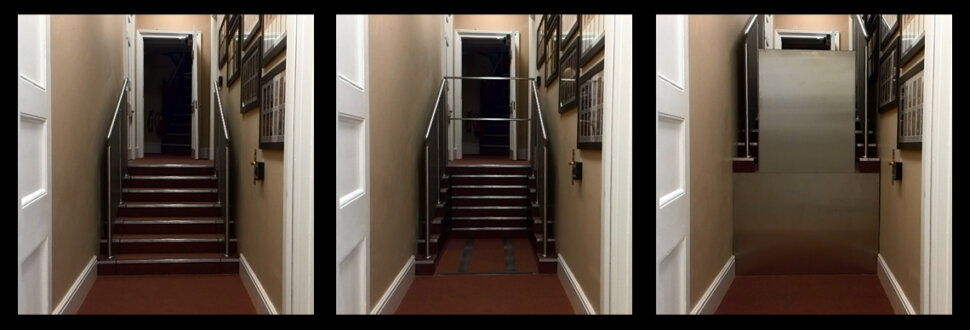
The Whitehall is a horizontal retracting step lift with a rising upper landing barrier and integrated handrails that rise with the lift platform.
Q2. What makes the Whitehall different from other Sesame lifts?
Its key feature is the permanent handrails that move up and down with the lift. This makes it the horizontal retracting stair version of the Seattle ADA Lift, which uses vertical retracting stairs.
Q3. What standards does the Whitehall comply with?
It can be configured to meet BS 6440:2011 if a top landing gate is used, or to the Machinery Directive Annex VIII when a rising goalpost barrier is required.
Q4. What users is it designed for?
The lift is suitable for both seated and standing users, with handrail and barrier heights set at 1100 mm to ensure safety for all passengers.
Q5. What is the maximum rise height?
The Whitehall lift can achieve a rise of up to 3 metres, though headroom above the lift must be carefully checked in design due to the rising handrail section.
Q6. What are the standard platform dimensions?
The usable platform area is 900 mm wide × 1458 mm long, with the total platform width at 1300 mm including the handrail structures. The total platform length, including the barrier, is 1516 mm.
Q7. Can the platform width be increased?
Yes. To comply with Scottish and Irish accessibility standards, the usable width can be increased to 1100 mm.
Q8. What are the pit requirements?
-
Minimum pit depth: 1650 mm
-
Pit width: 1415 mm
-
Pit length: 1516 mm
The stair pit is typically the same width as the lift pit, with a length of 1200 mm.
Q9. How does the rising barrier design work?
The Whitehall uses a straight-line rising barrier rather than a dog-leg style. This saves floor space and simplifies installation while still meeting safety requirements.
Q10. What happens if the rise exceeds 1500 mm?
Once the rise exceeds 1500 mm, the pit depth must equal the total rise + 50 mm to accommodate the full lift movement.
Q11. What type of drive system does the Whitehall use?
It uses a hydraulic system to operate the horizontally retracting steps. An electric option is not available for this model.
Q12. Can the lift operate during a power failure?
Yes. The Whitehall can include a UPS battery backup that automatically lowers or resets the lift to stair mode in the event of a power failure.
Q13. What are the cladding and finish options?
All visible cladding, handrails, and barrier finishes are bespoke to the client’s specification – typically stainless steel or aluminium, but can be colour-matched or glass-integrated to suit heritage or modern environments.
Q14. Can the Whitehall be installed outdoors?
Yes. It can be installed externally or internally, following standard drainage and waterproofing rules used across the Sesame range.
Q15. Where has the Whitehall lift been installed before?
Whitehall systems are often used where corridor-width constraints or heritage step restoration make horizontal retracting stairs the best accessibility solution.
Q16. What safety systems are included?
The lift has front rising barrier safety edges, eliminating the need for a toe guard. All safety features comply with Sesame’s standard protection systems used across other DDA-compliant lifts.
Q17. What should architects consider during design?
Key design considerations include:
-
Headroom clearance when the lift is raised
-
Pit depth and drainage
-
Crush zone protection between the lift and surrounding walls.
Q18. Where can I learn more about crush zones and safety edges?
See the Crush Zones and Safety Edges page for detailed compliance guidance referenced in the Whitehall design notes.