
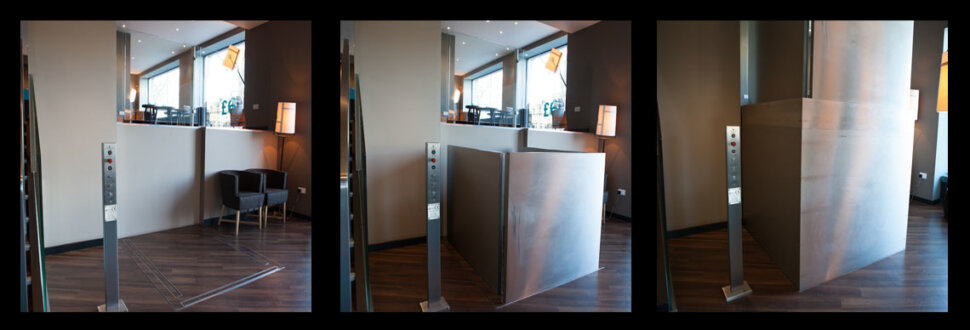
1. What is the Pimlico Lift?
The Pimlico Lift is a fully concealed wheelchair platform lift designed for heritage and architecturally sensitive buildings. It operates in the same way as the Richmond Rising Platform Lift, but instead of a rising upper barrier it uses an upper landing gate, which can be manual or automatic.
2. How is the Pimlico Lift different from the Richmond Rising Platform Lift?
The main difference is the upper landing protection. The Richmond model uses a rising barrier, while the Pimlico uses an upper landing gate. The lift mechanics, pit requirements and operation are otherwise identical. For comparison, see the Richmond Rising Platform Lift here:
https://www.sesameaccess.com/lifts/richmond-rising-platform-lift
3. What other Sesame lifts use the same upper landing gate as the Pimlico?
The same gate system is shared with the Waterloo Lift, Victoria Retracting Stairlift, Oxford Disability Lift, Cambridge Platform Lift, Belgravia Lift, Trafalgar Access Lift and the Windsor Mobility Lift.
Relevant pages:
https://www.sesameaccess.com/lifts/waterloo-lift
https://www.sesameaccess.com/lifts/victoria-retracting-stairlift
https://www.sesameaccess.com/lifts/oxford-disability-lift
https://www.sesameaccess.com/lifts/cambridge-platform-lift
https://www.sesameaccess.com/lifts/belgravia-lift
https://www.sesameaccess.com/lifts/trafalgar-access-lift
https://www.sesameaccess.com/lifts/windsor-mobility-lift
4. What finishes can be applied to the Pimlico Lift?
Any finish specified by the architect or designer can be applied to the lift table and surrounding components. Sesame engineers will advise on the correct material interface for the riser wall and the cladding around the gate structure.
5. What pit size is required for the Pimlico Lift platform?
The standard platform lift pit is 1650 mm deep, 1832 mm long (measured from the Sesame riser wall) and 1422 mm wide. These dimensions match the Richmond lift and can be adjusted by Sesame engineers where site conditions require bespoke changes.
6. What are the pit requirements for the upper landing gate?
There are two pit options depending on whether you choose a manual or automatic gate:
Manual gate:
• 130 mm deep
• Length depends on gate width (typically 1–1.15 m)
• 252 mm wide
Automatic gate (standard drawing pack):
• 748 mm deep
• 660 mm long
• 619 mm wide
Sesame can redesign the automatic gate pit to be much shallower when required, depending on structural constraints.
7. Can the Pimlico Lift be customised for unusual site layouts?
Yes. Although the drawing pack provides standard dimensions, all Sesame lifts are bespoke. The width and length of the platform, the rise, the pit depth, and the gate arrangement can all be modified. Your project manager and engineer will help finalise the design.
8. What power supply does the Pimlico Lift need?
The power requirement is a single-phase 240 V, 32 A supply with a type C MCB breaker. The supply location and installation details match those used on the Richmond model.
9. How does the Pimlico Lift operate for the user?
Three rising barriers lift up on the platform sides and rear as the user prepares to travel. At the upper landing, the gate opens automatically for exit. When returning down, the gate closes behind the user and the lift descends. Once at the lower landing, the front barrier lowers, followed by the two side barriers, leaving the lift completely hidden under the floor.
10. What is the usable platform space inside the lift?
Once the side barriers are raised, the internal clear space accommodates both seated and standing users and meets the 1100 mm barrier height requirement of BS 6440:2011.
11. How long does the upper landing gate stay open?
The automatic gate stays open for 30 seconds at the upper landing before closing. It is fitted with pressure sensors: if it encounters resistance while closing or opening, it will reverse its movement to prevent injury.
12. Why choose the Pimlico instead of the Windsor Mobility Lift?
The Windsor Mobility Lift has permanent barriers and a visible upper landing gate. The Pimlico (and Richmond) have barriers that fully retract into the floor, leaving the area visually clear. The Pimlico is preferred when architectural sensitivity or space optimisation is important.
View the Windsor here:
https://www.sesameaccess.com/lifts/windsor-mobility-lift
13. Can the Pimlico Lift be used for both seated and standing users?
Yes. It has full 1100 mm rising barriers suitable for standing users. If the lift is only intended for seated wheelchair users with rises up to 1 metre, the Waterloo Lift may be more suitable:
https://www.sesameaccess.com/lifts/waterloo-lift
14. What is the maximum rise the Pimlico Lift can handle?
For rises over 1600 mm, the pit depth increases based on the total rise (rise height + 50 mm). Sesame can also supply a bellows system instead of a solid stainless steel skirt for higher rises.
15. Is the Pimlico Lift suitable for public buildings?
Yes. The fully retractable design makes it ideal for heritage buildings, listed environments, museums, churches, public institutions and architect-led projects where a permanently visible platform lift is not acceptable.
16. Does Sesame provide a full drawing pack for the Pimlico Lift?
Yes. An A1 drawing pack is available, including platform pit details, gate pit variants (manual and automatic), structural requirements and machine room cabinet drawings. These can be customised after site surveys.
17. What type of riser wall is needed for the Pimlico Lift?
The riser wall must support either a guidance track (similar to the Richmond) or stabilising wheels on one or both sides. Because the gate actuator sits in the upper landing structure, the cladding and materials for the riser wall must be agreed with Sesame engineers before final design.
18. Can the Pimlico Lift achieve a completely flush finish at lower landing?
Yes. When the lift is at rest in the lowered position, all barriers retract and the platform sits flush with the surrounding floor. The area can be fully used for normal foot traffic without any visible lift components.
19. Which lift should I choose if the site has very shallow pit depth limitations?
If pit depth is extremely restricted, the Trafalgar Access Lift or other shallow-pit systems may be more suitable.
https://www.sesameaccess.com/lifts/trafalgar-access-lift
20. Can the Pimlico lift support remote controls?
Remote controls can be integrated, but they are not typically used in public buildings. They are more common in private residences. The Belgravia Lift uses a remote-controlled barrier system but is less common for public access:
https://www.sesameaccess.com/lifts/belgravia-lift