What is the Richmond Rising Platform Lift?
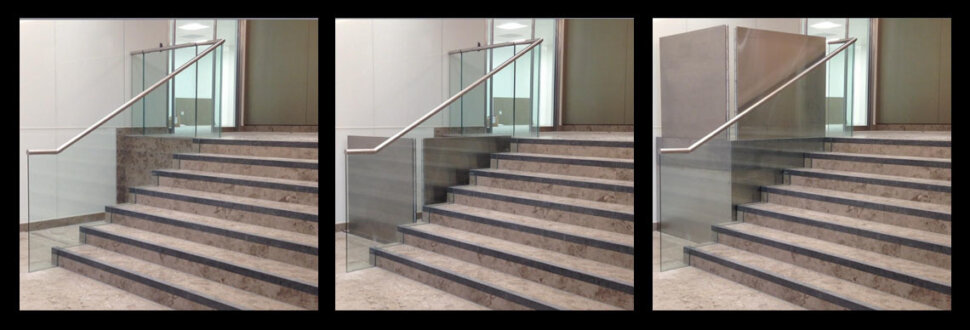
The Richmond Rising Platform Lift is a vertical platform lift with three rising barriers that move through the lift table and enclose the user to 1100 mm. It is suitable for both seated and standing users. A similar lift with a different upper landing configuration is the Pimlico Lift:
https://www.sesameaccess.com/lifts/pimlico-lift
How is the Richmond different from the Pimlico Lift?
The Richmond uses a rising barrier at the upper landing, while the Pimlico Lift uses a hinged gate. Both lifts typically offer a usable internal width of 972 mm, but the Richmond requires additional pit depth to house the rising barrier at the upper landing. The Pimlico is used when pit depth is limited at upper landing.
What pit depth is required?
The upper landing rising barrier requires a pit depth of approximately 1650 mm. The lift table usually shares the same pit depth. Some contractors choose to extend the pit to the full depth of the base slab.
What is the usable platform size?
The standard usable platform width is 972 mm. This can be increased depending on local regulations; for example, Scotland and Ireland often require about 1100 mm usable width. The overall table footprint is approximately 1250 mm x 1746 mm.
What pit size should the main contractor provide?
A typical pit width of around 1412 mm is recommended. This allows for installation tolerances and ensures that pit trims can close the gap to an 8 mm finish around the 1250 mm lift table.
What is the maximum rise for this lift?
The Richmond can be engineered to achieve rises of up to approximately 3 metres. Rises above 1650 mm may require a stainless-steel skirt or protective bellows.
How does the user operate the lift?
When the lift is called from the lower landing, the two side barriers rise first. The user moves onto the platform and presses the lift button, which raises the rear barrier. The lift then travels to the top landing, where the upper landing rising barrier drops to allow exit. All barriers feature sensitive safety edges.
Does the Richmond comply with British Standards?
Yes. The lift is designed to comply with BS 6440:2011. For comparison, you can also view the Westminster Stairlift, which operates under the same standard but includes retracting stairs:
https://www.sesameaccess.com/videos/westminster-stairlift
What happens in a power failure?
In a power failure, the lift uses a key-switch-controlled emergency lowering system that brings the lift down to the lower landing and drops the front barrier so the user can exit. UPS backup can be added if required.
Can this lift be used for fire evacuation?
No. This type of platform lift is not for fire evacuation unless installed in a fully fire-rated shaft. It should be switched off during a fire event. For reference, see the Seattle ADA Lift for alternative compliance contexts:
https://www.sesameaccess.com/lifts/seattle-ada-lift
Can the lift cladding be customised?
Yes. All cladding on the lift table, riser wall, and service hatches can be specified by the client. Material thickness is accounted for during design.
How is maintenance access provided?
Maintenance access is usually through service hatches at the upper landing, or through a basement room if one exists. In those cases, access doors are often fire-rated. A similar access principle can be seen in the Belgravia Disabled Lift:
https://www.sesameaccess.com/lifts/belgravia-disabled-lift
Can the visible parts of the lift be coloured?
Yes. The visible components can be colour-matched or powder-coated as required. Clients can choose to colour only the upper trims or the full lift in its raised position.
Is drainage required?
Yes. Standard drainage is needed for both internal and external installations. For comparable drainage considerations, see the Whitehall DDA Lift:
https://www.sesameaccess.com/lifts/whitehall-dda-lift
What head height is required?
A head height of approximately 2.2 metres above the platform in its raised position is preferred. Reduced headroom may be possible in heritage environments subject to building control agreement.
Does the Richmond use gates or barriers?
The Richmond uses three rising barriers on the lift and a rising barrier at the upper landing. It does not use hinged gates. If a hinged gate solution is required, the Pimlico Lift is the alternative:
https://www.sesameaccess.com/lifts/pimlico-lift
Where is the machine room cabinet located?
The Richmond uses the standard Sesame machine-room cabinet used across most lift models. Controls and electronics are housed there. A comparable layout can be seen in the Knightsbridge Stairlift:
https://www.sesameaccess.com/lifts/knightsbridge-stair-lift-2
Can the Richmond be installed externally?
Yes, it is suitable for internal or external installation. External versions may require waterproof access panels and enhanced drainage. You can view another external-capable system here:
https://www.sesameaccess.com/lifts/windsor-lift