Key Takeaways
-
This article continues the London terrace house accessibility series, following Part 1 and Part 2.
-
The client requires step-free access down into a narrow moat-level courtyard beside the entrance steps.
-
Space constraints mean a standard platform lift will not fit, requiring a bespoke Windsor-based design.
-
A Quadruple Scissor Mechanism is being engineered to achieve the required near-3m travel height within a constrained footprint.
-
Drainage, sump pumps, gate orientation and railing modifications are key design considerations.
-
Sesame Access is designing a certified, site-specific solution not available off the shelf.
Introduction
Architects and building owners often struggle to provide step-free access in Victorian terrace house moat spaces, where narrow dimensions, basement doors, and heritage protections severely restrict the use of standard lift products. In this enquiry, the lift must travel close to 3 metres using a pit-mounted platform lift solution, making the geometry critical from the outset.
Unlike standard platform lifts, Sesame’s bespoke solutions based on the Windsor Lift are specifically engineered for heritage buildings where space constraints prevent off-the-shelf products from working.
This page continues the story developed in earlier enquiries documented in:
Part 1 – London Terrace House Platform Lift Solution
https://www.sesameaccess.com/knowledge-hub/london-terrace-house-platform-lift-solution
Part 2 – Terrace House Windsor vs Edinburgh Platform Lifts
https://www.sesameaccess.com/knowledge-hub/terrace-house-windsor-vs-edinburgh-platform-lifts
In Part 3, the design has evolved significantly: instead of placing a lift within the staircase, the client now requires access down into the moat-level area adjacent to the building façade.
What is the new problem the client is trying to solve?
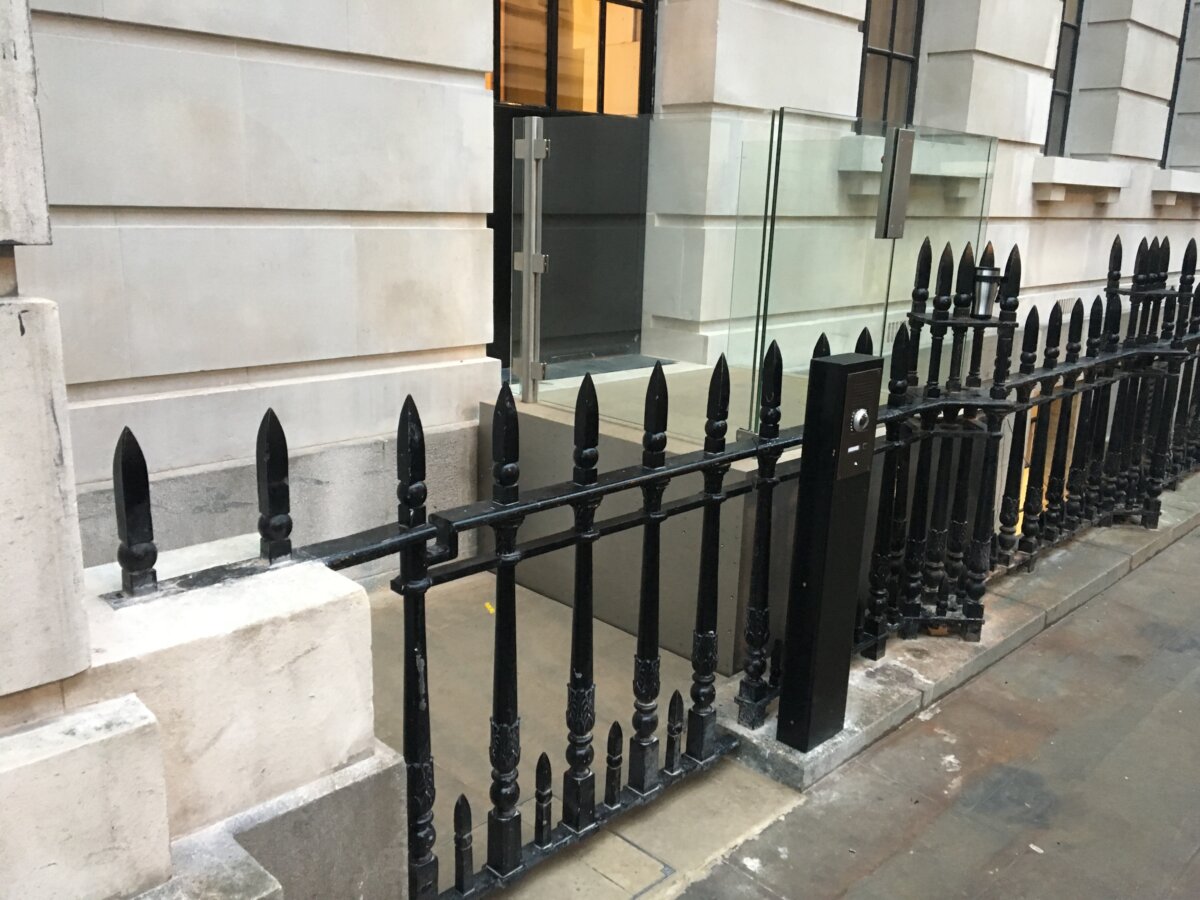
The requirement is to create step-free access from the pavement down into a basement-level courtyard. This area includes existing double doors, restricted turning space, and a narrow structural opening between the terrace steps and the front wall of the property.
The lift must:
-
Fit within a tight footprint
-
Provide a travel height close to 3 metres
-
Sit flush at basement level
-
Allow continued access to adjacent basement doors
-
Integrate with modified railings at pavement level
A standard lift cannot meet these constraints.
Why a bespoke Windsor-style platform lift is required
The Windsor Lift is the nearest Sesame product type, as it is a pit-mounted platform lift with platform gates. However, the site geometry requires:
-
A longer platform than standard
-
Two gate positions
-
Customised guarding
-
A slimmer or reconfigured scissor arrangement
-
Additional structural stabilisation
This means developing a bespoke scissor-lift configuration specifically for the project.
Introducing the Quadruple Scissor Mechanism
To achieve a travel height close to three metres while keeping the lift short enough to fit between the building façade and basement doors, Sesame is evaluating a Quadruple Scissor Mechanism.
Key benefits:
-
Higher travel with a shorter closed height
-
Increased rigidity for longer platforms
-
Ability to configure scissor orientation to suit unusual spaces
This mechanism has been used in complex international projects and provides the technical headroom needed for this terrace house solution.
What the early measurements are telling us
From the transcript analysis:
-
Approximate rise: just under 3000 mm
-
Approximate scissor lift length required: 1600–2300 mm depending on gate orientation
-
Clearance to basement doors: approximately 1720 mm
-
Narrowest section near façade overhangs: approx. 1385 mm
-
Pit depth: sufficient for scissor retraction but needs drainage and pump integration
These constraints influence the final platform width, length, and scissor configuration.
Railing modifications and bridge landing
At pavement level, the lift cannot simply open out onto the public footpath. The design therefore includes:
-
A modified railing section
-
A small independently supported bridge landing
-
A controlled approach route to the upper landing gate
This approach has been successfully used on previous projects as seen here https://www.sesameaccess.com/v...
Basement access and multi-directional gates
The client requires continued access to the basement rooms via the existing double doors. This means the lift:
-
Must not block the lower landing space
-
Requires careful gate placement
-
Must allow movement to more than one direction at basement level
A bespoke gate arrangement is therefore required.
Basement Lift Drainage & Sump Pumps
Moat spaces are highly susceptible to water ingress. Although the site contains an existing drain, its level is too high to allow natural gravity drainage from the pit.
To ensure long-term reliability:
-
A sump pump will be installed in the lift pit
-
Drainage channels will be integrated into the pit design
-
The pump will discharge to the building’s approved drainage route
-
Waterproofing measures will be incorporated into the pit structure
This section directly addresses common search queries such as “basement lift drainage solutions”, “sump pump for platform lift pits”, and “moat-level accessibility drainage”.
What happens next?
The Sesame engineering team is now:
-
Modelling scissor lift configurations
-
Testing whether the Quadruple Scissor Mechanism achieves the required travel
-
Simulating stability with gate placement and load distribution
-
Confirming pit depth, drainage and sump pump details
-
Drafting planning and concept drawings
Once complete, a full design pack will be issued to the architect and client team.
Frequently Asked Questions (FAQ)
Can a lift be installed in a Victorian terrace house moat space?
Yes. Sesame regularly designs bespoke solutions for terrace houses with narrow courtyards and limited access.
Why can’t a standard platform lift be used?
Standard lifts are too long, too wide, or lack the travel height. The Quadruple Scissor Mechanism enables higher travel in tighter spaces.
Do we always need a sump pump?
In most moat-level installations, yes. Pit depth is below natural drainage gradients, making pumps essential.
Can the lift have gates on more than one side?
Yes. This project requires gates at both upper and lower landings.
Will the design require planning approval?
Yes, especially due to railing modifications and heritage constraints.
Call to Action
If you are exploring accessibility options for a terrace house or similar constrained site, book a Teams Meeting with one of our Project Managers:
https://www.sesameaccess.com/book-a-meeting