Key Takeaways
-
London terrace houses present unique accessibility challenges where off-the-shelf lifts do not fit.
-
The Windsor Lift offers a bespoke moat-based platform lift solution that fits between the pavement and the building façade.
-
The Edinburgh Access Lift integrates directly within existing staircases, ideal for heritage properties and Victorian terrace layouts.
-
Both solutions support UK accessibility requirements, including Building Regulations Part M, and are suitable for London terrace house lift installations and UK heritage property accessibility.
-
Early collaboration between lift consultants, access consultants, and Sesame Access ensures an accurate specification and smooth installation process.
Introduction
This article explores two of the most effective retractable platform lift options for terrace houses: the Windsor Lift and the Edinburgh Access Lift. These solutions respond to the common architectural challenges found in London terrace houses, UK heritage properties, and platform lifts for Victorian terraces. It follows directly from our previous article: London Terrace House Platform Lift Solution.
Why Are Terrace House Lift Installations So Challenging?
London terrace houses and similar UK-wide terraces often include narrow pavements, vaulted cellars, steep staircases, iron railings, and limited structural tolerance. Historic or listed status can further restrict façade changes. This is why bespoke engineering is essential when creating a compliant and safe lift solution for heritage property accessibility.
To help architects and consultants navigate these complexities, complementary resources such as Finishing BOM Integration & Surface Treatment Communication and Access Lift Floor Finishes Guide provide deeper technical guidance on the finishes we can apply to our Sesame lifts to help blend in.
Windsor Lift: The Bespoke Moat Platform Solution
The Windsor Lift is designed for buildings with a moat or void space between the pavement and the front façade. This makes it ideal for many London terrace houses where modifying the front staircase or façade is restricted.
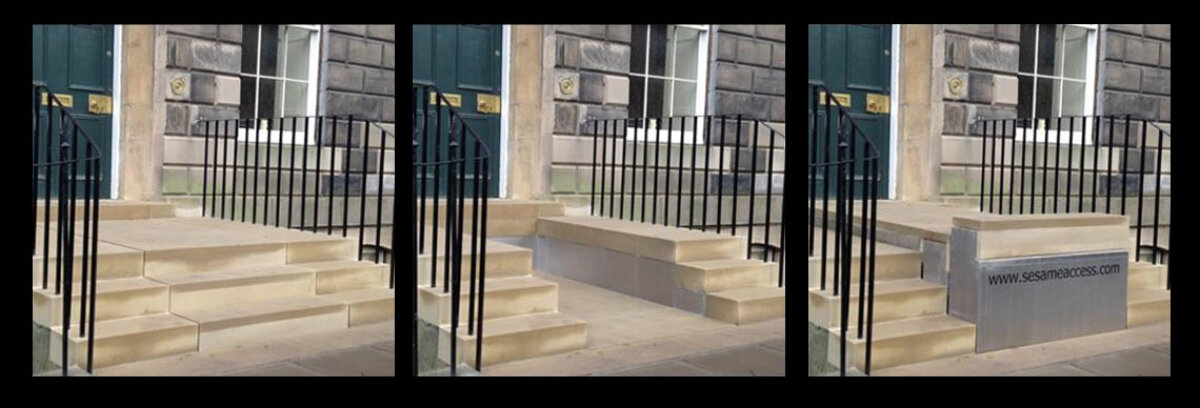
This lift rises from below pavement level and delivers wheelchair access directly to the internal floor level without altering the existing steps. It preserves heritage aesthetics while providing a modern accessibility system.
Best when:
-
You have adequate moat depth.
-
You want to avoid altering the façade or internal staircase.
-
You require a discreet London terrace house lift installation.
Edinburgh Access Lift: Seamless Internal Stairwell Integration
The Edinburgh Access Lift is designed to sit within the existing staircase structure. This is ideal when moat depth is insufficient, pavement works are restricted, or the building falls under conservation oversight.
This solution retains the staircase profile while enabling smooth wheelchair travel between levels. It is particularly suitable for Victorian terraces and properties where external alterations are prohibited.
Best when:
-
The internal stairwell has sufficient width and depth.
-
No external works are allowed or desirable.
-
A fully internal accessibility route is preferred.
Comparison Table: Windsor vs Edinburgh Access Lift
| Criterion | Windsor Lift | Edinburgh Access Lift |
|---|---|---|
| Installation Location | In moat between pavement and façade | Within existing staircase |
| Suitable For | Properties with adequate moat depth | Properties with limited external space |
| Structural Impact | Minimal façade alteration | Requires stairwell structural review |
| Typical Platform Sizes | Custom to moat footprint | Custom to stairwell footprint |
| Weight Capacity | Typically 250–400kg (bespoke available) | Typically 250–400kg (bespoke available) |
| Installation Duration | Approx. 2 weeks (site-dependent) | Approx. 2 weeks (site-dependent) |
| Best For | London terrace houses with moat space | Victorian terraces with internal access needs |
How Specifications Are Developed with Access and Lift Consultants
In projects involving London terrace house lift installation and UK heritage property accessibility, the specification process usually follows a collaborative sequence:
-
Pre-survey review of drawings, pavement conditions, stair geometry, and vaults.
-
On-site measurement to determine structural tolerances and headroom constraints.
-
Consultant-led requirements mapping (Part M, safety edges, railing coordination).
-
Sesame Access engineering design, gate positioning, safety system layout, and platform sizing.
-
Review cycles with consultants, main contractor, and heritage stakeholders.
-
Tender-ready documentation issued with full drawings and performance specification.
If needed, consultants may request additional guidance from authoritative bodies such as https://www.planningportal.co....
Frequently Asked Questions (FAQ)
Q: Are both lifts compliant with Building Regulations Part M?
Yes. Both the Windsor and Edinburgh configurations can be designed to comply with Part M, including platform size, controls, safety features and landing arrangements.
Q: What load-bearing capacity is needed for installation?
Typically, the structure must support 250–400kg plus dynamic load factors. A structural engineer should verify the bearing performance of masonry vaults, staircases or retaining walls.
Q: Does installation require Building Control approval?
In most cases, yes. Building Control will assess structural changes, pit construction, guarding heights, electrical integration, and safe access for maintenance. Heritage properties may require additional approvals.
Q: How long does a terrace house lift installation take?
Most installations, including the builders work, take between 6 and 12 weeks depending on pit creation, railing coordination, safety-edge requirements, and electrical supply routes.
Q: Can the Windsor Lift be installed without altering the façade?
Yes, that is one of its primary advantages. With suitable moat depth, no façade changes are required.
Q: What if my staircase is too narrow for the Edinburgh Access Lift?
If the stairwell is unsuitable, Sesame Access will recommend alternative configurations, including a modular platform or a custom retracting stair lift.
Q: Can these lifts be installed in listed buildings?
Yes, these products are frequently selected for heritage and listed buildings due to their minimal visual impact and bespoke detailing.
Q: How do I begin the process?
To discuss a project or begin a specification for your own terrace house accessibility upgrade, you can book a Teams meeting with a Project Manager here:
https://www.sesameaccess.com/book-a-meeting