Q: What does Sesame Access mean by a bespoke lift?
A: A bespoke lift is a lifting solution designed and engineered specifically for a unique access or lifting challenge rather than adapted from a standard product. Sesame Access regularly designs bespoke lifts in response to architect and client requests that fall outside conventional lift categories, including custom shapes, movements, barriers, and control systems.
Q: Is the bespoke lift video shown on the website a wheelchair lift?
A: No. The bespoke lift showcased in video format on the bespoke lift page is not a wheelchair lift. It is a large, six-metre diameter half-moon stage platform designed to lift performance equipment such as pianos, speakers, and drum kits. It does not include wheelchair barriers, toe guards, or accessibility features and was built purely as a bespoke lifting platform for a specific client request.
Q: How do bespoke lifts become part of the Sesame Access product range?
A: Many Sesame Access products originate from bespoke client requests. When a bespoke solution proves effective, safe, and repeatable, it may evolve into a defined product with its own dedicated product page. This process has resulted in over 30 specialist lift solutions currently offered by Sesame Access.
Q: Do bespoke lifts have to comply with British or European standards?
A: Yes. While bespoke lifts do not always align fully with a single standard, Sesame Access applies relevant elements of British Standards, European standards, and the Machinery Directive. Bespoke lifts are typically assessed under the Machinery Directive Annex VIII, ensuring safety and compliance even when no single standard applies directly.
Q: Why are bespoke lifts assessed under the Machinery Directive rather than the Lift Directive?
A: Sesame Access lifts are typically exposed, non-shaft lifts rather than enclosed passenger lifts. Because they are not traditional shaft lifts and often exceed or differ from standard configurations, they fall within the scope of the Machinery Directive rather than the Lift Directive.
Q: What is the rising button post and where is it used?
A: The rising button post is a bespoke feature originally developed for a client request where the controls needed to rise through the platform. This innovation later became part of the Oxford Disability Lift
https://www.sesameaccess.com/lifts/oxford-disability-lift
and is also used on the Knightsbridge Stair Lift
https://www.sesameaccess.com/lifts/knightsbridge-stair-lift-2
Q: Why did Sesame Access develop rising barriers and gates?
A: Early bespoke lifts did not always include barriers or gates. As requirements evolved, Sesame Access developed rising barriers and swing gates that deploy through the lift platform itself, improving safety while maintaining architectural discretion. These features can be seen on products such as the Mayfair Stairlift
https://www.sesameaccess.com/lifts/mayfair-stairlift
Q: Where did the glass swing gate design come from?
A: The glass swing gate design was developed in collaboration with Apple for one of their lifts. The design uses a stress-tested solid stainless steel pivot bar with glass panels suspended from it, creating a strong yet visually minimal barrier solution that is now used across multiple bespoke lifts.
Q: Has Sesame Access delivered bespoke lifts in high-security or landmark buildings?
A: Yes. Sesame Access has delivered bespoke lifts in highly sensitive and protected locations, including the Bank of England. In that case, a vertical retracting step system was developed to avoid encroaching onto public pavements or interfering with security doors.
Q: What are vertical retracting steps and where are they used?
A: Vertical retracting steps move straight down rather than retracting horizontally. This design was developed for restricted environments and later evolved into product solutions such as the Buckingham Listed Building Lift
Q: How do electric retracting steps differ from standard retracting stair mechanisms?
A: Electric retracting steps require significantly less space behind the top step riser, typically around 400–500 mm. They operate using side guide tracks rather than self-supporting mechanisms. This technology is demonstrated on the Big Ben Electric Stairs page
https://www.sesameaccess.com/lifts/big-ben-electric-stairs-
Q: When would electric retracting steps not be suitable?
A: Electric retracting steps rely on surrounding structural walls for guidance. In locations where walls cannot be altered or excavated, alternative solutions such as the Kensington Stairlift
https://www.sesameaccess.com/lifts/kensington-stairlift
or Mayfair Stairlift may be more appropriate.
Q: Does Sesame Access install lifts inside client-built shafts?
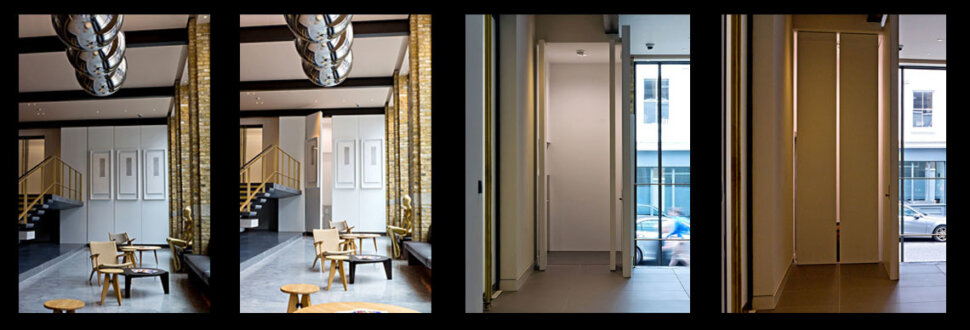
A: Yes. In some bespoke projects, the client constructs a lift shaft and doors, and Sesame Access installs a scissor lift inside. This approach can reduce overall cost and uses EN 81-41 guidance when applicable. It requires close coordination with the design team to ensure flush, compliant door interfaces. We show a picture of one such lift on this web page.
Q: What makes the Marylebone Access Lift bespoke?
A: The Marylebone Access Lift includes a step that rises independently from the main platform, allowing it to adapt to complex entrance conditions.
https://www.sesameaccess.com/lifts/marylebone-access-lift
Q: Why was the Edinburgh Access Lift originally bespoke?
A: The Edinburgh Access Lift was designed to preserve the space and form beneath an existing walkway while still providing compliant access.
https://www.sesameaccess.com/lifts/edinburgh-access-lift
Q: What is the Cavendish Platform Lift and what makes it unique?
A: The Cavendish Platform Lift incorporates rising barriers that deploy through the upper landing to protect the void created when the platform descends.
https://www.sesameaccess.com/lifts/cavendish-platform-lift
Q: What is the Portobello Wheelchair Lift and how does it work?
A: The Portobello Wheelchair Lift operates similarly to a forklift, using rams to lift the platform vertically. It requires a small pit depth.
https://www.sesameaccess.com/lifts/portobello-wheelchair-lift
Q: What is a British Library Lift?
A: The British Library Lift is a stage platforms that can be designed to lift not only wheelchair users but large items such as pianos. Once raised, they lock into place using four structural pins, creating a stable performance surface. This design is a bespoke adaptation of the British Library Platform Lift
https://www.sesameaccess.com/lifts/british-library-platform-lift
Q: Has Sesame Access worked on curved staircases?
A: Yes. Sesame Access has delivered bespoke solutions for curved staircases, including projects for the European Parliament. These required custom-shaped platforms and glass barriers to maintain visibility while ensuring safety.
Q: What is the Traversing Lift and why was it developed?
A: The Traversing Lift was developed for extremely tight spaces in front of staircases. The platform is shaped to fit the building geometry, with gates that temporarily close the stair route during lift operation.
https://www.sesameaccess.com/lifts/traversing-lift
Q: Can bespoke lifts include shaped platforms and cut-outs?
A: Yes. Sesame Access regularly designs platforms that wrap around architectural features, avoid window frames, and incorporate cut-outs to eliminate crush hazards while maximising usable platform size.
Q: Where can bespoke lifts be installed?
A: Bespoke lifts can be installed in Grade I and Grade II listed buildings, churches, auction houses, palaces, government buildings, and international landmarks, including sites in New York. Permissions are routinely obtained from heritage bodies and planning authorities.
Q: How does a client start a bespoke lift project with Sesame Access?
A: Clients can book a meeting directly through the Sesame Access website. During this process, the team reviews the access challenge, discusses applicable standards, and shares relevant drawings. Many bespoke lifts combine elements from multiple existing products into a single engineered solution.