
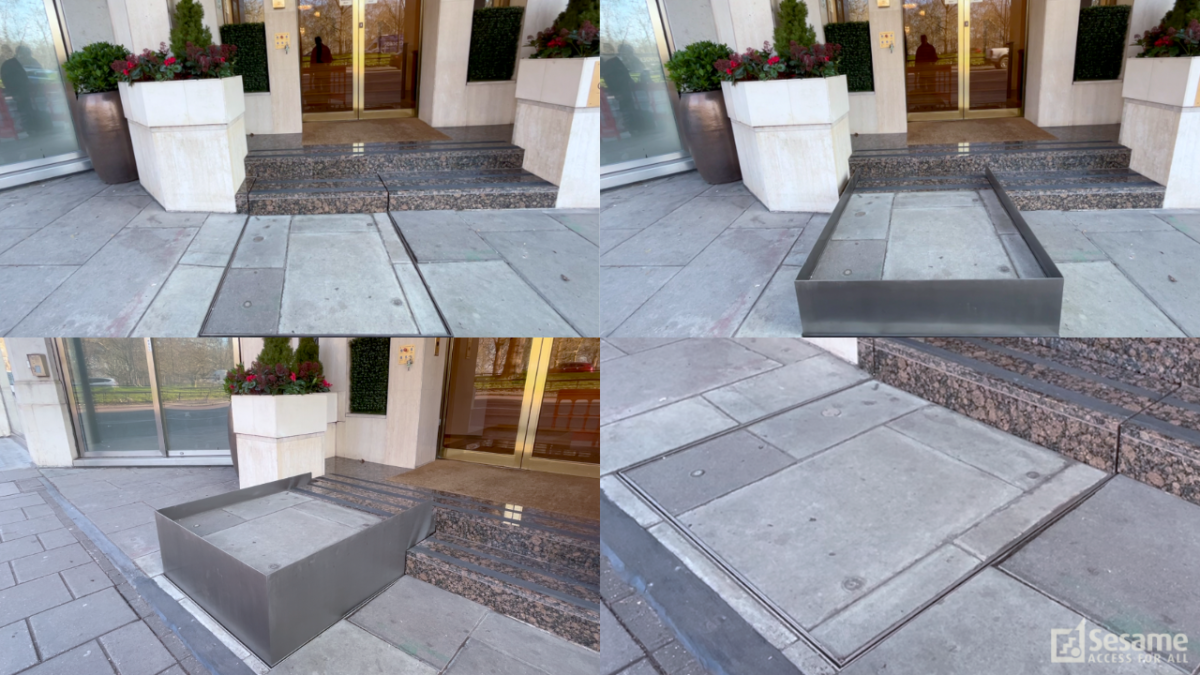
In this enquiry, a design team for a Grade II listed luxury store entrance explored how to convert a short flight of external steps into a fully hidden, staff‑managed platform lift—maintaining the building’s character while unlocking independent access. The conversation focused on fit, safety, heritage sensitivity, and a clear next‑step plan to de‑risk the project.
The entrance sits on a busy city pavement, with basement accommodation directly below. The team sought a “beautiful, seamless stair that turns into a platform lift”—no bullnose overhangs, no visual clutter, while satisfying:
- Listed-building constraints and a preference for minimal visual impact.
- A relatively modest rise (~616 mm) that still introduces fall risks and public-realm considerations.
- The need to preserve (or sympathetically re-make) granite treads/risers and handrail character.
- Space limitations below the upper landing (basement toilets/services), influencing pit length/depth.
- Public operation risks at a high-footfall entrance, demanding strong safety interlocks and supervision.
Sesame engineers walked the team through two core mechanisms, each proven on heritage sites, and the operational model that keeps the public safe:
- Mechanism options:
- Mayfair (horizontal retracting stairs + hidden rising barrier at the upper landing): Shallowest build-up; with ~800 mm stair retraction below the upper landing plus the ~616 mm rise, the total vertical allowance is ~1,400 mm (subject to final detailing). Pit length behind the top step depends on tread count; with 3×300 mm treads, the retraction length can be ~900 mm. This option is also the most visually "invisible", no "stud" access points on treads.
- Buckingham (vertical-dropping stairs): Requires greater pit depth below the lower landing but reduces space demands behind the top step, useful if services constrain horizontal retraction. Compatible with an upper-landing rising barrier (typically ~1.6 m pit depth below the upper landing for the barrier module).
- Upper-landing protection (public safety): The preferred solution is a hidden rising barrier at the upper landing that appears only during lift travel, minimal visual impact and robust public protection for voids greater than 500 mm. An always-visible swing gate reduces pit impact but is less preferred visually. A rope barrier with keyed interlock can work in managed, low-traffic settings but isn’t recommended here.
- Operation & compliance: The Mayfair or Buckingham with wrap-around tow-guard is a wheelchair (seated-user) lift under post-2011 rules; standing travel isn’t permitted. In busy public environments, Sesame configures the system "off" between uses to prevent misuse; a "call for assistance" triggers staff attendance. Staff-managed operation aligns with the site’s doorman/facilities protocols and de-risks movement among unaware pedestrians.
- Layout optimisation & handrail strategy: A 1,500 mm turning circle may share part of the platform footprint once deployed, an approach often accepted to centralise the handrail and ease clearances. Crush hazards near the right-hand handrail can be mitigated by shifting the stair/lift ~300 mm away, adding a safety edge along that flank (less robust in a high-heel/high-traffic environment unless reinforced), or detailing the handrail so the horizontal member stays clear of the rising tow-guard envelope. With the ~616 mm rise and the handrail set as high as practicable, the tow-guard won’t pass the handrail’s horizontal member, avoiding crush risk while preserving aesthetics.
- Materials & heritage finish: The proposal includes granite treads, risers, and landing (target ~20 mm tile thickness, subject to on-site verification) and a stainless-steel skirt (initially) for the Mayfair configuration. Final trim interfaces will be tuned in site-specific drawings to blend with heritage detailing.
After the session, the team agreed to:
- Send PDFs and DWGs to Sesame.
- Sesame will test both mechanisms in plan and section, move the assembly left to centralise the handrail, verify pit length/depth (considering ~900 mm retraction for three treads), and map clash risks with basement services.
- Sesame will issue a budget based on the most straightforward, lowest-impact option (likely the Mayfair with hidden rising barrier). If accepted, they will carry out a site survey and produce site-specific drawings (no charge for this design iteration).
- If later surveys show scope to shave pit requirements, Sesame has next-generation rising-barrier technology in development that may reduce the ~1.6 m envelope by the time this project mobilises.
By combining hidden-in-plain-sight engineering, staff-managed safety and thoughtful handrail/turning-space geometry, this project shows that heritage character and modern accessibility can co-exist. The entrance remains a luxury design statement while welcoming every customer with dignity. It’s a model for listed retail frontages, embassy steps and flagship venues facing similar constraints.
Q1. Which mechanism best fits a shallow rise with basement constraints?
A. The Mayfair (horizontal retracting) typically wins on overall depth when basement space is tight behind the top riser, especially with 3×300 mm treads (~900 mm retraction). We’ll still test the Buckingham if vertical drop helps your specific clashes.
Q2. How do we protect the public at the upper landing without visible gates?
A. A hidden rising barrier is the preferred solution here: minimal visual impact, compliant protection over voids >500 mm, and proven on heritage sites.
Q3. Can visitors operate it themselves?
A. In high-footfall settings we configure a staff-managed mode with call-for-assistance. It prevents misuse, aligns with doorman/FM routines, and upholds post-2011 seated-user rules.
Q4. Will the handrail create a crush hazard?
A. Not with careful detailing. With a ~616 mm rise and the handrail’s horizontal member set appropriately, the tow-guard won’t pass the rail. Alternative mitigations include 300 mm set-back or a reinforced safety edge if needed.
Q5. What finishes are typical for a listed context?
A. Granite for treads/risers/landing (c. 20 mm tile thickness, TBC), and a stainless-steel skirt around the mechanism—both tuned in site-specific drawings to match the heritage palette.