
Key Takeaways
-
Heritage performance halls built before modern accessibility standards often cannot accommodate conventional platform lifts due to limited backstage space, fragmented levels, and preservation requirements.
-
A hidden stage-edge lift can provide dignified wheelchair and standing access while fully protecting sightlines and historic architecture.
-
UK-manufactured Sesame lifts can be installed internationally when supported by local engineering teams, remote diagnostic tools, and structured training.
-
The Pimlico Lift, British Library Platform Lift, and The People’s Lift suit different rise heights, pit depths, and stage environments.
Introduction
Heritage performance halls built before accessibility requirements present unique challenges that conventional lifts cannot solve. Many theatres, concert halls, and university auditoria rely on 100-year-old infrastructure that was never intended to provide barrier-free stage access. Backstage areas often consist of small stairways, split levels, and narrow routes that make traditional lift installations extremely difficult without significant demolition.
This article outlines how a UK-manufactured hidden stage-access lift can solve these constraints, using a real project discussion involving a 1912 performance hall undergoing a major refurbishment. It covers lift options, international standards, remote maintenance, and the practical steps needed to integrate a lift into a sensitive heritage setting.
To support this topic, this guide also links to two relevant Knowledge Hub articles:
Why are heritage performance halls so difficult to make accessible?
Older concert halls typically contain fragmented back-of-house circulation created through decades of retrofits. Space behind the stage is often narrow, multi-level, and structurally fragile. Creating a new lift shaft or goods elevator would require removing large sections of the building’s historic fabric.
This means the challenge is not simply providing vertical travel, but delivering a solution that:
-
Maintains clean architectural sightlines
-
Avoids permanent guardrails on stage
-
Fits within extremely tight footprints
-
Creates a dignified approach to the stage
-
Minimises noise in an acoustically sensitive environment
A hidden platform lift installed at the stage edge can achieve all of these requirements.
What is the best lift type for a heritage stage environment?
Discreet engineering is the key priority. During the consultation described in the transcript, three Sesame products were explored:
-
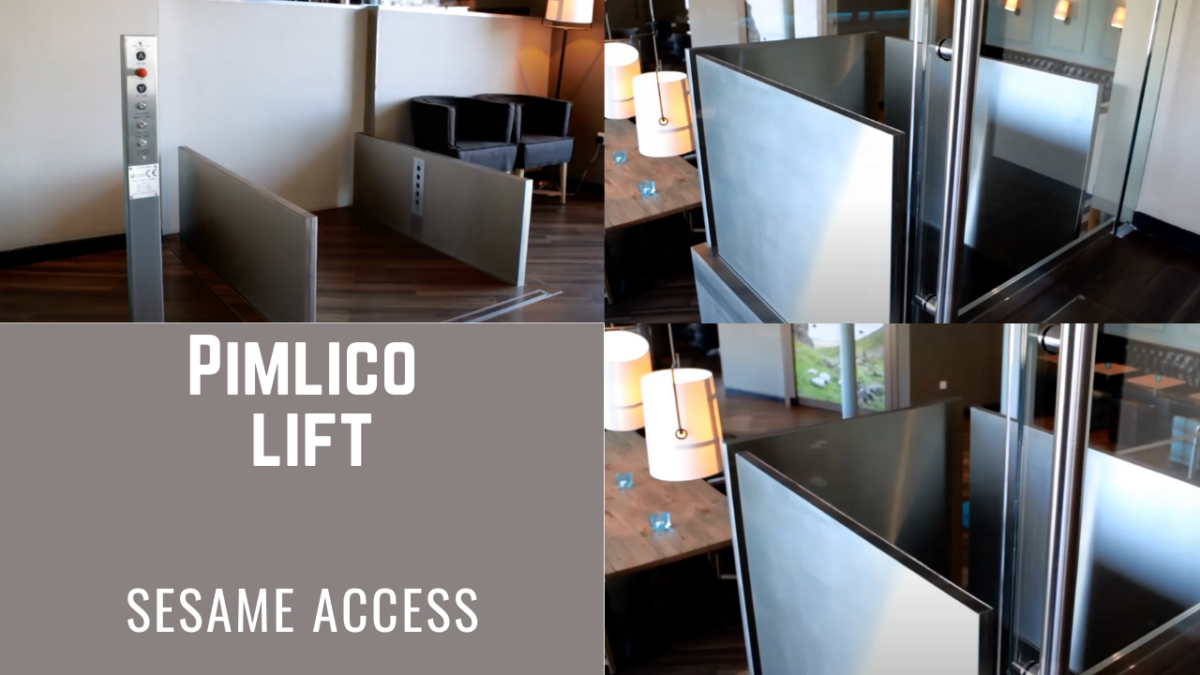
Pimlico Lift (rising side barriers, fully hidden when retracted)
-
British Library Platform Lift (compact recessed lift with tow-guard ramps)
-
The People’s Lift (low-rise, wheelchair-only hidden lift)
Each lift offers different benefits depending on rise height, pit depth, and required user type.
Below is a comparison table to support architects, access consultants, and heritage teams.
Comparison Table: Hidden Lift Options for Stage Environments
| Lift Model | Typical Rise | Best For | Key Features |
|---|---|---|---|
| Pimlico Lift | Up to 3 Meters | Standing and wheelchair users | Rising 1100 mm safety barriers, fully hidden in stage, ideal for dignified public stage access |
| The People’s Lift | Up to 1 m | Wheelchair users only | Low-profile scissor lift, hidden platform, tow-guard system, minimal pit depth |
| British Library Platform Lift | Variable (often <1 m) | Stages with no pit depth available | Surface-mounted configuration, removable tow-guards and ramp, recessed integration into stage face |
How do UK lifts comply with international standards such as ASME and CSA?
Sesame lifts comply with UK and European Machinery Directive requirements through detailed engineering risk assessments. In countries using ASME A18.1 or CSA B355 (such as the United States and Canada), hidden lifts require careful coordination with the Authority Having Jurisdiction.
Key points from the discussion:
-
University estates departments often have their own AHJ, allowing project-by-project evaluation.
-
Where required, Sesame can prepare documentation, risk assessments, and variation proposals.
-
Rising barriers may replace the continuous grab rails normally required by North American codes when an AHJ accepts a performance-based approach.
For architectural teams exploring UK-manufactured lifts for international heritage venues, the article on Export Logistics for Bespoke Lifts provides further clarity.
How does a hidden lift maintain safety if the barriers are not always visible?
Hidden lifts remain locked and immobile when barriers are retracted. Movement only begins when all safety checks confirm:
-
Barrier-up limits
-
Platform limit switches
-
Safety edges
-
Locking pins (where applicable)
-
Controlled access via key or staff operation (for managed venues)
This ensures full compliance with UK safety requirements, even in bespoke stage environments.
Can a hidden stage lift work in a concert hall environment?
Yes. Two design elements are especially important for acoustic spaces:
-
The hydraulic power pack can be located away from the stage to reduce noise.
-
Rising barriers remain completely hidden when not in use, protecting sightlines for musicians and audiences.
Because this particular hall intended to reduce stage height to around one metre, the Pimlico Lift was identified as the most appropriate model due to its rising 1100 mm barriers.
How does maintenance work for an international installation?
A major concern raised in the consultation was access to servicing for a UK-manufactured lift located overseas. Sesame’s global model includes:
-
Local engineering teams attending commissioning
-
A follow-up warranty service visit with refresher training
-
Remote diagnostics allowing Sesame engineers to view live input/output data
-
Spare parts packs shipped with international installations
-
Video walk-through guidance for local engineers if required
This method is already used successfully for projects in locations such as North America, Australia, Europe, and the Middle East.
Recommended Related Reading
To support long-term planning for heritage accessibility, the following articles provide deeper technical insights:
Frequently Asked Questions (FAQ)
Can rising barriers be customised to match stage finishes?
Yes. Barriers and platform surfaces can be colour-matched or finished in materials that complement the stage.
What happens during a power failure?
Sesame lifts include manual lowering or battery backup descent methods depending on configuration.
Can the lift be used by both speakers and performers?
Yes. Models like the Pimlico Lift are designed for safe standing-user access with 1100 mm rising barriers.
Do the lifts require a deep pit?
The Pimlico Lift typically requires around 1650 mm pit depth, though compact versions exist. The British Library Platform Lift requires minimal or no pit depth.
Can a UK-manufactured lift be approved in the US or Canada?
Yes, subject to AHJ evaluation, risk assessments, and in some cases, documented variations.
Can the lift be integrated with heritage-grade materials?
Yes. All visible parts can be customised to suit conservation or design requirements.
Call to Action
If you are planning stage or heritage accessibility upgrades and want expert guidance, book a meeting with one of our Project Managers below:
https://www.sesameaccess.com/book-a-meeting