
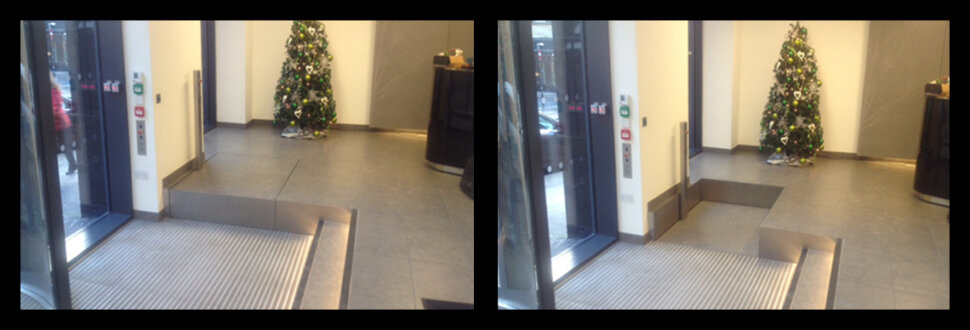
What is the Wembley Lift?
The Wembley Lift is a bespoke hidden platform lift designed for very short rises, typically up to 200 mm. It sits locked at the upper landing, rises slightly to release its locking pins, and lowers to the lower landing to collect the wheelchair user. It is ideal for single-step or very shallow level changes where a fully enclosed shaft is not required. However, larger rises can work in certain environments with the correct Risk Assessments.
What is the difference between the Wembley Platform and Wembley Low Profile versions?
There are two design variants:
• Wembley Platform – standard version with a pit depth of approximately 341 mm (including 30 mm of cladding).
• Wembley Low Profile – reduced-depth version requiring only 271 mm of pit depth.
The low-profile version is used where pit excavation is limited.
Why would an architect choose the Wembley Lift?
Architects typically choose the Wembley Lift for tight spaces, short rises, and scenarios where a top-landing platform is preferred. It is often chosen when a stage or raised platform has a minimal rise and visibility must be kept to a minimum. It its riser wall must be a plumb, flush vertical face to allow the front skirt to drop safely into the pit.
How does the Wembley Lift differ from the British Library Lift?
The British Library Lift includes a front door and creates an enclosed mini-shaft when lowered. This allows greater rise flexibility and reduces the need for toe guards. The Wembley Lift does not have a door, meaning it requires a plumb flush outer face and typically supports lower rises unless a removable manual toe guard is used.
When is a removable manual toe guard required?
A manual toe guard is required when the rise exceeds 200 mm to prevent wheels from rolling off the platform. For rises up to 200 mm, architects can often avoid the toe guard, but above this height it becomes essential.
What space or surface conditions are required at the upper landing?
The front face must be plumb and flush so the lift’s front skirt can drop into a gap of less than 10 mm without creating a crush hazard. Any cladding or finish must maintain this flush condition.
What are the platform size options?
Standard pit: platform size 1400 mm x 1035 mm (including pole socket; usable width approx. 900 mm).
Low profile pit: platform size 1558 mm x 924 mm.
Custom sizes are possible for the standard pit version; the low profile version is generally fixed to minimum dimensions.
Can you make the platform narrower?
Yes. The standard Wembley platform can be made narrower if required, but the low-profile version cannot be reduced below its minimum footprint.
How do the controls work?
Controls can be mounted on pedestals or wall plates, positioned at both upper and lower landings. Where visibility minimisation is important, the call station can be placed low on an adjacent wall. Button height can be between 400 mm and 1100 mm depending on whether the installation is intended for seated users only or seated and standing users.
Can the lift have a permanent button station on the platform?
Yes, this is possible, although many clients avoid it to keep the system visually hidden. When the lift is next to a wall, controls can be inserted within the compliant height range even when the total rise is small.
How does the pit depth change for rises above 200 mm?
Once the rise exceeds the two standard pit-depth templates, the pit depth becomes the total rise plus approximately 75 mm to allow the solid front skirt to descend fully without collision.
What finishes can be used?
The lift table and riser wall can be clad in stone, timber, metal, or other architectural materials. Shaft walls revealed when the lift lowers can be stainless steel, brushed aluminium, or powder coated.
Can the machinery be hidden inside the lift?
Yes. Similar to the People’s Lift, the Wembley Lift can be designed with the machine cabinet integrated within the lift structure, depending on space and specification.
When would you use the People’s Lift instead of the Wembley Lift?
If there is space in front of the riser and the client wants the automatic tow guard to rise around the platform, the People’s Lift is preferred. The Wembley is used when space is too tight to allow the People’s Lift to sit in front of the step or when a doorless aesthetic is required.
When should the Cavendish Lift be used instead?
For rises above 500 mm or the creation of a significant fall hazard, rising barriers are needed. The Cavendish Lift provides rising barriers on three sides and requires deeper pits (approx. 1.65 m). It is typically used when safety barriers must deploy automatically.
What if the site is a stage or performance space?
In managed stage environments, where voids larger than 500 mm are common, clients may choose:
• Wembley Lift (for small rises)
• Richmond Rising Barrier Lift
• Pimlico Lift
• Cavendish Lift
depending on the rise, visibility, and need for rising barriers.
Does the Wembley Lift need a machine room cabinet?
Yes, unless integrated into the lift. The standard external machine room cabinet follows the same rules as other Sesame lifts and can be installed internally or externally depending on site constraints.
Can the Wembley Lift be installed outdoors?
Yes. It can be installed externally, subject to weatherproofing and drainage design.
What is the maximum safe rise for a Wembley Lift?
200 mm without tow guard, higher rises are possible but require a removable tow guard and additional safety review with building control.
What is the key reason architects compare the Wembley with other Sesame models?
Architects compare the Wembley model with the British Library Lift, People’s Lift, and Cavendish because these products cover the same design consideration: hidden access at a step or riser where visual impact must be minimal but safety requirements vary depending on rise height, available space, and enclosure requirements.