Key Takeaways
-
Internal preparation meetings typically reduce client meeting follow-ups by around 60% by resolving design and compliance questions in advance.
-
Early alignment allows client meetings to focus on decisions rather than uncertainty.
-
Visual modelling and code checks ensure only viable solutions are presented.
-
Structural constraints are addressed before the client meeting, not during it.
Introduction
Client meetings are most effective when the groundwork has already been done. At Sesame Access, internal preparation meetings are a core part of how projects are delivered. Before any discussion with a client takes place, design, engineering, and compliance considerations are reviewed together to ensure accuracy, clarity, and confidence.
This preparation-driven approach typically reduces post-meeting clarifications and redesigns by up to 60%, helping projects move forward faster and with fewer unknowns. Instead of using client meetings to discover problems, Sesame Access uses them to present clear, buildable solutions.
How Internal Preparation Improves Client Meetings in Structurally Constrained Projects
Many accessibility projects involve complex site limitations such as load-bearing beams, tight pits, or boundary walls close to public routes. Discussing these challenges for the first time in a client meeting often leads to hesitation and follow-up work.
Internal preparation meetings allow teams to test whether a platform lift can fit between a structural beam and a pit wall, whether tolerances of 5–10 mm are achievable, and whether access routes can remain compliant without structural compromise. By resolving these issues early, client meetings stay focused on outcomes rather than constraints.
Why Sesame Access Aligns Design and Engineering Before Every Client Meeting
Lift design decisions sit at the intersection of aesthetics, engineering reality, and regulatory compliance. Internal alignment ensures that everyone involved understands how the solution works in practice.
Typical internal discussions include platform dimensions, stair geometry, handrail positioning, and clearance requirements. This is especially important when preparing solutions similar to those explored in projects involving hidden or discreet lift integration, such as those discussed in hidden platform lifts for New York landmark buildings.
Aligning these details internally prevents mixed messages and builds confidence during client discussions.
Using Visual Modelling to Prepare Clear and Confident Client Presentations
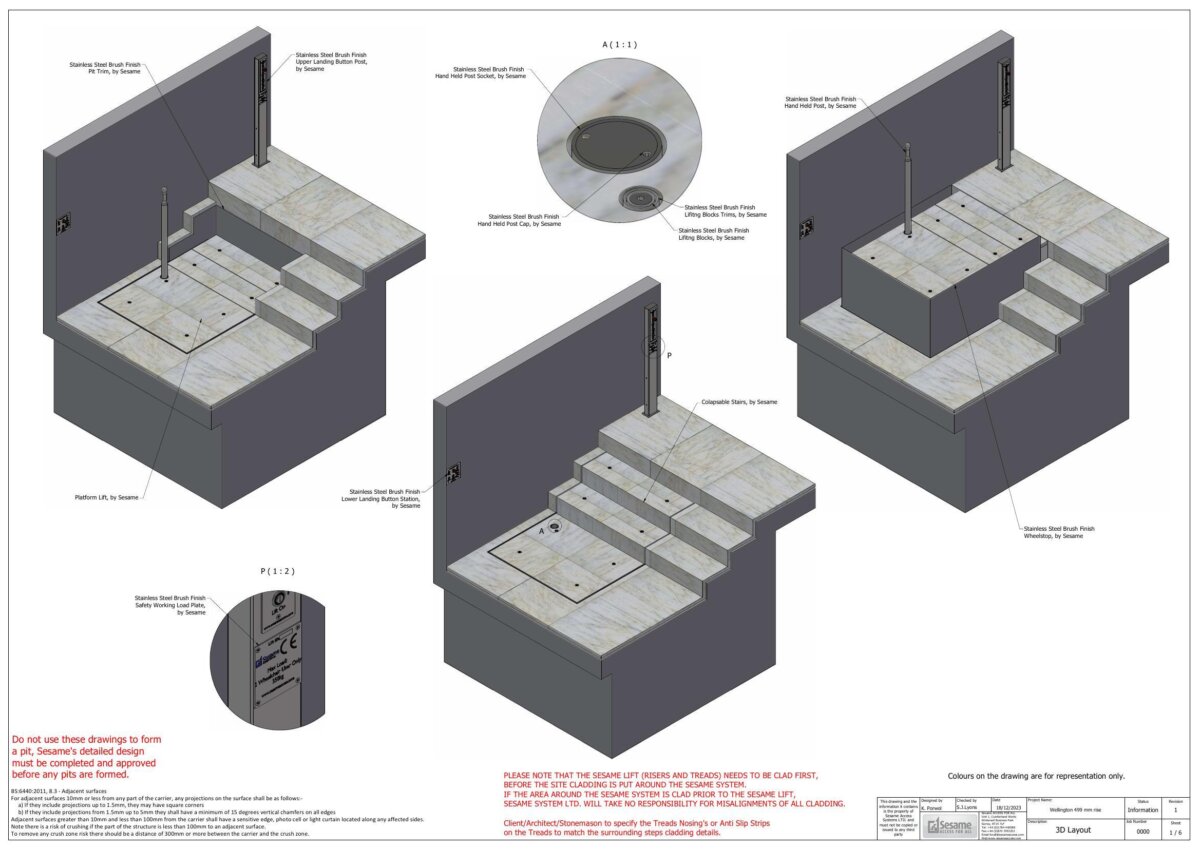
Visual clarity is critical when explaining complex accessibility solutions. Internal preparation meetings rely on accurate 3D layouts and visual studies to ensure what is shown to clients reflects what can be delivered.
Visual modelling helps teams:
-
Confirm platform clearances against existing structure
-
Validate handrail heights within typical ranges such as 900–1000 mm
-
Check interface details with existing stairs and landings
-
Anticipate client questions before they are asked
This approach mirrors the thinking behind evolving design strategies explored in evolving accessible entrance design for heritage buildings, where careful preparation is essential to balance access and context.
Common Pre-Meeting Questions Resolved Internally
Before a client meeting takes place, Sesame Access teams typically resolve questions such as:
-
Will the platform clear the structural beam at the rear of the pit?
-
Can we achieve full-length handrail coverage without obstructing the stair?
-
Are handrail heights compliant with applicable standards?
-
What tolerance margin exists between fixed walls and the platform?
-
Can the solution align with ADA expectations or ASME 18.1 requirements where applicable?
By answering these internally, the client meeting becomes a confirmation discussion rather than an exploratory one.
Typical Pre-Meeting Preparation Process
-
Site constraints reviewed, including beams, walls, stair geometry, and pit depth
-
Initial layout and 3D modelling created to test feasibility
-
Code and compliance considerations reviewed, including relevant accessibility standards
-
Internal alignment meeting held to confirm messaging and viable options
-
Clear, structured client presentation prepared
This workflow ensures consistency, accuracy, and efficiency across all client interactions.
Preparing for Compliance Before the Client Meeting
Compliance is not treated as an afterthought. Internal preparation includes early consideration of relevant guidance, whether related to British standards, ADA expectations, or ASME 18.1 where applicable.
By confirming that proposed solutions align with regulatory principles before presenting them, Sesame Access avoids speculative discussions and focuses meetings on compliant, deliverable outcomes.
Problem–Solution: Turning Complex Constraints Into Clear Client Decisions
Problem
Client meetings can become unfocused when structural, dimensional, or compliance issues are identified too late.
Solution
Internal preparation meetings resolve these issues first, allowing client discussions to focus on clear options, informed decisions, and next steps rather than technical uncertainty.
Frequently Asked Questions
Why does Sesame Access hold internal meetings before client discussions?
To ensure that only accurate, compliant, and viable solutions are presented.
Does this approach slow down early project stages?
No. It reduces rework and accelerates progress later.
What types of constraints are typically reviewed?
Structural beams, pit walls, stair geometry, tolerances, and regulatory considerations.
Does this preparation benefit architects and consultants?
Yes. It provides clarity, reduces ambiguity, and supports faster decision-making.
Call to Action
If you value structured, well-prepared client discussions that focus on solutions rather than uncertainty, an early conversation can help set the right direction.
Book a Teams meeting with one of our Project Managers to explore your project in a clear, people-first way:
https://www.sesameaccess.com/book-a-meeting