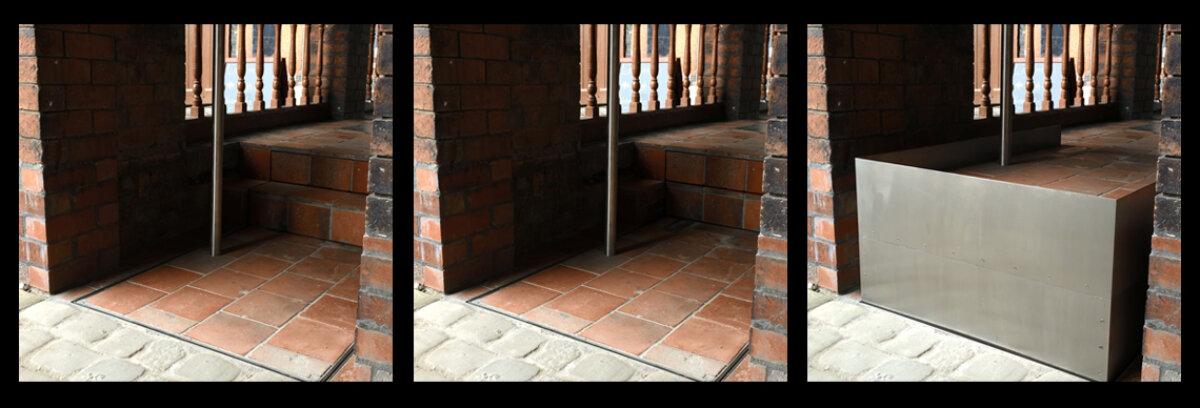
In this case, our engineers turned a fast-moving call into a clear, ordered Serviceable Spares Pack for a bespoke hidden platform lift at a luxury hospitality site. The goal: identify the parts most likely to be needed during commissioning and early life, reduce site risk, and ensure rapid swap-outs without over-ordering.
The Challenge
A complex hidden lift comprises actuators, cams, scissor assemblies, roller blinds, tape switches, stair hydraulics, gate hardware, sensors and a hydraulic power unit, each with its own suppliers, stock codes and lead times. In this enquiry, the team needed to turn raw model references and engineering dialogue into a right-sized spares list: comprehensive enough to de-risk the project, but disciplined enough to avoid “ordering a second lift.”
Sesame’s Approach
Sesame engineers worked collaboratively through the model and transcript, grouping parts by subsystem (Lift Lid / Wheel-Stop, Scissor Lift, Stairs, Gate, Button Stations, Hydraulics) and tagging items by risk, criticality and replaceability.
Where relevant to product types, the following Sesame lift categories may apply:
Hidden platform lifts
https://www.sesameaccess.com/lifts
Bespoke hidden staircase lifts
https://www.sesameaccess.com/knowledge-hub/designing-bespoke-heritage-staircase-lift
Lift pit depth guidance
https://www.sesameaccess.com/knowledge-hub/bespoke-lift-pit-depth-solutions
Engineers prioritised items with realistic wear or impact risk, tricky lead times, or the ability to halt commissioning if missing.
Where supplier-specific references appeared in drawings, they recorded both the Sesame part code and the vendor/manufacturer reference to keep procurement flexible.
Highlights from the transcript review
Instead of building a bulky, expensive kit of everything imaginable, the review reaffirmed that most components in Sesame’s hidden lifts are engineered for longevity. As Andy noted, nylon wheels and bearings “never wear out,” and even the gate assembly bearings experience minimal duty.
The engineering conclusion: only a small set of targeted parts, such as lower roller wheels, limit switches and sensors, are realistically likely to need swapping. The core lifting mechanisms can be trusted to run reliably for years.
This illustrates Sesame’s design philosophy: build to last, prepare smartly. The resulting spares pack is not a shopping list, it is a confidence kit that supports the lift’s long-term reliability while ensuring that, if anything does require attention, the operator can restore service immediately.
The Outcome
The team produced a compact Serviceable Spares Pack that:
-
Covers the highest-probability early-life failures
-
Is quick to order and easy to store
-
Is site-ready and based on a structured engineering review
Why This Matters
A well-judged spares pack protects programme, uptime and reputation, especially in hospitality, heritage and high-profile venues. It minimises repeat visits, reduces downtime risk and provides a repeatable framework for future projects: a blueprint for “what to stock” for complex hidden lifts.
Q&A
Q1. What did we exclude, and why?
Bulky aluminium tape-switch extrusions and generic hoses. Extrusions add cost and storage volume; hose assemblies require exact measured lengths and are best made to order.
Q2. Why order “sets” of pins, cams and rollers?
Sets maintain symmetry and matching wear characteristics, reduce mixed-wear issues and allow a one-visit full restore.
Q3. How do we handle handed/mirrored parts?
Using M1 mirror conventions and explicitly listing “_MIR” variants prevents left/right mix-ups on site.
Q4. Why keep decals and only replace button cores?
Decals rarely fail. The EAO cores and bulbs are the true service elements, allowing quick function restoration while keeping the visual language consistent.
Q5. What single hydraulic item has the greatest preventive impact?
The accumulator set at 60 bar — compact, critical for performance stability and often the longest lead-time component.