
Key Takeaways
-
Many heritage staircases include irregular geometry, uneven treads and sensitive floor finishes that dictate what accessibility solutions can be installed.
-
Typical platform lifts for historic buildings require a usable platform rotation depth of around 1100 mm and a minimum platform width of 1400 mm.
-
Pit depths in heritage sites often range from 300 mm to 850 mm, influencing whether vertical or horizontal retracting stairs are possible.
-
Solutions must respect safety, fire strategy, side-void protection, building control requirements and conservation principles.
-
Retracting stair systems can preserve visual character while delivering modern accessibility, but only when the staircase width and sub-structure allow it.
Introduction: What problem does this article solve?
If you are responsible for improving accessibility in a heritage building and are facing challenges such as uneven stair geometry, mosaic landings, narrow column spacing or a lack of pit depth, this article explains how to design a bespoke accessibility lift that works safely and sensitively in a historic environment.
Historic Building Accessibility has become a leading concern for councils, architects and conservation officers. Whether for a Grade II listed building in Central London or a heritage community space elsewhere in the UK, many staircases were never designed to support modern inclusive access.
This guide uses lessons learned from a complex site survey to explain how engineers transform constrained heritage entrances into safe, discreet and fully compliant accessibility solutions.
Links such as our page on Accessible Heritage Staircase Solutions and Heritage Garden Hidden Lift Design demonstrate how different sites demand different engineering responses.
What makes heritage staircase geometry so difficult to work with?
During the survey, the staircase included a deep intermediate landing of approximately 850 mm before the top riser. This created an unusual break in the staircase rhythm.
Engineers must decide whether the lift should rise only to this intermediate landing or directly to the internal finished floor level. This choice affects:
-
Turning space
-
Barrier positioning
-
Lift platform dimensions
-
How the mosaic or threshold is protected
-
Whether planning or heritage approval is required
Irregular landings are one of the most common obstacles in heritage lift engineering, and they heavily influence product selection.
How do engineers protect mosaic or historic flooring during lift installation?
The site included a decorative mosaic positioned immediately in front of the entrance door. Mosaic or stone finishes require sensitive treatment because altering them may not be permitted.
Engineers typically consider options such as:
-
Lifting and reinstating the mosaic at a new level
-
Raising the entire landing while embedding the mosaic into the new floor
-
Designing the lift to avoid any disturbance to the mosaic
This problem often mirrors the challenges described in Heritage Garden Hidden Lift Design, where surface materials must be preserved while creating a functional lifting mechanism.
How do engineers choose between vertical and horizontal retracting stair systems?
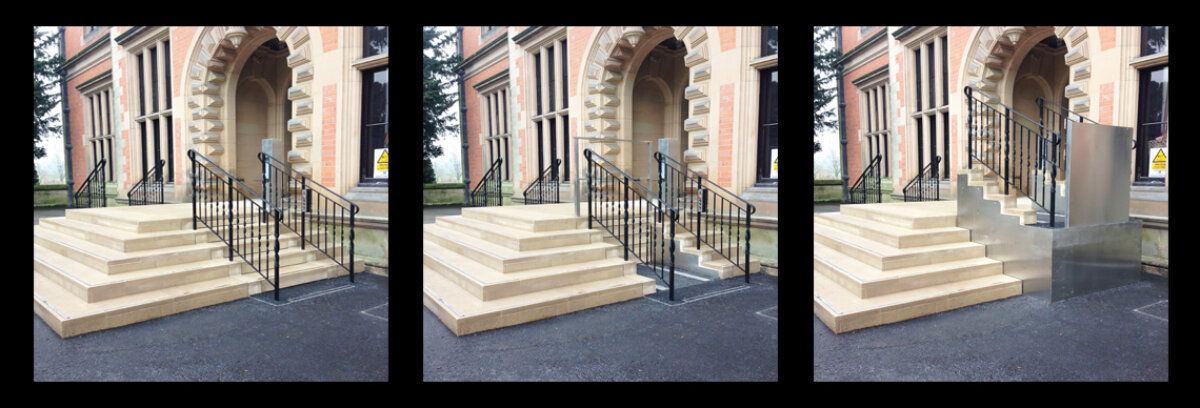
Retracting stair systems fall into two main types, both of which are widely used in historic environments.
Vertical retracting stairs
These retract downward into a pit.
Advantages:
-
Minimal visual disturbance
-
Stairs typically remain unchanged
-
Ideal where pit depth is available (often 500–850 mm)
Considerations:
-
Side voids must be fully protected
-
The pit must be deep enough to accommodate the stair frame
-
The structure below must not be part of a fire escape route
Horizontal retracting stairs
These slide back into an available void behind or beneath the staircase.
Advantages:
-
Useful when vertical pit depth is limited
-
Works well in porticos with deep vaults
Considerations:
-
Requires a significant clear zone below
-
Structural obstructions must be removed or bridged
-
May require more extensive planning consultation
Solutions like the Thames Retracting Stair Lift are often used when a deep horizontal void is available in heritage architecture.
How do engineers deal with exposed left and right voids around the staircase?
A key challenge identified in the survey was the presence of open voids to the left and right of the staircase. When the stairs retract to reveal the lift, these gaps could expose a fall hazard.
Safety solutions may include:
-
Rising side barriers
-
Vertical infill panels
-
Discreet handrail replacements
-
Heritage-sensitive iron railings
-
Automated gate systems linked to lift operation
This is similar to the approach used in some Buckingham Listed Building Lift installations, where side barrier integration is essential for public safety.
What happens when the staircase is too narrow for a standard straight-through lift?
If the staircase is narrow, a wheelchair may not be able to travel straight up. In such cases, engineers may use a 90-degree rotating platform lift.
This method works when:
-
The staircase width is limited (often around 1.7–1.8 m column-to-column)
-
The usable platform length available is only 1100 mm
-
Turning space can be provided on the lift platform itself
-
Side-void barriers and handrail modifications can be sensitively integrated
This configuration is commonly seen in installations similar to the Whitehall DDA Lift, where 90° rotation solves site constraints without altering the architectural character.
How do fire escape routes affect lift design in heritage buildings?
Many heritage buildings use staircases as fire escape routes, or contain vaults beneath the portico that function as part of the emergency egress system. In the survey:
-
A basement escape door existed beneath the staircase
-
Engineers needed to confirm whether the door was still part of the fire strategy
-
The lift frame would occupy space that might otherwise be used in an emergency
This requires consultation with:
-
Fire engineers
-
Building control
-
Conservation officers
The review process ensures that the lift will not compromise evacuation routes, even during lift operation.
Which Sesame lift models are typically suited to heritage staircase challenges?
Different heritage geometries call for different bespoke products. Common choices include:
-
Buckingham Listed Building Lift – Ideal when side voids need robust rising barriers.
-
Thames Retracting Stair Lift – Effective in porticoes with usable horizontal voids.
-
Whitehall DDA Lift – Suited to installations needing discreet appearance and tight rotations.
Each product is adjustable, and each installation is fully bespoke.
Frequently Asked Questions (FAQ)
How can heritage surfaces like mosaics be protected during lift installation?
Engineers can lift and reinstate the mosaic, raise the landing while embedding it, or design the lift to avoid disturbing it.
Can retracting stair lifts be installed in listed or sensitive buildings?
Yes. Sesame’s systems are used in highly sensitive Grade II and Grade I environments where conservation approval is required.
Will the lift block the staircase during operation?
Yes, for safety reasons the staircase is blocked while the lift is in motion. This is factored into fire strategy and building use assessments.
Can prams or buggies use heritage staircase lifts?
Most lifts are intended for seated wheelchair users, but unoccupied buggies can travel if supported by staff.
What if the staircase is too narrow?
A 90-degree rotating platform lift may be used, allowing the wheelchair to board in one direction and travel in another.
Call to Action
If you are planning an accessibility upgrade for a heritage staircase, you can book a Teams meeting with our Project Managers:
https://www.sesameaccess.com/book-a-meeting