Key Takeaways
-
Early 3D visualisation helps architects and stakeholders understand how platform lifts can work within severe structural constraints.
-
Bespoke lift design can achieve compliance while fitting within tolerances as tight as 10 mm.
-
Comparing lift options at concept stage reduces structural risk and avoids late redesigns.
-
Addressing handrail heights, tread depths, and pit constraints early improves approval outcomes.
Introduction
Designing accessible lift solutions in existing buildings is rarely straightforward. Architects and consultants are often working around load-bearing beams, pavement walls, tight pit depths, and fixed stair geometry, all while meeting accessibility legislation and safety standards.
This article explains how early-stage visual modelling and bespoke lift engineering help resolve these challenges. By combining detailed 3D staircase visualisation with code-aware design, it becomes possible to deliver compliant, people-first access solutions without unnecessary structural intervention.
How to Design Platform Lifts in Buildings with Structural Beam Constraints
Structural beams are one of the most common limitations encountered when retrofitting platform lifts. Cutting into these elements is often not possible due to cost, safety, or planning restrictions.
Through bespoke design, lift platforms can be dimensioned to sit precisely between fixed elements. In practice, this can mean working within tolerances as tight as 9–10 mm between a rear structural beam and a front wall supporting a pavement or circulation route.
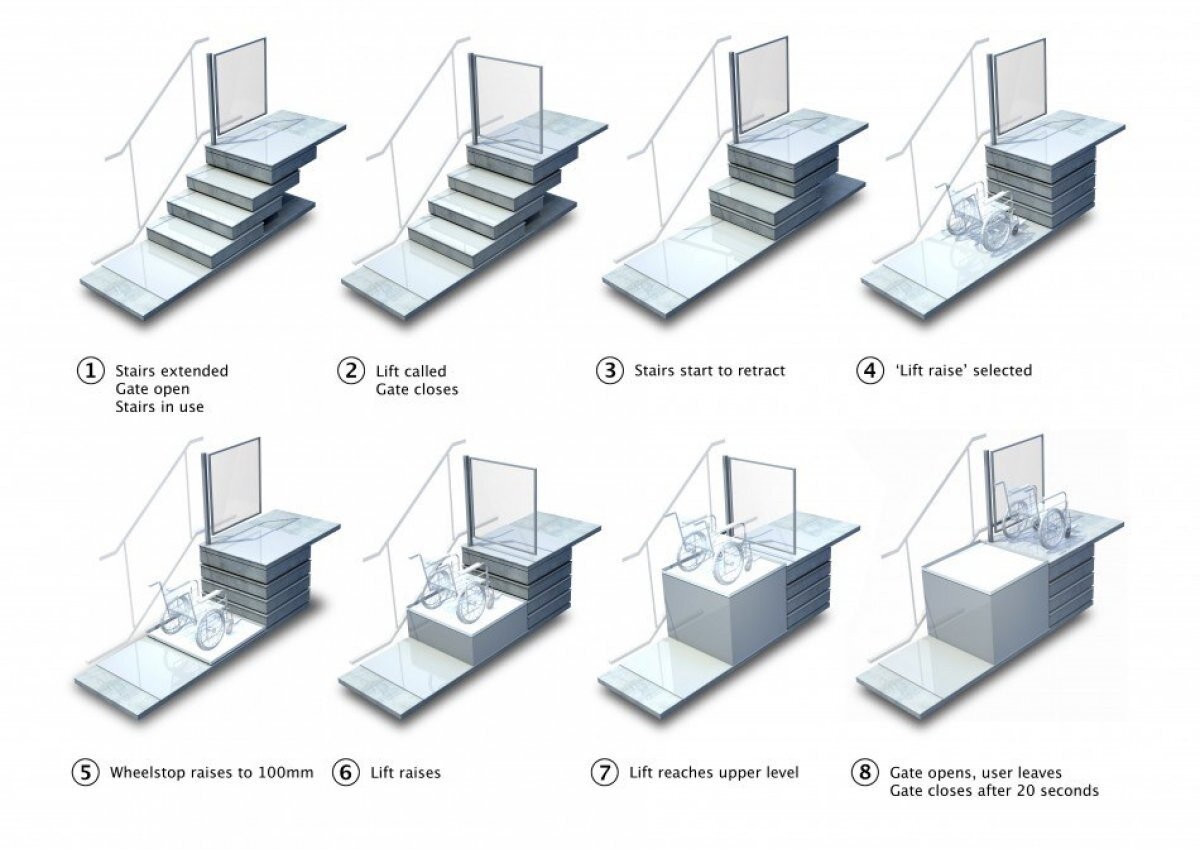
Using 3D staircase visualisation for architects, these constraints can be modelled accurately before any decisions are locked in, allowing teams to confirm feasibility without risk.
ADA Lift Solutions for Limited Pit Depth and Tight Stair Geometry
In constrained environments, stair geometry often dictates what is possible. Typical challenges include fixed tread depths of approximately 280 mm, restricted landings, and minimal space at the upper and lower levels.
An ADA-compliant platform lift such as the Seattle ADA Lift can be adapted to suit the exact number of steps and total rise on site. By adjusting platform length and interface details, the lift can align cleanly with existing stairs while remaining compliant in relevant areas with ASME 18.1 requirements.
This approach avoids unnecessary excavation or alteration to surrounding structures and keeps the solution focused on user safety and dignity.
How Bespoke Lift Design Reduces Structural Alterations and Cost
Standard lift products often require the building to be altered to suit the equipment. Bespoke lift engineering reverses this relationship.
By tailoring the lift around the building, it is often possible to:
-
Avoid cutting into load-bearing beams
-
Eliminate the need for deep pits
-
Reduce changes to pavement or external walls
-
Minimise disruption to surrounding areas
Solutions such as the Bespoke Lift and the Westminster Equality Act Lift are frequently explored side by side at concept stage to demonstrate how different design approaches impact structure, cost, and installation complexity.
Managing Handrail Heights and Safety Clearances in Platform Lift Design
Small dimensional details can have a significant impact on compliance. Handrail design is a common example.
During early modelling, handrail heights are typically reviewed against ranges of approximately 900 mm to 1000 mm, ensuring they provide full-length support across the platform. Clearance between the handrail and the top stair riser is also critical, with gaps such as 50 mm often required to avoid snagging or obstruction.
Resolving these details early avoids rework during approvals or installation.
Site Constraints and How Sesame Access Solutions Address Them
Architects and consultants frequently describe their challenges in practical, site-based terms. Common constraints include:
-
Load-bearing beams at the rear of the pit, addressed by shortening or reshaping platform geometry.
-
Pavement or sidewalk walls at the front of the lift, managed through careful alignment and tolerance control.
-
Tight pit dimensions, resolved using shallow-pit or no-pit bespoke designs.
-
Fixed stair dimensions, accommodated by matching platform length to existing tread depths.
Each of these constraints can be reviewed and tested virtually before construction, reducing uncertainty and improving outcomes.
Product Integration Summary
The following Sesame Access solutions are commonly assessed during early-stage modelling for constrained environments:
| Lift solution | Typical application | Design advantage |
|---|---|---|
| Seattle ADA Lift | Tight staircases with strict code requirements | Designed for ASME 18.1 and ADA in limited spaces |
| Westminster Equality Act Lift | Public and civic buildings | Flexible configuration options for complex sites |
| Bespoke Lift | Highly constrained or unique buildings | Engineered around existing structure rather than standard dimensions |
Each option can be visually compared to support informed, people-first decision-making.
Frequently Asked Questions
When should 3D lift modelling be introduced into a project?
As early as possible. Early modelling reduces risk and allows constraints to be resolved before approvals and construction.
Can a platform lift really fit within 10 mm tolerances?
Yes. Bespoke engineering allows platforms to be designed around extremely tight site conditions.
Are these lifts compliant with British and international standards?
Designs are informed by relevant standards and guidance, including those outlined in Sesame Access’s overview of British standards, as well as international codes where applicable.
Does bespoke design increase cost?
Not necessarily. Avoiding structural alterations often offsets the cost of bespoke manufacturing.
Can early visualisation help with stakeholder approval?
Yes. Clear visuals make complex solutions easier to understand and approve.
Call to Action
If you are dealing with tight structural constraints and need clarity early, a design review can make a significant difference.
Book a Teams meeting with one of our Project Managers to explore suitable lift options for your site:
https://www.sesameaccess.com/book-a-meeting