
Key Takeaways
-
Concealed step lifts allow full DDA-compliant access without visible ramps in UK heritage buildings
-
Vertical retracting stair systems preserve façades in England, Scotland and Wales
-
Rises under one metre can use compact Buckingham and Wellington mechanisms
-
Standing-user access requires 1100 mm containment under BS 6440:2011
-
Fire escape routes can remain compliant using UPS-backed step-return systems
Introduction
Many UK heritage buildings, including memorial halls, museums and places of reflection, were designed with raised entrances, ceremonial steps and protected façades. In conservation areas across England, Scotland and Wales, this makes traditional ramps both visually destructive and technically impractical.
This article explains how concealed step lifts for listed buildings can provide unassisted heritage accessibility using discreet retracting stair technology that meets BS 6440:2011 and Building Regulations Part M while remaining conservation-area approved.
It is based on a real multi-level heritage access feasibility study, fully anonymised for publication.
How to provide access to listed buildings without ramps in the UK
Heritage memorial venues typically present:
-
Two or more flights of external steps
-
Floor levels raised 600–1000 mm above ground
-
Protected stone façades
-
Listed doorways that cannot be altered
-
Conservation area restrictions on visible structures
A ramp capable of achieving a Part M-compliant gradient would often extend several metres, visually overwhelming the building and breaching conservation consent.
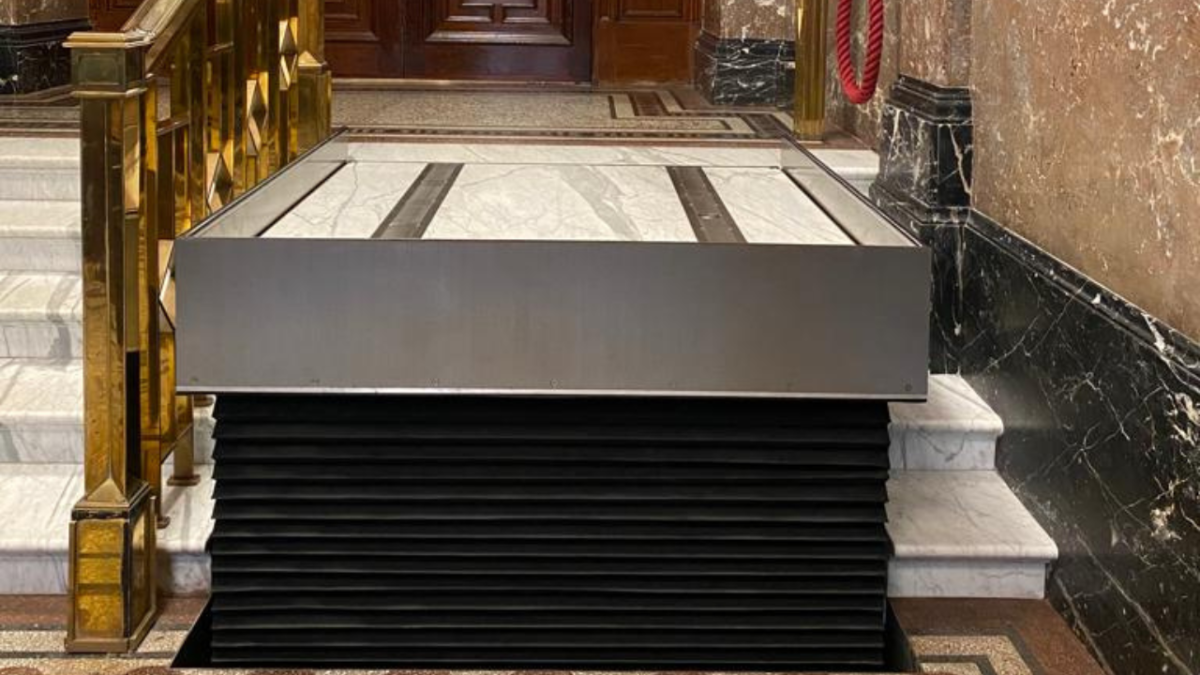
Concealed step lifts for listed buildings solve this by allowing the staircase itself to transform into a lift only when needed.
This approach mirrors the principles used in the Heritage Garden Hidden Lift Design framework, where landscape, steps and platforms remain visually unchanged until activated.
What is a concealed step lift for heritage buildings?
A concealed step lift is a DDA-compliant lifting platform that is hidden within the staircase structure. When not in use, it functions as normal steps. When activated, the steps retract and a platform rises to transport the wheelchair user.
This provides:
-
Unassisted heritage accessibility
-
Zero visual impact when idle
-
Full compliance with BS 6440:2011
-
Compatibility with conservation-area approval
-
Compatibility with Building Regulations Part M
This approach is widely used across UK heritage lift installations where visual and architectural preservation is mandatory.
Which Sesame Access system is best for the lower heritage steps?
For rises under 1000 mm, the most compact and discreet option is the Wellington Lift, also known as the Buckingham system.
This uses:
-
Vertical retracting stairs for rises under one metre
-
A hidden lifting platform
-
A 100 mm BS 6440 toe-guard to prevent wheel roll-off
-
Stone or metal treads matched to the historic steps
When not in use, the steps appear identical to the surrounding heritage stonework.
This makes it ideal for concealed step lifts for listed buildings across England, Scotland and Wales.
When do standing users require a different system?
Under BS 6440:2011, standing users require full 1100 mm high containment on the lifting platform.
This is provided by the Westminster Equality Act Lift, which uses:
-
Horizontally retracting stairs
-
Rising safety barriers
-
Full enclosure for standing and seated users
-
DDA-compliant protection
This allows the lift to be left operational at all times, making it suitable for public memorial venues where staff-free use is required.
How can heritage doors be used as the safety barrier?
Where a historic doorway exists at the top landing, Sesame can use the closed door as the 1100 mm safety barrier.
This allows a Wellington Lift to:
-
Rise to the closed door
-
Use the door leaf as the containment barrier
-
Avoid installing a visible rising balustrade
-
Preserve the historic frame and stonework
This technique is widely used in UK heritage lift installations to reduce both cost and visual impact.
How are drainage and weather handled in UK climates?
All external concealed step lifts are designed for British weather conditions using:
-
Gravity-fed drainage channels
-
Weather-rated hydraulics
-
Non-slip BS 7976-compliant treads
-
Frost-protected pits
Where possible, power packs and control cabinets are located inside the building to protect them from moisture and simplify maintenance.
How are fire escape routes kept compliant?
Under UK fire strategy and BS 9999 guidance, concealed step lifts can be installed on escape routes if they include:
-
UPS battery backup
-
Automatic step-return on power failure
-
Emergency override switches
-
“Lift in use” warning signage
This ensures the escape stair is restored if the lift is deployed during a fire event.
Wellington vs Westminster: Which heritage lift?
| Feature | Wellington Lift | Westminster Equality Act Lift |
|---|---|---|
| Max rise | Up to 1000 mm | Up to 3000 mm |
| Standing users | No | Yes |
| Barrier type | 100 mm toe-guard | 1100 mm full enclosure |
| Stair movement | Vertical retracting | Horizontal retracting |
| Pit depth | Shallow | Deeper |
| Cost | Lower | Higher |
| Best use | Staff-managed heritage access | Fully unassisted public access |
Can side entrances use permanent platform lifts?
Yes. Where a side elevation allows a visible lift, options include:
-
The architectural Windsor Lift
-
The minimal-visual-impact Waterloo Lift
These are often used in secondary access routes to supplement concealed step lifts at main heritage entrances.
Frequently Asked Questions
Can you install wheelchair lifts in Grade I listed buildings in England, Scotland or Wales?
Yes. Sesame Access specialises in conservation-area approved, concealed step lifts for listed buildings across the UK.
How do concealed step lifts stay compliant with BS 6440 and Part M?
They provide the required platform sizes, toe-guards or 1100 mm barriers depending on whether seated or standing users are accommodated.
Can wheelchair users enter heritage museums without staff assistance?
Yes. Systems like the Westminster Equality Act Lift allow fully unassisted heritage accessibility.
Do hidden stair lifts work outdoors in UK weather?
Yes. They are designed for rain, frost and debris using drainage, sealed hydraulics and non-slip finishes.
Are concealed lifts acceptable to conservation officers?
Yes. Because they preserve the historic façade and only appear when used, they are frequently approved in conservation areas.
Next Step
If you are planning unassisted heritage accessibility for a memorial, museum or listed building in the UK, the geometry of your steps and doors determines the correct concealed lift solution.
Book a Teams Meeting with a Sesame Project Manager to review your building and receive concept drawings.