
Key Takeaways
-
Listed and heritage buildings often prohibit drilling or fixings into protected façades.
-
Historic thresholds and projecting stonework can introduce hidden crash hazards for platform lifts.
-
Freestanding glass protection removes these risks without altering the building fabric.
-
This approach reduces mechanical complexity while improving long-term reliability.
-
Early engineering decisions can shorten conservation approval timelines.
Introduction: Why Heritage Buildings Require Non-Invasive Safety Solutions
Protected buildings are governed by conservation controls designed to prevent cumulative damage to historic fabric. Even small fixings can be refused where façades, thresholds, or stonework are original or structurally sensitive.
When accessibility improvements are required, engineers must resolve modern safety requirements without altering the building itself. This article explains how non-invasive glass protection can eliminate lift crash hazards while remaining fully compatible with conservation expectations.
For broader context on heritage-led accessibility thinking, see heritage accessibility lift design considerations.
Why This Method Emerged: Engineering Under Conservation Constraints
This engineering approach developed from repeated real-world constraints encountered on listed and landmark buildings. Traditional solutions, such as façade-fixed guards or safety-edge systems, were often considered inappropriate where original thresholds had survived for centuries.
Rather than adding more monitored components, the design objective shifted toward removing the hazard entirely. The result was a freestanding framework that could support protective elements independently of the historic structure.
This method aligns with conservation principles by remaining reversible, visually discreet, and structurally independent.
The Problem: Overhanging Thresholds Create Impact Risk
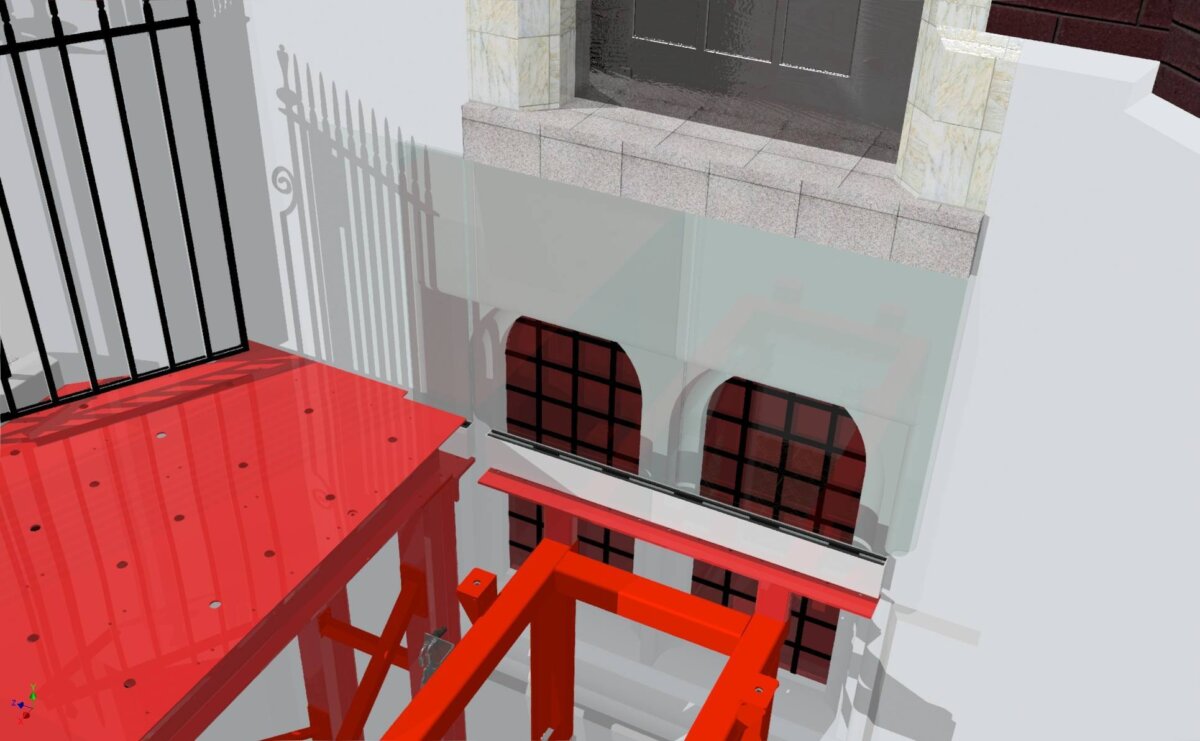
Many historic entrances include projecting stone or timber thresholds extending 35–60mm beyond the façade line. When a platform lift travels upward past this point, the projection becomes a potential impact hazard to the platform, barriers, or user space.
The challenge is not the lift itself, but the interaction between modern movement and historic geometry that cannot be altered.
Decision Framework: When Glass Protection Is Required vs Optional
Glass protection is typically required when:
-
Threshold or door overhang exceeds 1.5mm or 5mm but with a 15 degree chamfer as per BS 6440:2011
-
The threshold cannot be modified due to listing
-
Multiple safety-edge zones would otherwise be required
-
Conservation conditions restrict mechanical systems near original fabric
Glass protection may be optional when:
-
Thresholds can be modified with consent
-
A single monitored safety zone is sufficient
Cost implications are typically a 15–20% increase in framework fabrication. Importantly, this decision must be made before lift manufacture begins, as retrofitting is rarely practical.
The Solution: Freestanding Glass Protection Without Building Fixings
Instead of attaching protection to the façade, a structural framework is designed beneath and around the lift. Laminated glass panels are clamped into this framework and positioned directly beneath the overhang.
All impact loads are transferred into the lift chassis and landing structure, completely isolating the historic fabric. This removes the crash hazard without relying on sensors, switches, or façade-mounted components.
Engineering Validation Points
Typical engineering parameters considered during validation include:
-
Laminated glass specification, typically a minimum of 8.8.4 for impact zones
-
Maximum unsupported cantilever spans of approximately 600mm
-
Vertical loads transferred through the lift chassis
-
Lateral loads resolved through the landing framework
While this approach typically adds 2–3 days to the design phase, it often eliminates 6–8 weeks of conservation negotiation compared with façade-fixed alternatives.
Common Misconceptions
Glass protection is purely cosmetic.
In reality, the glass acts as a structural crash barrier designed to resist defined impact loads.
This only works on flat façades.
Because the framework is independent of the building, it can accommodate curved, stepped, or irregular historic stonework.
Conservation officers prefer invisible solutions.
Transparent protection is often preferred because its function and failure modes are visually obvious, unlike concealed mechanical systems.
Trade-Offs Architects Should Know
This solution typically requires 150–200mm of framework depth beneath the lift and effectively locks in the threshold geometry, meaning future changes must work around the installed system.
Product Integration Summary
This approach is commonly delivered using Sesame’s heritage and bespoke platforms, including:
-
Windsor Lift – discreet platform lift for heritage buildings
-
Buckingham Listed Building Lift – designed for protected façades
-
Westminster Equality Act Lift – compliance-led access solutions
-
Bespoke Lift – engineered for complex conservation constraints
A related example of careful integration within a highly sensitive setting can be seen in the British Library platform lift integration.
Frequently Asked Questions
Can glass protection be installed without touching a listed building?
Yes. The framework supports the glass independently of the façade, avoiding any fixings into protected fabric.
Why not just use safety edges?
Safety edges introduce additional mechanical systems that require monitoring and long-term maintenance. Glass protection removes the hazard entirely.
Will conservation officers accept this approach?
In many cases, yes. The solution is non-invasive, reversible, and visually discreet.
Does this affect lift reliability?
Removing additional monitored systems can improve long-term reliability and simplify servicing.
Talk to a Project Manager
If you are working with a protected building and need early engineering clarity, book a Teams meeting with one of our Project Managers: