Key Takeaways
-
Selecting the right platform lift for a commercial building depends heavily on pit depth, rise height, operational needs and architectural constraints.
-
Early clarification of pit depths and surrounding structures helps determine whether a custom solution like the Windsor Lift, Waterloo Lift, or Jubilee Disabled Access Lift is the best technical fit.
-
Bespoke lifts allow seamless architectural integration, especially in heritage, public-facing and sensitive environments.
-
Clear coordination between architects, contractors and lift designers prevents rework and accelerates approvals.
-
Pit depth directly determines concealment, neatness, and mechanical configuration, making it the single most important early-stage design parameter.
Introduction
Commercial and mixed-use buildings often require multiple platform lifts, each designed around unique rise heights, pit depths and architectural conditions. This article distils practical guidance from real design coordination work to help architects, contractors and project managers identify the correct lift type for each location. It also highlights how Sesame Access adapts every lift to suit the building’s structure, finishes and accessibility goals.
To explore further coordination principles, you can also review our Knowledge Hub articles on Coordinating Bespoke Lift Installations and Heritage Lift Installation Challenges.
How do pit depth and rise height determine which lift you can use?
Pit depth is the decisive factor when choosing a bespoke platform lift. Different models require different mechanical envelopes, meaning a precise early measurement prevents incorrect assumptions later in design.
Here is a clear breakdown of the most common pit depths and what each enables:
-
150 mm pit depth
Suitable for compact solutions like the Trafalgar Access Lift Ideal for rises between 200–500 mm where a shallow recess is required. -
210 mm pit depth
Supports short-rise lifts and offers a balance between shallow recessing and more sophisticated concealment options like the Jubilee Disabled Access Lift. -
450 mm pit depth
Works for rises up to around 650 mm. This depth is often used when the goal is a partially concealed platform without deep structural modification. -
650 mm pit depth
Suitable for rises above 650 mm and enables the use of bellows or a solid skirt. This is the standard requirement for the Windsor Lift. -
1000 mm (1 metre) pit depth
Required for premium retracting systems or lifts with integrated rising barriers. Also used when accommodating standing-user retractable stair systems. -
1650 mm pit depth
Needed for full retracting staircases with rising barriers where the lift mechanics store beneath the flight.
Pit Depth Selection Table
This table helps answer the key technical query: “Which lift can I use for my pit depth?”
| Pit Depth Available | Compatible Lift Models | Typical Rise Height | Notes |
|---|---|---|---|
| 150 mm | Jubilee Disabled Access Lift | 200–500 mm | Best for restricted slabs and shallow recesses |
| 210 mm | Jubilee variations / shallow bespoke lifts | 300–600 mm | Allows neater integration than 150 mm |
| 450 mm | Mid-rise custom platforms | Up to ~650 mm | Suitable for semi-concealed designs |
| 650 mm | Windsor Lift | Up to 1400mm | Supports bellows or solid skirts; high architectural finish |
| 1000 mm | Retracting stair systems (standing & seated) | 0–1000 mm | Advanced mechanics; requires deeper structural zone |
| 1650 mm | Full retractable staircases | Up to 3000mm | Needed for rising barriers and fully disappearing stair flights |
When is the Windsor Lift the right solution?
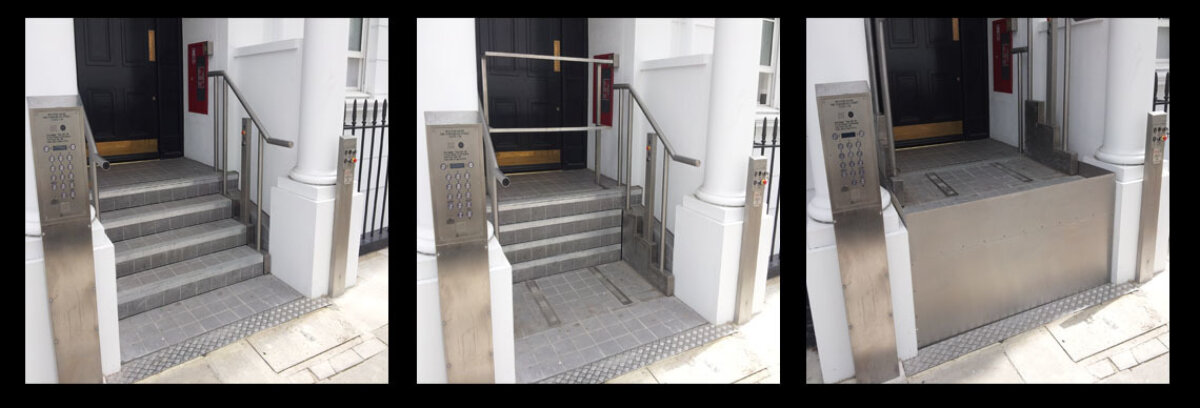
The Windsor Lift is recommended when the lift sits on a primary circulation route and must support both seated and standing users independently. It is commonly used for rises between 650–1400mm and requires a 650 mm pit depth.
Because each unit is bespoke, the Windsor Lift can be adjusted to match walls, handrails, reception areas or architectural junctions. It also allows high-grade finishes that suit premium commercial entrances.
When is the Waterloo Lift more appropriate?
The Waterloo Lift is suited for seated-only applications, using a managed operation method such as a key switch, key fob or remote device. This reduces cost but requires oversight from building management.
It is not generally recommended for public routes unless a reception desk or concierge can supervise activation. However, it is ideal for staff entrances, controlled doors, or secondary building transitions.
Selecting a lift for shallow pits or constrained locations
Where pit depths are limited to around 150–210 mm, the available choice narrows to shallow bespoke platforms, including the Trafalgar Access Lift and the Jubilee Disabled Access Lift.
Shallow-pit lifts are practical for historic slabs, refurbished structures or locations where deeper excavation is not possible. While they may include fewer concealment features, Sesame Access adapts materials and finishes to ensure the lift integrates cleanly.
How Sesame coordinates multi-lift buildings
Many commercial buildings include up to 5–10 different lift locations, each requiring a tailored engineering solution. Sesame Access typically requests:
-
Updated GA drawings with the latest naming conventions
-
Confirmed pit depths at every lift position
-
Rise heights for internal and external transitions
-
Floor build-ups, wall alignments and surrounding finishes
-
Clarification on public, tenant or back-of-house use
-
Required operation type: seated-and-standing or seated-only
Once this information is received, the design team produces site-specific drawings for each lift, ensuring optimal alignment with walls, balustrades or structural openings. For further reading on this workflow, see our article on Coordinating Bespoke Lift Installations.
Why bespoke lifts outperform off-the-shelf platform lifts
Off-the-shelf lifts often use plastic components, fixed-size enclosures and visible housings that cannot be tailored to the building. In contrast, Sesame Access designs each lift uniquely, which enables:
-
Millimetre-accurate alignment with stair geometry
-
Integration with architectural metalwork or stone
-
Use of matching finishes to blend into the surroundings
-
Reduced visual impact in heritage spaces
-
Enhanced reliability and safety compliance
For examples of how these considerations apply in heritage contexts, see Heritage Lift Installation Challenges.
Expanded Frequently Asked Questions
What pit depth does a Windsor Lift require?
Approximately 650 mm, suitable for rises between 650–1400 mm.
What pit depth is needed for a Jubilee Lift?
210 mm
Can I install a platform lift with only 200 mm pit depth?
Yes, shallow bespoke platforms or Jubilee configurations can be used.
What’s the difference between Windsor and Waterloo lifts?
Windsor supports standing and seated users; Waterloo is seated-only with managed access.
Are seated-only lifts appropriate for public routes?
Generally no, unless staff supervision is available.
Can platform lifts be installed externally?
Yes, all Sesame lifts can be adapted for external environments with suitable finishes.
Can I change the sides or remove glass?
Yes, glass can be replaced with solid walls if the lift sits against a structural surface.
How long do bespoke lifts take to manufacture?
Typically around six months including design approvals.
Are retractable stair lifts suitable for tight spaces?
Yes, but require pit depths between 1000–1650 mm depending on the rise.
Do lifts need power-off supervision?
Only seated-only systems like Waterloo; Windsor lifts allow independent operation.
Book a Design Meeting
To discuss your project with one of our Project Managers, please schedule a Teams meeting:
https://www.sesameaccess.com/book-a-meeting