Key Takeaways
-
Phase 1 established the technical feasibility of a new compact traversing lift using a single scissor lift architecture.
-
A deeper pit depth of approximately 548–550 mm enables a total rise of around 850 mm while reducing overall platform width and length.
-
Vertical stacking of sliders, actuators, and safety systems allows a significantly narrower footprint than existing traversing solutions.
-
The concept is designed to address access challenges in highly constrained architectural environments where existing lifts cannot be specified.
-
This article forms Phase 1 of a multi-stage R&D programme that will progress through detailed design, testing, and certification.
Introduction: Why develop a new traversing lift?
Many access challenges arise in buildings where space constraints make conventional platform lifts impractical. Narrow doorways, shallow stair voids, and protected architectural features often limit what can be installed without major alteration.
Phase 1 of this development programme explored whether a traversing lift could be made narrower and shorter than existing solutions while still delivering meaningful vertical rise. Rather than refining a current product, this phase focused on rethinking geometry, pit depth, and component placement from first principles.
This article documents the engineering foundations of that work and forms the first chapter in a transparent R&D series that will track the product from feasibility through to certification.
What problem is this new lift designed to solve?
The new traversing lift is intended to solve access problems where both width and length are restricted but increased pit depth is achievable. These conditions frequently occur in heritage properties, compact commercial entrances, and retrofit scenarios where widening structural openings is not permitted.
Existing Sesame Access solutions such as the Traversing Lift, Wellington Lift, and Pimlico Lift already address many complex sites, but Phase 1 identified a gap where an even more compact traversing solution would be beneficial.
How does a deeper pit increase lift capability?
A deeper pit allows vertical stacking of mechanical components, reducing the lateral space required by the lift.
By increasing pit depth to approximately 548–550 mm, the design unlocks around 850 mm of total vertical rise while keeping the platform footprint compact.
This approach shifts complexity below floor level rather than spreading it across the plan, which is often preferable in architecturally sensitive environments.
Why was a single scissor lift chosen for this design?
A single scissor lift offers a more compact and predictable geometry than low-profile or double scissor configurations.
Phase 1 confirmed that a single scissor lift, combined with dual hydraulic rams, provides sufficient stability while allowing the platform length to be reduced.
This stability-first approach draws on lessons learned from compact stair-integrated systems such as the Wellington Lift, where lateral movement must be tightly controlled.
How are sliders, actuators, and safety systems integrated more efficiently?
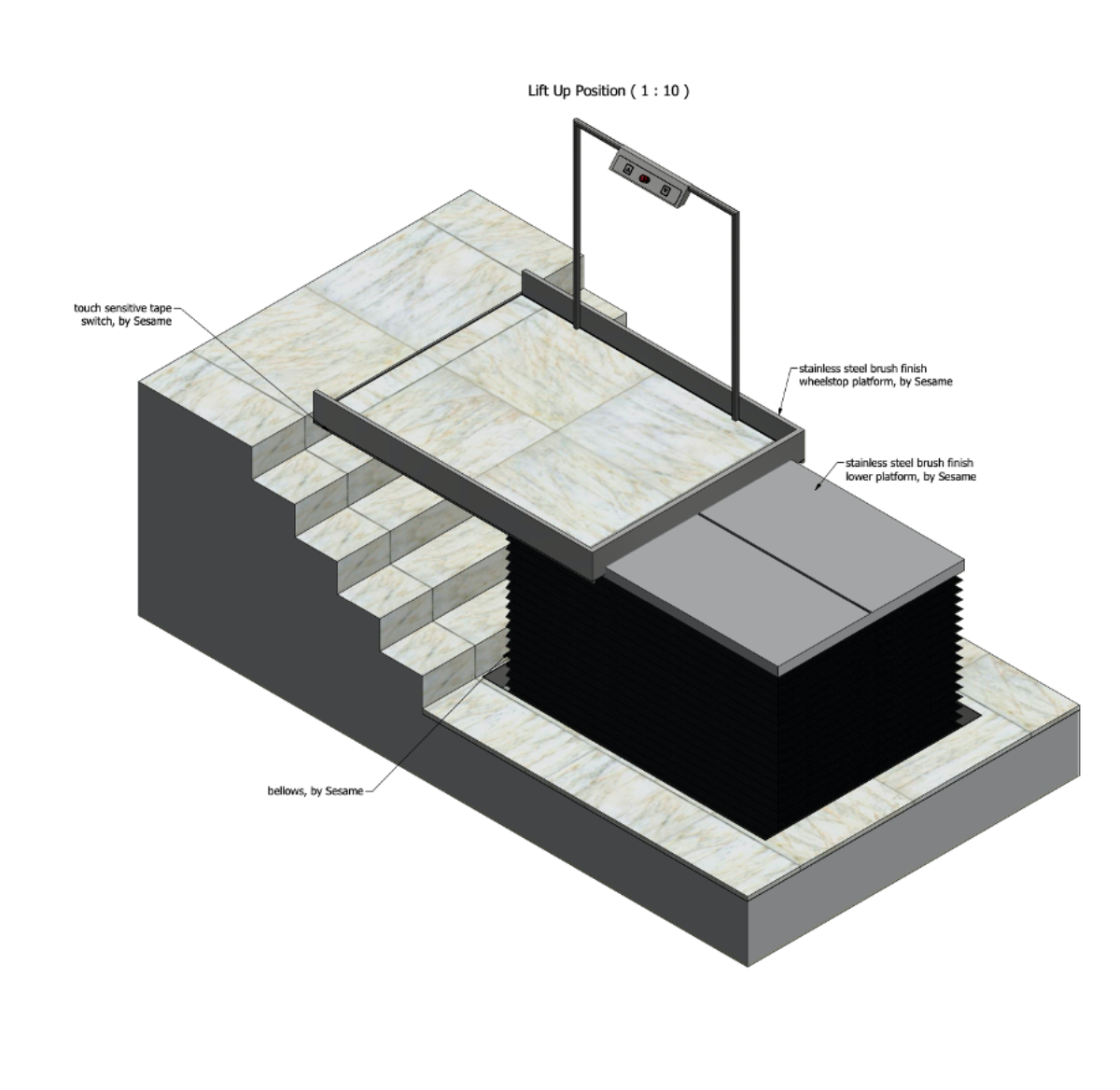
The new concept relocates slider mechanisms, actuators, roller shutter blinds, and tape switches above the scissor lift rather than beside it.
This vertical layering strategy reduces overall width to approximately 830 mm while maintaining a usable internal platform width of around 800 mm in line with standards BS 6440:2011.
This principle mirrors the discreet engineering strategies used in the Pimlico Lift, where minimal visual and spatial impact is essential.
What technical benchmarks were achieved in Phase 1?
Phase 1 achieved several measurable technical milestones that define the feasibility envelope of the concept:
-
Pit depth target refined to approximately 548–550 mm
-
Total vertical rise unlocked at approximately 850 mm
-
Minimum overall lift width established at approximately 830 mm
-
Usable internal platform width of approximately 800 mm
-
Platform length reduced while retaining functional usability
-
Improved stability through a dual-ram single scissor configuration
These metrics form the baseline for detailed CAD development in later phases.
How does this lift compare with existing Sesame Access solutions?
The table below shows how the Phase 1 concept differs from existing Sesame Access products. All figures for the new lift reflect early feasibility findings and will be refined in later phases.
| Feature | New Traversing Lift (Phase 1) | Traversing Lift | Wellington Lift | Pimlico Lift |
|---|---|---|---|---|
| Overall width | ~830 mm | Wider | Stair-dependent | Project-specific |
| Platform length | Shortened | Longer | Stair-integrated | Compact |
| Pit depth | ~548–550 mm | Shallower | Variable | Variable |
| Typical rise | ~850 mm | Lower per footprint | Stair rise dependent | Project-specific |
| Primary advantage | Extreme compactness | Shallower pit depth | Discreet stair integration | Minimal visual impact |
This comparison helps clarify when the new concept is more appropriate than existing products.
When should architects specify this new traversing lift?
Architects should consider this lift when facing access questions such as:
-
How can wheelchair access be achieved through narrow Georgian townhouse doorways without widening the opening?
-
What lift solution works within listed building stair voids where plan space is limited but excavation is possible?
-
How can a constrained commercial entrance hall gain step-free access without visually dominant equipment?
-
What option exists when horizontal traversal is needed but standard traversing lifts are too wide?
By directly addressing these scenarios, the new design complements the broader Sesame Access portfolio rather than replacing it.
How does this development align with industry standards and compliance?
This project is being developed with early consideration of UK accessibility and safety frameworks. Relevant guidance includes:
Embedding these references at Phase 1 ensures that later design stages remain aligned with regulatory expectations.
How does this R&D work with consultants and international partners?
Early-stage product development benefits from collaboration with consultants and delivery partners. Sesame Access regularly works alongside lift consultants and access specialists, as outlined in the guide to lift consultant partnerships with access lift companies.
For international projects, this collaborative approach extends through trusted global relationships, described in detail in the overview of how Sesame Access works with international lift partners to deliver bespoke lifts worldwide.
This ensures that new products are designed not only for UK use but also for scalable international delivery.
What happens in Phase 2 of this project?
Phase 2 will move from feasibility into detailed design and validation.
This will include refined CAD layouts, tolerance modelling, component finalisation, and early cost confirmation.
As the project progresses, readers will be able to follow the next chapter through a dedicated link to Detailed CAD Refinement in Phase 2, establishing a clear R&D narrative across the Knowledge Hub.
Frequently Asked Questions
What is a traversing lift?
A traversing lift combines horizontal movement with vertical lifting to overcome stairs or level changes where a straight vertical lift is not possible.
Why increase pit depth instead of width?
Increasing pit depth allows components to be stacked vertically, reducing the visible footprint and preserving architectural features.
Is this lift suitable for listed buildings?
The design principles are specifically aimed at heritage and architect-led environments where space and visual impact are tightly controlled.
Will this replace existing Sesame Access lifts?
This lift is intended to complement existing products by addressing a narrow set of constraints not currently covered.
When will this lift be available?
This article documents Phase 1 only. Availability will depend on the outcomes of subsequent design, testing, and certification phases.
Next Step: Discuss your project
If you are working on a project with severe space constraints and want to explore whether this emerging solution could apply, you can book a Teams meeting with a Sesame Access Project Manager to discuss feasibility and early design considerations.