Key takeaways: Accessible entrance access when ramps won’t work
-
A ramp was explored, but the gradient and uneven levels made it impractical for safe wheelchair access.
-
The fastest way to protect programme is to map a few viable lift layouts early, because the “obvious” position often fails once structural coordination begins
-
A compact concealed platform lift can work well for seated users, but standing-user compliance typically requires deeper pits and visible rising barriers
-
Public realm permissions and door/threshold coordination usually control the critical path more than fabrication does.
Introduction: A people-first access upgrade for a tight, uneven entrance
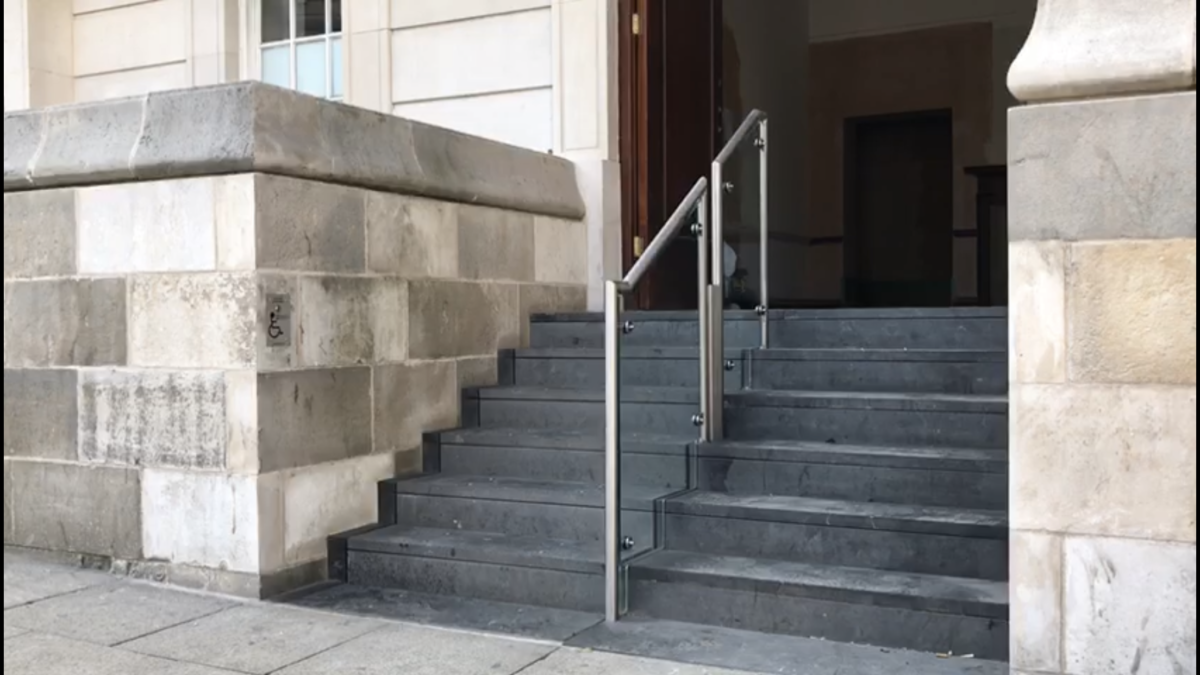
This enquiry started with a straightforward need: a wheelchair user must be able to enter an office building safely and with dignity. The complication was equally familiar: external steps, a tight approach, and uneven levels that made a compliant ramp unrealistic.
The client team asked Sesame Access for an overview of what’s feasible, what the next steps are, and how the timeline can work alongside an occupancy deadline.
Why most entrance access projects fail at feasibility stage
Most entrance access projects fail early because the first-choice location is selected visually, not structurally. In 60% of enquiries we receive, the first-choice location proves unviable once structural coordination begins, our role is to map all three viable options before formal appointment.
Typical “non-obvious” blockers include drainage fallback paths that force pit repositioning, waterproofing continuity at the threshold plane, door automation conflicts with lift dwell time, and unknown services below the pavement that prevent excavation where everyone assumed the pit would sit. Another common issue is external stair geometry: finishes that look acceptable on static stairs can become a safety hazard when steps move, such as overhanging ball-nose treads creating toe-trapping zones as the stairs travel.
What was the real access problem at the entrance?
The project team had already gathered drawings and levels and quickly identified that a ramp concept would not work. One comment captured the core constraint: “the levels are just all over the place.”
The site also had a public realm approach surface that made getting to the lift area itself more difficult, so the access solution needed to consider the approach route, not just the steps.
For a broader view on why “ramps-first” thinking can unintentionally exclude people, see Inclusive design beyond ramps: when steps need smarter solutions.
Why was a ramp ruled out?
The ramp was rejected because the gradient would be too steep and the surrounding levels were inconsistent. The client described it simply: “we had thought we might be able to put a ramp in… but it will be too steep.”
Even when there is theoretical run length, real entrances often fail on crossfalls, transitions, drainage features, and landing clearances, creating more barriers than the original steps.
Permissions vs geometry: what decides the best option?
This enquiry came down to a practical trade-off:
-
If the local authority will allow use of public space beyond the bottom step line, the straight-line solution is typically the simplest and most cost-efficient.
-
If that space cannot be used, the design often pivots to a rotated configuration that stays within the building boundary while keeping platform usability compliant.
This was stated clearly in the discussion: the simplest option is achievable “if you get approval from the council” for the space in front of the steps.
What lift solutions did Sesame propose for this enquiry?
Option 1: Straight-line concealed entrance lift (permission-led)
If public realm permission is possible and the footway width remains acceptable, a compact concealed platform lift is often the quickest route to a high-quality result.
Relevant product: Wellington Lift concealed platform lift for entrance steps
Key feasibility note from the call: this option typically needs around 1.4m depth beyond the top step riser, which is why permissions and width checks are essential.
Option 2: 90-degree rotated platform to fit tight depth (geometry-led)
Where the straight-line depth is not available, Sesame can rotate the platform 90 degrees so the required clearances work left-to-right instead of front-to-back.
This is directly supported by the transcript: “we turned the lift 90 degrees… British Standards BS6440 2011 will allow for a 90 degree turning lift as long as the platform sizes are 1100mm x 1400mm.”
Relevant product: Wellington Lift with 90-degree turning layout
Option 3: Part-internal pit strategy (coordination-led)
Where external space is extremely constrained, one advanced route is to bring part of the platform/pit geometry inside the threshold line, reducing public realm impact.
This option increases interface complexity because waterproofing and drainage become critical at the threshold plane. The transcript calls this out: part of the pit can be “part exposed… to the water and the rain that will get in there,” so the design must be coordinated carefully.
Relevant product: Bespoke Lift for complex threshold interfaces
If your project needs a clear responsibilities map across architect, structural engineer, main contractor and specialist trades, see Coordinating a bespoke lift: what each team needs to deliver.
Standing vs seated users: why compliance changes the product
A crucial safety point in this enquiry was user profile.
The transcript states: “The lifts that I’ve shown you are for seated users only. They’re not for standing users… Standing user lifts are very different.”
For standing users, the meeting highlighted the knock-on impacts: taller barriers, deeper pit requirements, and more visible elements. It also referenced that rising barriers can drive pit depth requirements to around 1.6m.
Related products depending on the brief:
-
Seated-user concealed access: Wellington Lift concealed platform lift
-
Equality-led access strategies where the operational brief is broader: Westminster Equality Act Lift for discreet inclusive access
Engineering Reality Check: why stair tread details matter on moving steps
This enquiry included a detail that many teams miss until late stage: tread profiles.
The discussion notes that overhanging ball-nose treads can create a toe-trapping zone as moving steps travel, which is why Sesame recommends a square riser-to-tread setup where steps move.
This is a small design decision with outsized safety impact, and it’s exactly why feasibility needs to consider both compliance and real-world user interaction.
When a platform lift is the wrong answer for your entrance
If any of the following are true, a platform lift may be the wrong first move and you should explore alternative circulation changes or a different access route:
-
If there is less than 800mm clear width at the threshold, platform sizing and guarding may push you toward a very different (and more visible) standing-user solution.
-
If your programme is under two months and approvals are uncertain, the permissions pathway can become the critical risk gate.
-
If below-ground constraints are unknown and you cannot commission service detection or trial pits early, the pit location assumption can fail late.
-
If your operational model cannot tolerate temporary door shutdown during lift use, you may need a different configuration or a different entrance strategy.
What architects misunderstand about entrance platform lifts
Misconception 1: You can always fit a compliant ramp if you extend the run length
Reality: ramps often fail on real-world levels, approach surfaces, and transitions. This enquiry is a direct example: the ramp was ruled out because it would be too steep and levels were inconsistent.
Misconception 2: The straight-line platform layout is always the best
Reality: if you don’t have the depth, rotating the lift can unlock compliance. This was specifically discussed with the 90-degree turning solution under BS 6440.
Misconception 3: Hidden lifts work the same for standing and seated users
Reality: seated-user toe-guard style solutions are not intended for standing users under the post-2011 approach discussed in the call. Standing-user compliance typically demands higher guarding and deeper pits.
Misconception 4: Planning is the only consent that matters
Reality: for entrances interacting with public realm, the controlling consent can be highway/public realm approval for encroachment beyond the step line.
Misconception 5: External steps are “just finishes”
Reality: moving step systems can introduce toe-trapping risks if tread details are wrong, such as ball-nose overhangs.
What actually controls your delivery timeline
Weeks 0–3: Feasibility and option selection
Confirm whether public realm permission is viable, measure the available depth/width, and select the best of three workable layouts.
Weeks 4–12: Permissions pathway
If public realm encroachment is involved, local authority approvals can become the pacing item. If a planning submission is needed, the call discussed using that window to progress detailed design rather than pausing.
Weeks 8–20: Detailed design and builders-work coordination
Coordinate pit formation, power, conduits, cladding interfaces, door automation, and any UPS/fire alarm integration. The transcript makes clear that Sesame supplies and installs the lift system, while the main contractor delivers pit, conduits, power and making-good.
Weeks 20–28: Fabrication and site enabling works
The transcript referenced a typical seven-month lead-in from order, while also noting that early-stage work can “knock off” weeks when the process is structured correctly.
Frequently Asked Questions (FAQ)
Can you install a wheelchair lift when a ramp is too steep?
Yes. In this enquiry, the ramp was ruled out early and a concealed platform lift strategy was used to map workable options.
How much clear space do you need in front of entrance steps?
It depends on configuration. A straight-line layout often needs around 1.4m depth beyond the step line, while a 90-degree turning configuration can shift that requirement side-to-side.
Do you always need planning permission for an entrance platform lift?
Not always, but if any part affects public realm space, the local authority permissions pathway can become the controlling approval route.
Are concealed “toe-guard” lifts suitable for standing users?
No. The transcript explicitly states the solutions shown were for seated users only, and standing-user lifts are fundamentally different in guarding and pit requirements.
What’s the best wheelchair lift for a tight office entrance with steps?
A compact concealed platform lift is often the best balance of usability and aesthetics, particularly when ramp geometry fails and permissions can be secured.
Can a platform lift be installed if the approach surface is cobbled or uneven?
Often yes, but the approach route must be part of the access strategy, not an afterthought. This enquiry specifically highlighted the approach surface as a practical barrier.
What is a 90-degree turning platform lift and when is it used?
It is a configuration where the platform orientation is rotated to fit constrained depth, and it can be compliant under BS 6440 when platform usability is maintained.
Who is responsible for pits, drainage and builders work on a platform lift?
Typically the main contractor delivers pits, drainage, conduits, power, and making-good. Sesame supplies and installs the lift system and provides builders-work requirements and interface information. s
Next step: book a Teams feasibility meeting
If you can share existing drawings, levels, and photos of the entrance and approach route, Sesame can quickly confirm which of the three options is most feasible and what approvals and coordination you’ll need.
Book a Teams meeting with a Sesame Project Manager: https://www.sesameaccess.com/book-a-meeting