
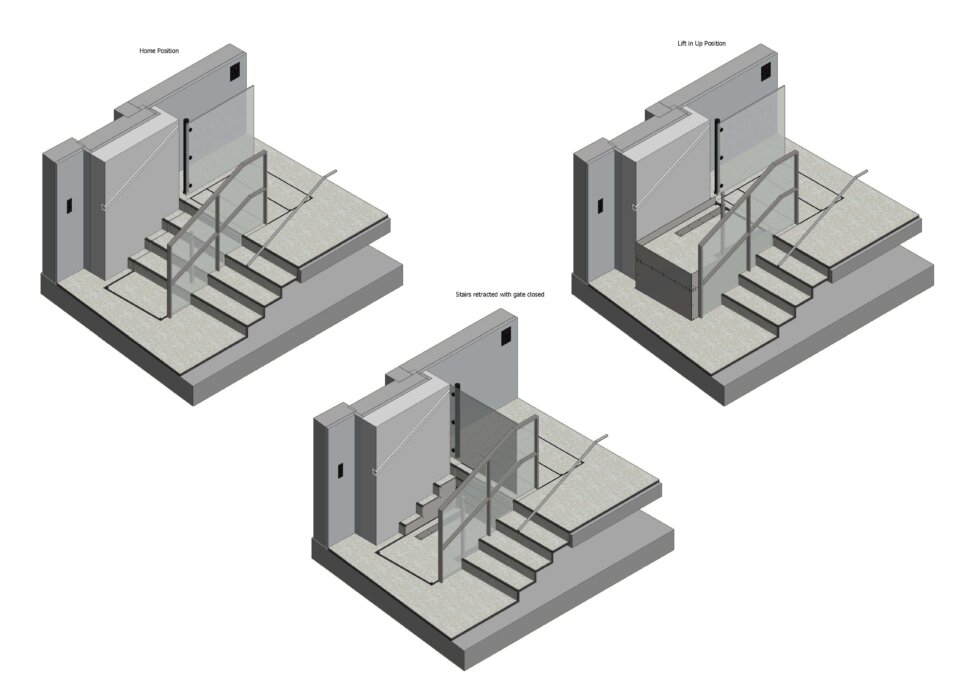
What is the Regent Wheelchair Platform Stairlift?
The Regent is a horizontal retracting stairlift that reveals a hidden seated-use platform lift beneath the steps. It includes a toe guard below the platform and a gate at the upper landing. This upper landing gate is the defining feature that differentiates the Regent from other Sesame products such as the Mayfair Stairlift.
How is the Regent different from the Mayfair Stairlift?
The Regent uses a solid gate at the upper landing, whereas the Mayfair Stairlift uses a rising barrier. The rising barrier on the Mayfair drops 1.6 metres below the upper landing, which means the Mayfair requires significant clear space under the upper landing. The Regent does not require this 1.6-metre pit below upper landing, making it suitable where space beneath the upper landing is obstructed.
Link to the Mayfair Stairlift: https://www.sesameaccess.com/lifts/mayfair-stairlift
Why would I choose the Regent instead of the Mayfair?
You would select the Regent when space under the upper landing level is limited or obstructed. The Mayfair requires a deep space below the upper landing for its rising barrier to retract, whereas the Regent’s gate design eliminates that requirement. This makes the Regent suitable for listed buildings, heritage entrances and locations with structural restrictions.
Does the Regent comply with BS 6440:2011?
Yes. The Regent’s solid upper landing gate provides full compliance with BS 6440:2011. Both the Regent and the Mayfair are legally compliant, but they follow different certification pathways. The Mayfair often uses the Machinery Directive Annex VIII route, while the Regent meets BS 6440:2011 directly through its gate design.
Does the Regent require deep pit space beneath the upper landing?
No. The Regent does not need the 1.6-metre pit space required for the Mayfair’s rising barrier. This is the primary practical reason to specify the Regent over the Mayfair.
Who is the Regent designed for?
The Regent is designed for seated wheelchair users only. It includes a toe guard and therefore is limited to a rise of up to 1 metre. Once a lift exceeds 1 metre of travel, British Standards require it to accommodate standing passengers, in which case the Westminster Lift is more appropriate:
https://www.sesameaccess.com/lifts/westminster-equality-act-lift
What if the client needs both seated and standing users?
You would not use the Regent for mixed seated and standing use. The correct product in that scenario is the Westminster Lift, which provides 1100 mm high barriers on the platform for mixed-user operation.
https://www.sesameaccess.com/lifts/westminster-equality-act-lift
How does the Regent compare to the Oxford Disability Lift?
The Regent and the Oxford are used in similar restricted-space projects. The Oxford Disability Lift includes a rising button post on the platform, whereas the Regent uses either a removable handheld post or a button station built into the handrails that travel with the lift.
Oxford Disability Lift: https://www.sesameaccess.com/lifts/oxford-disability-lift
Can the Regent be used internally and externally?
Yes. It can be installed internally or externally. For external installations, drainage is required.
Can the stairs be clad in any material?
Yes. The retracting stairs, treads, risers and upper landing can all be clad in any material suitable for the project. This includes heritage stone, tiles, timber, or architect-specified finishes.
What is the standard pit depth for the Regent using a mechanical wheel stop?
For rises up to 650 mm using a double scissor lift with a mechanical wheel stop, the minimum pit depth is approximately 470–480 mm for a rise up to 650mm. The pit depth increases proportionally with the rise, plus an additional 150 mm.
What is the pit depth when the Regent uses a double scissor lift?
A double scissor lift arrangement allows rises up to 1 metre. In this setup, the minimum pit depth is 650 mm.
Does Sesame offer a low-profile version of the Regent?
Yes. The Regent can be configured with a low-profile electric wheel stop system similar to those used on the Thames and Jubilee lifts. These options are used when pit depth at the lower landing is extremely limited.
Thames Lift: https://www.sesameaccess.com/lifts/thames-retracting-stair-lift
Jubilee Lift: https://www.sesameaccess.com/lifts/jubilee-disabled-access-lift
What are the pit depths for the low-profile Regent versions?
Single low-profile scissor lift:
• Rise up to 750 mm
• Pit depth: 210 mm
• Platform pit: 1696 mm long × 1389 mm wide
Double low-profile scissor lift:
• Rise up to 999 mm
• Pit depth: 210 mm
• Platform pit: 2256 mm long × 1484 mm wide
What space is needed for the retracting stairs?
All Regent stairlift variants require a stair pit approximately 1200 mm long. The width of the stair pit depends on the chosen platform size.
Is a separate pit required for the automatic gate?
Yes. An additional 1200 mm × 246 mm gate pit is required adjacent to the stair pit. This is used for the upper landing automatic gate mechanism.
Can the pit layout be stepped or varied?
Yes. Although the standard design uses a single-level pit, stepped pits or raised areas can be designed where required to suit existing site constraints.
What if the client does not want to see a gate at the upper landing?
If the gate is visually unacceptable for planning or heritage reasons, two alternatives exist:
-
Manual removable barriers (rarely preferred because they require manual placement by staff).
-
Using the existing landing doors as a barrier, provided the distance to the top step riser meets safety requirements.
If the gate is removed entirely, the correct product is usually the Kensington Lift:
https://www.sesameaccess.com/lifts/kensington-stairlift
Does the Regent ever use existing doors as the safety barrier?
Yes, if the existing doorway is close enough to the top step riser. Safety sensors can be fitted to monitor that zone to ensure no one is standing within the retracting-stair danger area. However, this configuration typically becomes a Kensington installation.
Kensington Lift: https://www.sesameaccess.com/lifts/kensington-stairlift
Which Sesame lifts are most closely related to the Regent?
• Mayfair Stairlift – same basic form but uses a rising barrier instead of a gate
https://www.sesameaccess.com/lifts/mayfair-stairlift
• Oxford Disability Lift – used in similar restricted-space layouts
https://www.sesameaccess.com/lifts/oxford-disability-lift
• Kensington Stairlift – used when a top-landing gate is not acceptable
https://www.sesameaccess.com/lifts/kensington-stairlift
• Westminster Lift – required for standing passengers or rises above 1 metre
https://www.sesameaccess.com/lifts/westminster-equality-act-lift