
Key Takeaways
-
Retracting stair lifts solve access challenges where fixed ramps or conventional lifts are not viable
-
Vertical retracting systems preserve original stair geometry while providing step-free access
-
Early GPR (Ground Penetrating Radar) surveys reduce risk from hidden utilities and vaults
-
Base-frame load distribution allows installation without overstressing historic structures
-
3D modelling significantly improves planning, compliance, and stakeholder approval
Introduction: Why Constrained Entrances Need a Different Access Strategy
Providing step-free access at historic or architecturally sensitive entrances often involves conflicting requirements. These can include outward-opening doors, limited landing depths, underlying vaults, and protected architectural features that cannot be altered.
In these situations, bespoke retracting stair lift systems offer a proven alternative to ramps and fixed platforms. By allowing the staircase itself to move vertically, access can be delivered without permanently altering the character, circulation, or proportions of the entrance.
This article explores how a problem-solving, workshop-led design process enables compliant access solutions using retracting stair technology.
The Core Challenge: Access Without Compromising Safety or Heritage
Many heritage entrances share the same constraints:
-
Outward door swing clearances that reduce usable landing depth
-
Minimum clear landing requirements immediately outside the doorway
-
Sub-ground vaults, basements, or service routes beneath the stairs
-
Utility routes identified through GPR site assessment
-
A need to maintain visual symmetry and original stair geometry
Traditional solutions often fail because they require permanent ramps, excessive excavation, or intrusive structural works.
Resolution Strategy: Vertical Retracting Stair Lift Systems
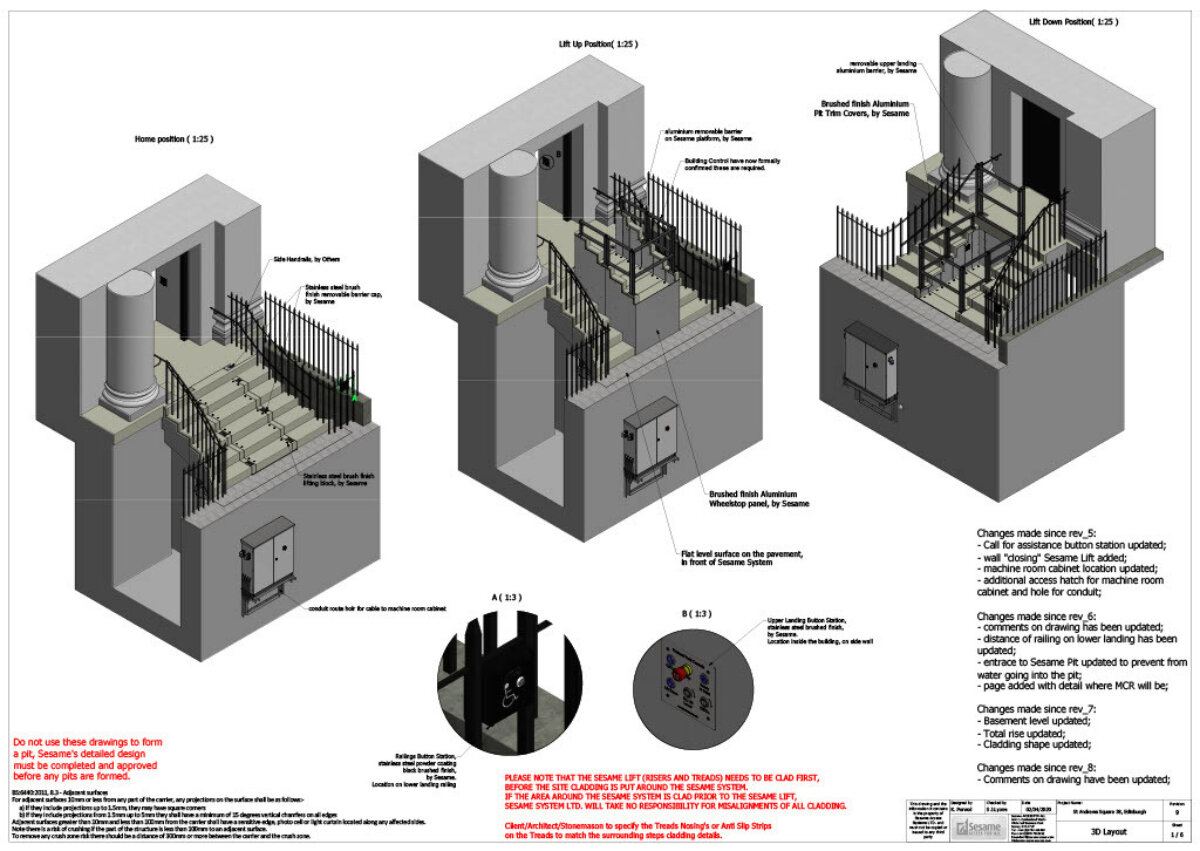
Vertical retracting stair systems allow the stair to function in two modes. When not in use, the entrance behaves as a conventional staircase. When activated, the stair rises or descends vertically to provide step-free access.
Solutions such as the Wellington Lift are designed specifically for these environments, offering:
-
Minimal pit depth compared to conventional lifts
-
Compatibility with outward-opening doors as long as the doors do not swing over the platform lift
-
Fully guarded movement with integrated safety logic
-
Preservation of original stair geometry and proportions
Case Study Logic: Balancing Door Swing and Landing Depth
A common design tension is balancing outward door swing clearance with minimum clear landing depth.
Problem:
Outward-opening doors reduce the available landing space in front of the threshold, increasing fall risk at the top of stairs.
Resolution:
By levelling the landing and integrating a shallow-rise platform element, finished floor levels can be aligned without introducing slopes directly outside the doorway. In some cases, a secondary lifting element such as the Westminster Equality Act Lift is used to fine-tune level changes while retaining stair alignment.
Managing Structural Vaults and Sub-Ground Constraints
Historic entrances frequently sit above masonry vaults or cellular voids. These conditions are identified early using GPR (Ground Penetrating Radar) surveys to detect:
-
Existing utilities
-
Service ducts and conduits
-
Structural voids requiring protection
Where vault intrusion must be avoided, Sesame systems use base-frame load distribution. Loads are spread across multiple bearing points, reducing point loads and avoiding overstressing historic fabric.
This approach also supports utility clash mitigation, allowing access solutions to be positioned clear of sensitive routes wherever possible.
Visual Validation Through 3D Modelling
2D drawings rarely communicate the spatial implications of moving stairs or lost circulation routes. For this reason, 3D modelling is integral to the design process.
As explored in 3D Staircase Visualisation for Architects, interactive models allow teams to:
-
Visualise stair movement and guarding zones
-
Confirm clearances at doors and landings
-
Assess changes to circulation routes
-
Present clear, regulator-ready proposals
This approach significantly reduces planning risk.
International Context: Retracting Stair Lifts Beyond the UK
The same principles apply internationally, particularly in regions with high architectural sensitivity and strict access requirements.
The Knowledge Hub article on Bespoke Retracting Stair Lifts in Saudi Arabia demonstrates how vertical retracting systems are adapted to complex civic and cultural buildings while meeting local regulations.
Design Considerations for Retracting Stair Lifts
Clearances and Landings
-
Typical minimum clear landing depth: 1200 mm
-
Preferred landing depth where doors swing outward: up to 1500 mm where achievable
-
No slopes should be introduced immediately outside door thresholds
Pit Depths
-
Typical pit depth range: approximately 205–1600 mm depending on rise
-
Shallow pits are achievable compared to conventional passenger lifts
Power Requirements
-
Single-phase or three-phase supply depending on duty cycle
-
Power and control equipment can often be located remotely to reduce visual impact
Structural Loads
-
Typical system weight: approximately 1.5–2.0 tonnes
-
Loads distributed via engineered base frames
-
Suitable for installation over basements and vaults subject to verification
Compliance and Regulatory References
Retracting stair lift systems are designed to support compliance with:
-
BS 6440:2011 – Safety requirements for powered lifting platforms
-
Building Regulations Part M – Access to and use of buildings
-
BS 8300 – Design of accessible and inclusive built environments
Early coordination with building control and access consultants is recommended to agree acceptable deviations where historic constraints apply.
Product Integration Summary
| Access Challenge | Suitable Solution | Key Benefit |
|---|---|---|
| Heritage stair preservation | Wellington Lift | Preserves original stair geometry |
| Door threshold level correction | Westminster Equality Act Lift | Fine level adjustment without ramps |
| High-use public entrances | The People’s Lift | Designed for frequent operation |
Frequently Asked Questions
What pit depth does a retracting stair lift need?
Typical pit depths range from 205–1600 mm depending on rise and configuration.
How long does installation take in a listed building?
Installation typically takes several weeks, depending on structural preparation and approvals.
Can retracting stair lifts be installed over vaults?
Yes, using base-frame load distribution to avoid overstressing vault structures.
Do retracting stair lifts work with outward-opening doors?
Yes, provided landing geometry and clearances are carefully designed.
Is GPR surveying required?
GPR surveys are strongly recommended to identify utilities and voids early.
Can the stairs still be used when the lift is not operating?
Yes, the stairs function normally when the lift is at home, stairs position.
Are retracting stair lifts compliant with BS 6440?
Systems are designed to support BS 6440 compliance when correctly specified.
What power supply is required?
Single-phase or three-phase supplies are used depending on duty and load.
How are safety risks managed during movement?
Through integrated guarding, interlocks, and controlled operation procedures.
Can these systems be used internationally?
Yes, systems are adapted to local regulations and standards.
Do retracting stair lifts require attendants?
Some installations use managed operation depending on risk assessment.
Can finishes be customised?
Yes, finishes are tailored to architectural requirements.
Are utility clashes a common issue?
They can be, which is why early utility clash mitigation is critical.
Is planning approval usually required?
In most heritage contexts, yes.
Speak to a Project Manager
If you are considering access solutions for a constrained or historic entrance, early technical discussion can prevent costly redesigns.
Book a Teams meeting with a Sesame Access Project Manager:
https://www.sesameaccess.com/book-a-meeting