Key Takeaways
Canadian platform lift planning for public buildings usually starts with the approval route and applicable standards, not the product itself.
CSA B355:19 places different safety expectations on platform lifts than BS 6440:2011, meaning toe-guard systems commonly used in UK low-rise applications are typically not accepted for public-use projects without additional barriers or approval.
Because local interpretation shapes compliance outcomes, early engagement with authorities such as TSSA is often essential when selecting barrier strategy and lift configuration.
Barrier strategy frequently determines which lift concepts are viable, particularly where requirements align with ASME A18.1-style enclosure and guarding expectations.
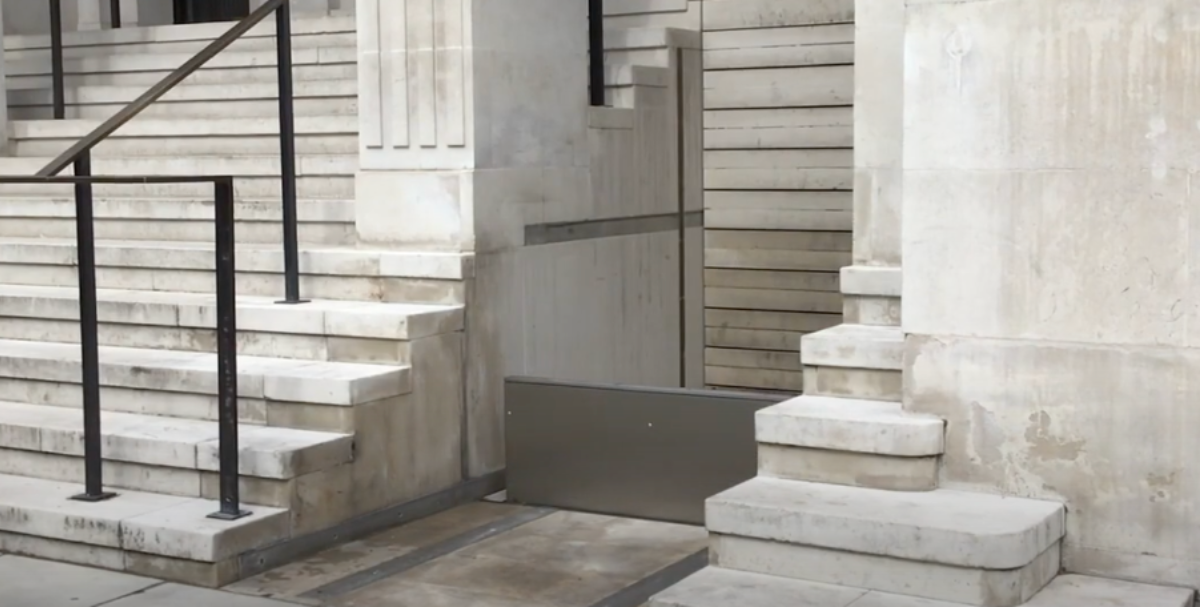
Retracting stairs can preserve a clean entrance aesthetic in both heritage and contemporary civic architecture while maintaining accessibility and circulation flow.
A clear go/no-go framework helps project teams avoid over-specification while still meeting safety, approval, and architectural requirements.
Early pre-tender technical consultation reduces redesign risk and helps align engineering, procurement, and authority submissions on multi-lift packages.
Introduction
Public buildings in Canada often present the most demanding lift-planning conditions: multiple stair locations, high footfall, strict safety expectations, and a structured procurement process that must be transparent and defensible.
This guide is designed for architects, access consultants, and project managers who need a practical method to select the right concept, document it clearly, and move through approval stages with fewer surprises.
If your project also involves North American authority-driven interpretations of accessibility lift standards, this reference can help frame the common issues and approval realities: Working with AHJs and ASME A18.1 for platform lifts.
To prepare efficiently for early technical calls, use this planning checklist and meeting structure: How Sesame prepares for client meetings.
Why Sesame Access
Sesame Access designs and manufactures bespoke platform lifts in the UK, engineering each system around the site conditions rather than adapting a fixed catalogue model.
A bespoke approach is most valuable when the project has complex stairs, strict barrier requirements, or multiple locations that must be delivered as a consistent package with controlled variants.
International projects benefit from a structured pre-tender method that clarifies the approval route, defines barrier assumptions early, and only then commits to detailed site-specific drawings and revisions.
Why CSA B355:19 changes the platform lift design approach in Canada
In Canada, platform lift designs are typically assessed against CSA B355:19, the standard governing lifts and stair lifts for barrier-free access, and this has important implications for barrier strategy and user protection. Unlike BS 6440:2011, which permits a toe-guard system in certain low-rise scenarios for seated users, CSA B355:19 does not recognise a toe-guard as sufficient fall protection for standing users or public applications. As a result, projects that might use a toe-guard approach in the UK often require full-height barriers, enclosed protection, or alternative guarding methods when being designed for Canadian installations. This difference means that approval pathways must be carefully considered early in the design process, as any solution diverging from standard interpretations will require review and acceptance by the relevant authority having jurisdiction. In Ontario, this naturally leads to engagement with TSSA, whose submission and approval process determines how bespoke platform lift designs are evaluated and accepted within the provincial regulatory framework.
What is TSSA and why does it matter for platform lift approvals in Ontario
In Ontario, accessibility lifts and platform lifts are regulated by the Technical Standards and Safety Authority (TSSA), the provincial public safety regulator responsible for elevating devices including elevators, escalators, platform lifts and other accessibility systems. TSSA oversees the engineering review and registration of lift design submissions, licensing of contractors and technicians, inspections of new and altered installations, and ongoing safety enforcement across the province. This means that projects must typically provide detailed technical documentation, including design submissions, safety logic, and compliance information before installation and final approval can be granted. Understanding how TSSA reviews elevating devices is essential when planning bespoke or retracting stair lift solutions for public buildings, as local regulatory interpretation can directly influence barrier strategy, enclosure requirements, and approval timelines. For more information about the regulator itself and its role in Ontario, see the official Technical Standards and Safety Authority (TSSA) website, and for additional context on how authority-led approvals influence platform lift design decisions, see UK platform lifts and ASME A18.1 approval pathways.
Problem: When the approval route defines the design
In Canadian public projects, approval is rarely a rubber stamp. Requirements can vary by province, authority, and the adopted edition or interpretation of key standards.
That uncertainty creates predictable risks if lift decisions are made too late:
Late-stage redesign of barrier configuration and guarding
Unexpected space requirements for retracting stair storage
Procurement delays caused by incomplete compliance narratives
Cost shocks when the specification jumps from low-rise concepts to full barrier systems
Solution: Start with the barrier strategy, then choose the lift concept
A simple method that prevents most planning errors is:
Confirm the likely approval route and what “compliant guarding” means in practice for the project.
Decide whether the design must assume full-height barriers on multiple sides, including grab-rail expectations.
Choose the retracting stair method that fits the geometry and void constraints.
Only then map the concept to the most suitable lift family and site-specific variant.
Where full enclosure is required, concepts aligned with the Seattle ADA Lift designed for North American barrier expectations are often the most approval-friendly starting point.
Where retracting stairs and rising barriers are required for a high-profile entrance, concepts aligned with the Westminster Equality Act Lift with retracting stairs and rising barriers are often relevant early references.
Decision Framework: Is bespoke engineering the right approach
Use this to decide whether bespoke platform lift engineering is justified.
Go/No-Go Technical Matrix
Decision factor |
Go: bespoke is likely the right approach |
No-Go: standard may suffice |
Approval complexity |
Formal submissions, iterative questions, authority review cycles |
Simple approval pathway with minimal queries |
Barrier expectations |
Full-height barriers on multiple sides, grab-rail constraints |
Low-risk guarding accepted without full enclosure |
Project scale |
Multiple lift locations delivered as a package |
One-off single low-rise location |
Architectural sensitivity |
Floor-to-floor continuity and clean aesthetics are critical |
Visible lift and adjacent guarding acceptable |
Geometry |
Curved stairs, tight landings, awkward voids |
Straight stair and generous space |
Programme |
Phased works, long lead time, storage strategies |
Immediate delivery, minimal staging |
A Canadian civic refurbishment often hits several “Go” conditions at once, especially where multiple access points must be solved consistently.
Retracting stairs: which approach fits the building
Retracting stair platform lift planning normally comes down to two options.
Horizontal retracting stairs store into an upper landing void. This typically needs usable space beneath the landing to house the stair assembly when retracted.
Vertical retracting stairs drop down out of the way. This can suit certain layouts but introduces a critical requirement: protecting the void at the landing when the platform moves, which usually means rising barriers around the opening.
The correct choice depends on geometry, available storage volume, and the barrier strategy required by the approval route.
Product Integration Summary
This matrix helps specifiers connect common Canadian project conditions to the most relevant Sesame product references.
Typical project requirement |
Suggested Sesame product reference |
Why it is a useful starting point |
Full-height barriers and grab-rail expectations |
Strong fit where authority expectations are strict and enclosure is mandatory |
|
Retracting stairs with rising barriers for public entrances |
Useful when the stair and barrier system is integral to the access solution |
|
Low-rise concept comparison for early feasibility |
Helpful as a reference point when assessing what the authority will accept |
|
Compact retracting stair references for design thinking |
Useful for understanding retracting stair concepts in constrained spaces |
|
Fully tailored engineering for complex geometries |
Relevant when the project requires site-specific structural and architectural integration |
Common misconceptions about platform lift planning in Canada
Misconception 1: Compliance with one standard guarantees approval everywhere
Canadian public projects often involve authority-led interpretation, so approval depends on the adopted code edition and local expectations, not just a single standards checklist.
Misconception 2: Retracting stairs are only for heritage buildings
Retracting stairs are often selected for contemporary civic buildings where a clean entrance aesthetic and unobstructed circulation are priorities.
Misconception 3: Bespoke means slow lead times by default
Bespoke engineering can align well with phased programmes when manufacturing and documentation are planned early and the project can accommodate storage or staged delivery.
Practical pre-tender steps that reduce risk
A repeatable pre-tender workflow helps project teams move faster and avoid redesign:
Confirm the approval body and submission expectations early.
Define barrier and guarding assumptions before specifying lift families.
Validate retracting stair feasibility with real geometry and void constraints.
Create a short concept pack: layout intent, barrier approach, and interface behaviours.
Only then move into site-specific drawings and revision cycles.
For a structured approach to preparing the right inputs for early calls, use: How Sesame prepares for client meetings.
Frequently Asked Questions (FAQ)
What is the best starting point for Canadian platform lift planning on public projects
Start by confirming the approval route and what guarding and barrier approach is expected in practice. Then select a lift concept that matches those assumptions.
Do Canadian public buildings typically require full-height barriers
Many public-sector contexts lean toward full-height barrier expectations, especially where the project adopts requirements aligned with ASME A18.1-style guarding principles.
Can retracting stairs work on larger staircases
Yes, but feasibility depends on whether there is adequate horizontal storage volume beneath the upper landing or whether a vertical retracting approach can be protected with rising barriers around the void.
What drives the difference between a compact concept and a full barrier solution
The barrier strategy is usually driven by the authority’s interpretation of fall protection, user containment, and public-use safety requirements.
Can a retracting stair platform lift be used on modern civic buildings
Yes. Retracting stairs are often chosen for modern buildings to keep entrances visually clean and reduce permanent obstructions when the lift is not in use.
What documents help approval bodies review platform lifts faster
Clear layouts, barrier descriptions, guarding logic, interface behaviour, electrical schematics, and a short narrative explaining how the system maintains safety during travel and when stowed.
When is bespoke platform lift engineering not necessary
If the site has a single low-rise requirement, generous space, and a straightforward approval path, a standard product may be sufficient and more cost-effective.
How early should we involve a lift manufacturer before tender
Early enough to confirm barrier assumptions and retracting stair feasibility so the tender specification reflects an approval-friendly concept rather than an optimistic placeholder.
Call to action
If you are planning a Canadian public building refurbishment and want to sense-check barrier strategy, retracting stair feasibility, and the most approval-friendly concept before tender, book a Teams meeting with one of our Project Managers here:
Book a Teams meeting with Sesame Access