Key Takeaways
-
Period hotel entrances often incorporate non-standard layouts and structural constraints that require bespoke accessibility engineering.
-
3D modelling helps visualise movement sequences, validate BS6440:2011 compliance principles and ensure safe integration into listed building environments.
-
Vertical retracting stair systems such as the Wellington Lift and Westminster Equality Act Lift provide discreet accessibility while maintaining the architectural character of historic hotel properties.
-
Additional learning is available via 3D Modelling in Lift Design and Bespoke Lift Options – 20 Minute Consultation.
Introduction
Creating accessible entrances for listed hotels, period buildings and other historic hospitality venues requires a precision-led engineering process. Entrances often feature narrow porticos, irregular staircases, projecting stone details and vaulted spaces below ground level. These constraints demand careful assessment before selecting an appropriate lift solution.
Through detailed 3D modelling, engineers can evaluate turning space, pit depth, crush-risk zones and door sequencing requirements. This ensures the final design not only meets operational needs but aligns with Part M Building Regulations principles and Equality Act expectations around inclusive access.
Understanding Real-World Constraints in Historic Hotel Entrances
Many traditional hotel entrances contain structural or geometric limitations such as:
-
Tight staircases or asymmetrical tread depths
-
Railings or window ledges that create crush zones
-
Subsurface vaulted cellars that restrict pit excavation
-
Limited landing space in front of entrance doors
-
Conservation rules that prevent modifying façades or gates
These make conventional surface-mounted lifts impractical. 3D simulations reveal whether dimensions fall short of BS6440:2011 internal platform requirements or whether alternative layouts could still achieve safe, user-friendly access.
How 3D Simulation Improves Safety and Feasibility
Modern 3D tools enable engineers to test:
-
Wheelchair turning circles and approach routes
-
Standing-user movement, including PRM travellers with luggage
-
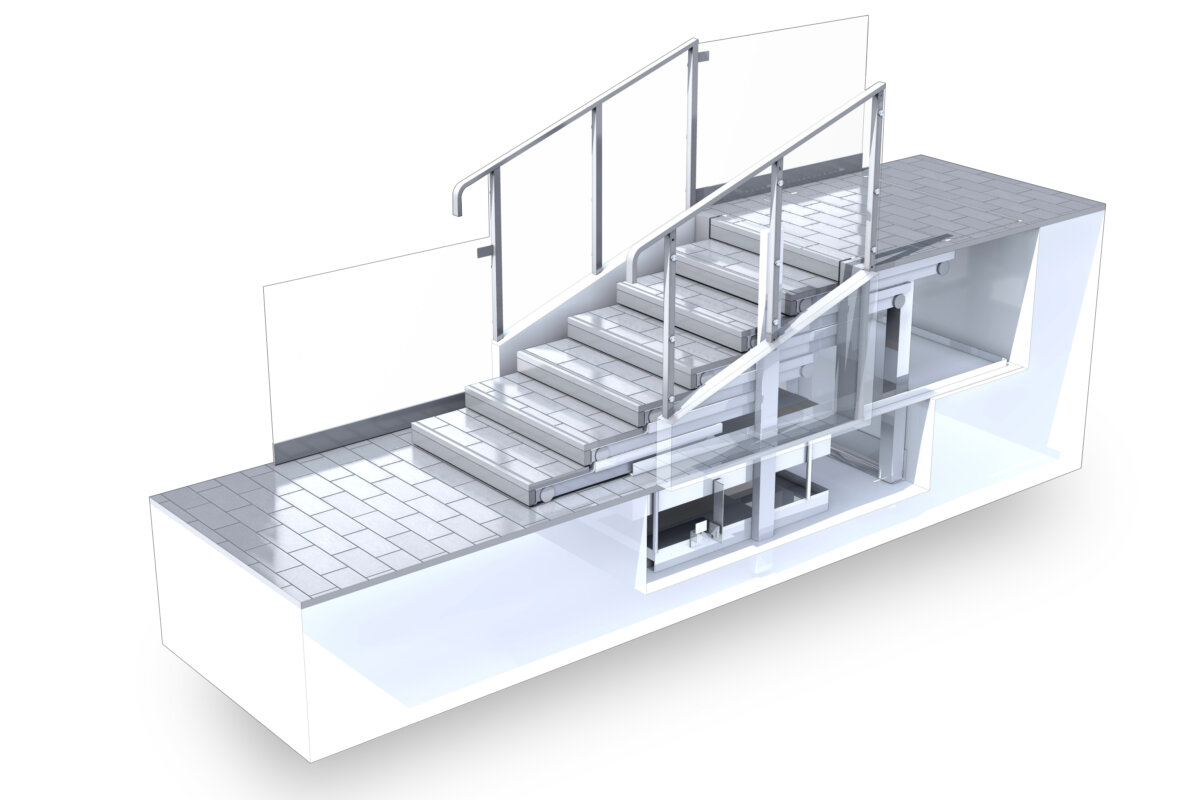
Rising barrier deployment and retracting stair movement
-
Safety-edge interactions near railings or stone ledges
-
“No-go zone” detection using scanners where necessary
-
Spatial clearance inside vaults or under treads
These simulations create a design-for-safety environment that identifies risks before installation begins. They also provide clear visuals for planning officers who require assurance that architectural character remains intact.
For more insight on simulation workflows, see 3D Modelling in Lift Design.
Choosing Between Wellington and Westminster Lift Systems
Wellington Lift, Wheelchair-Only, Fully Discreet
The Wellington Lift is ideal for hotels where users approach through a compact entrance and wheelchair-only access is required.
Benefits include:
-
No visual change to the entrance when the lift is stored
-
Minimal or no modification to railings or façade elements
-
Reduced impact on vaulted spaces beneath the steps
-
Fast, intuitive operation for staff and guests
It fits particularly well in listed hotel buildings where conservation teams prefer reversible interventions.
Westminster Equality Act Lift – For Seated and Standing Users
The Westminster Equality Act Lift is suited to historic hotels with diverse user profiles, including PRM guests who cannot climb steps.
Key features include:
-
Full-height rising barriers for standing-user protection
-
Automatic landing gates
-
Hidden platform integrated within the stair core
-
Broader turning space and usability envelope
This system supports Equality Act inclusive-access expectations, though it may require structural reinforcement or carefully planned pit depths depending on vaulting or brick arches.
Project Example: Solving a Complex Period-Hotel Entrance
A listed hotel approached our team with a challenging entrance layout:
-
A narrow historic gate
-
A projecting stone sill that created a crush hazard
-
Two active basement doors beneath the staircase
-
Only 65 mm safe standing space outside the main entrance doors
-
Vaulted brickwork limiting excavation depth
3D modelling revealed that a traditional platform lift would not achieve a compliant turning circle or protect users from identified crush risks. Two retracting stair strategies were tested:
Wellington configuration:
Suitable when wheelchair-only access is acceptable and where minimising structural impact on heritage fabric is a priority.
Westminster configuration:
Provided full PRM access with automated gates but required a deeper mechanical zone, carefully modelled around the vaulted ceiling.
The 3D walkthrough enabled the architect, hotel operator and conservation officer to understand each option clearly and select the pathway that balanced heritage preservation with user safety.
Planning Authority Support and Approval
Our heritage-access designs are frequently approved because:
-
3D visuals demonstrate minimal visual impact
-
Material selections respect conservation guidelines
-
Safety documents show BS6440:2011-aligned risk design
-
Platform behaviour is clearly explained through movement sequences
-
Subtle integration protects the character of listed entrances
We also supply documentation to accompany planning submissions, helping applicants build confidence with conservation officers and Building Control teams.
Additional Resources
To explore bespoke options and receive tailored guidance, see:
Bespoke Lift Options – 20 Minute Consultation
Frequently Asked Questions (Expanded)
What pit depth is required for a Westminster Lift in a listed building?
Pit depths vary significantly. Many period hotels include vaulted subfloors that restrict excavation. 3D modelling allows engineers to determine a safe mechanical zone without compromising structural integrity.
Does a Wellington Lift require modifications to the façade?
Usually no. The system retracts into the existing stair volume, making it ideal where conservation conditions prohibit façade alterations.
Can retracting stair systems meet Part M accessibility expectations?
Yes. When designed with correct landing space, barrier height and turning geometry, systems can meet the intent of Part M for safe, dignified access.
How long does installation take?
Most retracting stair systems are installed within three to six weeks depending on groundwork requirements and planning conditions.
What safety measures protect guests from crush hazards?
Designs may incorporate rising barriers, safety edges and detection scanners where railings, window ledges or limited offsets create high-risk areas.
Can these lifts support daily public use in busy hotels?
The Westminster systems are designed for frequent operation in commercial hospitality environments.
What type of imagery should we use in this article?
Use images with descriptive alt text such as “3D model showing retracting stairlift integrated into period hotel entrance” to improve accessibility and SEO.
Call to Action
If you are evaluating accessible entrance solutions for a listed or historic hotel property, book a meeting with a Sesame Access Project Manager:
https://www.sesameaccess.com/book-a-meeting