
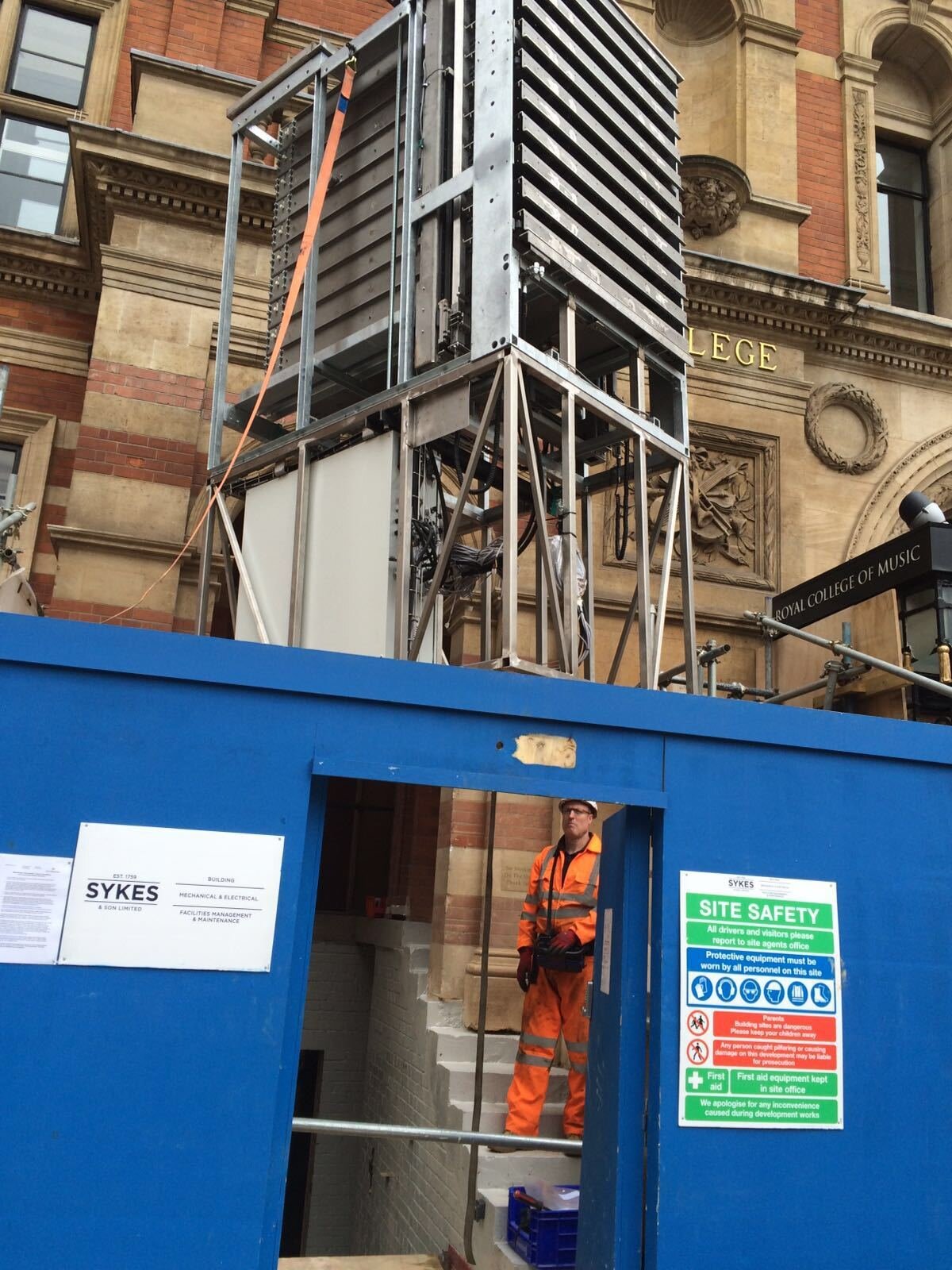
Key Takeaways
-
Oversize platform lifts frequently exceed original access assumptions as designs mature.
-
Narrow doors, limited turning circles, and low headroom require installation to be engineered, not improvised.
-
Controlled sub-assembly installation significantly reduces risk in heritage and restricted buildings.
-
Temporary works such as rotation-specific jigs, saddles, and crash decks are critical safety systems.
-
Early engagement prevents weeks of programme delay and late-stage redesign.
Introduction
Installing a large bespoke platform lift inside an existing building is rarely a matter of simple delivery. As accessibility requirements evolve, lifts often grow in size, weight, and capability, while entrances, corridors, and structural constraints remain unchanged.
This article explains how Sesame Access engineers the installation of oversize platform lifts through narrow doors and constrained internal routes. It focuses on people-first outcomes, safety-led decision making, and proven strategies for heritage and complex environments, drawing on experience across projects similar to those described in our guidance on heritage lift installations and installing platform lifts internationally.
Why Lift Installations Become Constrained Over Time
Problem: The lift evolves but access does not
During detailed design development, lifts often increase in footprint due to revised loading, safety interfaces, or inclusive use cases. However, door widths, structural openings, and internal circulation routes typically remain fixed.
As noted during internal planning discussions, “through the design phases, this lift got bigger and bigger and bigger, and the door stayed the same.”
The result is a lift that functions perfectly on paper but cannot physically reach its final location without a bespoke installation strategy.
Solution: Treat installation as an engineering discipline
Rather than reacting late on site, Sesame Access treats installation planning as part of the engineering scope. Dimensional envelopes, turning arcs, diagonal swing paths, and headroom tolerances are reviewed alongside lift performance criteria.
Critical Planning Windows in the Design Process
Early intervention is the single most effective way to prevent costly installation risk.
RIBA Stages Where Installation Risk Is Avoided
-
RIBA Stage 2–3: Preliminary installation feasibility review, identifying likely pinch points and access conflicts.
-
RIBA Stage 3–4: Detailed lifting strategy development, including sub-assembly sequencing and temporary works design.
In one anonymised example, early engagement allowed the installation method to be redesigned before manufacture, avoiding over six weeks of programme delay that would have occurred had access constraints been discovered post-delivery.
When Standard Installation Methods Fail
Diagnostic checklist
Standard installation methods begin to fail when one or more of the following conditions are met:
-
Platform width exceeds door clearance by more than 150mm.
-
Internal pinch points are narrower than 1200mm.
-
Scissor assembly mass exceeds 800kg with headroom below 2100mm.
-
Turning circles require diagonal rotation through doorways under 2000mm high.
-
Finished architectural surfaces cannot tolerate site welding or grinding.
When these thresholds are crossed, controlled disassembly or fully bespoke lifting strategies are required.
Controlled Disassembly as a Risk Reduction Strategy
Problem: Large assemblies cannot rotate safely in confined spaces
Oversize scissor mechanisms and platform assemblies often exceed both door width and turning clearance, making rotation inside the building unsafe or impossible.
As discussed during planning, “the platform in my opinion has got to come off regardless because of the risk.”
Solution: Sub-assembly installation with engineered temporary works
The lift is divided into defined sub-assemblies:
-
Scissor mechanism
-
Platform and gate assembly
-
Subframe and base structure
Each component is transported through the tightest access point using low-profile trolleys and rotation-specific lifting jigs, then reassembled within the lift space under controlled conditions.
Engineering Temporary Works for Tight Tolerances
Rotation-specific jigs and low-profile transport
Standard A-frames and gantries are often too tall or inflexible for constrained interiors. Sesame Access engineers custom lifting equipment designed to operate within tolerances as tight as 25mm.
One internal note highlighted the need to “get it as low as possible,” reducing vertical envelope while maintaining full control during rotation and lifting.
These systems allow components to be transported upright, rotated safely, and positioned precisely without damaging finished architectural elements.
Quantified Constraint Ranges Successfully Solved
| Constraint Type | Achieved Outcome |
|---|---|
| Tightest door clearance navigated | 950mm for a 1400mm platform |
| Heaviest scissor mechanism rotated in situ | 1,850kg |
| Lowest working headroom | 2,100mm |
| Narrowest internal pinch point | 1,160mm |
| Temporary floor point-loading managed | Timber crash decks engineered for >1,300kg |
These figures reflect real-world installations where standard methods were not viable.
Common Misconceptions About Oversize Lift Installation
Myth: Lift dimensions equal installation clearance
Correction: Installation clearance must account for rotation arcs, diagonal swing, and handling equipment, not just static lift dimensions.
Myth: Removing the platform voids warranties
Correction: Factory-supervised field reassembly maintains full warranty coverage when documented correctly.
Myth: Temporary works are optional
Correction: In constrained buildings, temporary works such as saddles and crash decks are safety-critical systems, not conveniences.
Myth: Access constraints should be solved on site
Correction: Reactive problem-solving on site increases risk, cost, and programme impact compared to engineered pre-planning.
Product Context and Application
Many of the strategies described here are developed to support complex systems such as the British Library Platform Lift, the Cavendish Platform Lift, and fully Bespoke Lift Solutions.
These lifts are specifically designed for environments where standard access assumptions do not apply.
Frequently Asked Questions
When should installation constraints be assessed?
Ideally during RIBA Stages 2–3, before manufacturing decisions are locked in.
Can large lifts be installed in heritage buildings?
Yes, provided installation is engineered with sub-assembly strategies and temporary works designed to protect historic fabric.
Is controlled disassembly slower than standard installation?
No. It is typically faster overall, as it avoids delays caused by unforeseen access conflicts.
Does sub-assembly installation affect reliability?
No. When reassembled and commissioned correctly, performance and reliability are unchanged.
Are international installations more complex?
Often yes, due to logistics, standards coordination, and site access constraints, which is why early planning is essential.
Call to Action
If your project involves narrow doors, heritage constraints, or oversize lift components, early advice can prevent costly delays.
Book a Teams meeting with one of our Project Managers to review your access constraints and installation strategy:
https://www.sesameaccess.com/book-a-meeting