
Key Takeaways
-
Architects frequently need accessibility lifts installed early while finishes evolve later.
-
Bespoke platform lifts can accommodate temporary finishes without compromising final compliance.
-
Accurate datum setting and tolerance control prevent misalignment in heritage and phased projects.
-
A phased commissioning strategy supports programme certainty.
Introduction
Architects and project managers often face the challenge of integrating accessibility lifts into phased construction programmes, particularly within heritage properties and architect-led commercial interiors. The lift may need to be installed early to maintain programme momentum, while surrounding finishes, partitions, and layouts remain temporary.
This article explains how phased lift installation can be planned so accessibility, aesthetics, and compliance are preserved through every construction stage. The principles outlined here reflect established best practice across complex refurbishment and heritage property accessibility projects.
How phased construction affects lift specification
In phased programmes, lifts are commonly installed before final floor finishes, joinery, or wall linings are complete. If datum points are referenced to temporary finishes, later design changes can introduce misalignment or restrict material choices.
The correct approach is to anchor the lift installation to structural references rather than finished surfaces. This allows final materials to evolve independently while ensuring the lift remains dimensionally correct.
This methodology is widely applied across listed building lift installation projects, where construction sequencing must align with conservation approvals and historic fabric protection. Additional context is covered in our guide to heritage lift installations:
https://www.sesameaccess.com/knowledge-hub/heritage-lift-installations
Problem: protecting installed lifts during ongoing works
Once installed, lifts may be exposed to dust, debris, temporary partitions, and trade traffic. Architects frequently ask whether lifts can remain in place while adjacent works continue without risking damage or future compliance.
Solution: engineered protection and dimensional tolerance
Bespoke platform lifts are designed to support phased construction environments. Protective plywood layers can be placed over the platform, preventing surface damage while allowing inspections and access.
Typical engineered allowances include:
-
33 mm tray depth for floor finishes
-
Maximum finish build-up of approximately 28 mm including adhesive
-
Final 8 mm finished perimeter gap once permanent cladding is applied
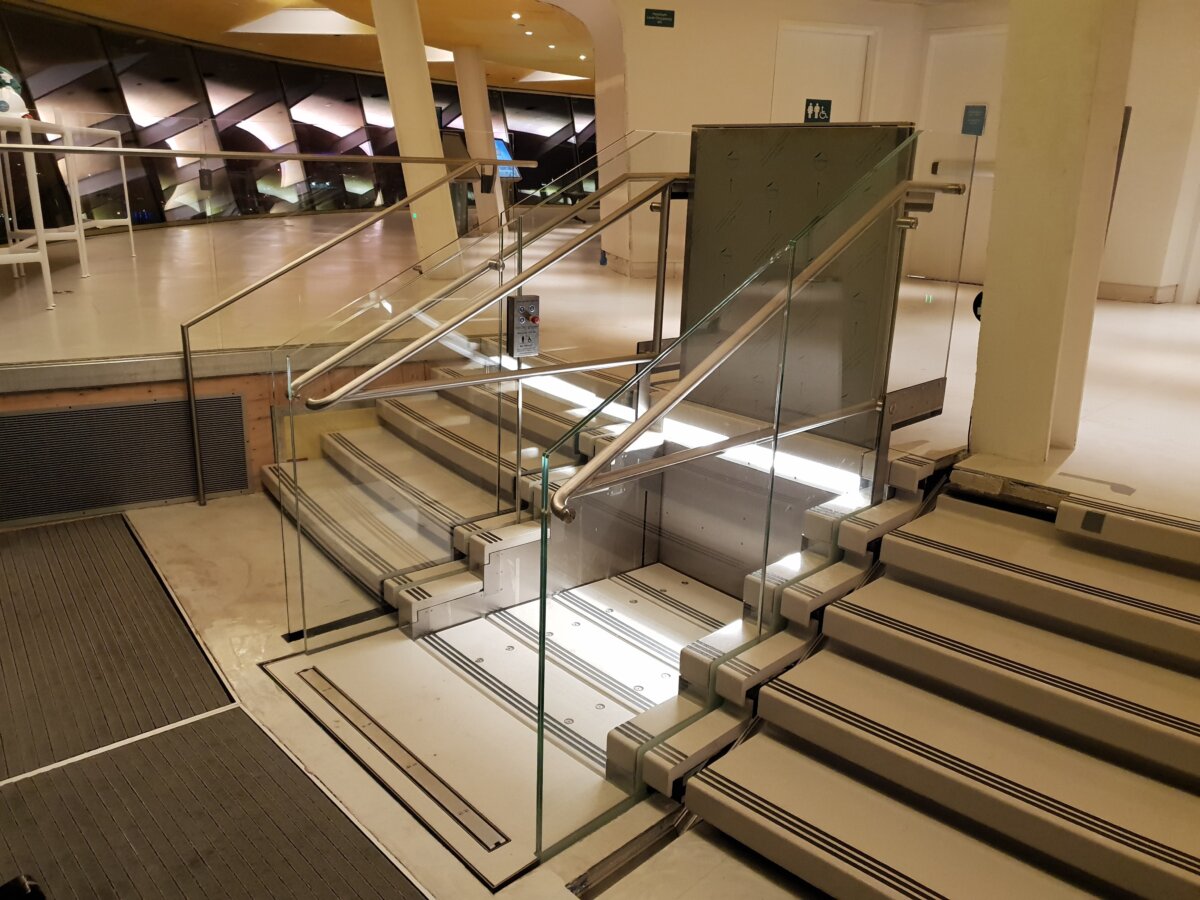
These tolerances allow temporary finishes to be replaced later without modification to the lift structure. Systems such as the Wellington Lift are particularly well suited to this approach due to their retracting stair geometry and defined datum profiles.
Why datum accuracy is critical in phased builds
Small dimensional errors compound as finishes are layered. To prevent this, installation begins with fixed pit trims that establish the final edge position of the lift.
These trims:
-
Absorb ±25 mm construction tolerances
-
Increase pit dimensions by 50 mm overall
-
Ensure a consistent 8 mm final gap once cladding is complete
This strategy ensures visual alignment and operational integrity even when temporary materials are used early in the programme.
Temporary finishes without fixing final design intent
Temporary finishes allow buildings to function during interim phases without locking in final materials. Because the lift geometry is fixed to structural datums, future changes to tiles or stone finishes do not require lift modification.
This principle is commonly applied in domestic and mixed-use environments, including projects using solutions derived from the People’s Lift concept, explained further in our domestic home lift guide:
https://www.sesameaccess.com/knowledge-hub/peoples-lift-domestic-home-lift-guide
Typical two-week installation sequence
A phased installation programme is typically structured as follows:
-
Pre-installation survey to confirm structural dimensions and centre lines
-
Installation of pit trims and datum profiles
-
Lift installation and functional testing using temporary controls
-
Protection of the lift platform and controlled power-down
-
Final recladding and recommissioning at the completion phase
This sequencing enables surrounding works to proceed while preserving long-term accessibility performance.
Pro-tips for surrounding trades
-
Use high-density blockwork to avoid drilling into mortar joints.
-
Restrict fixings for temporary partitions to approved build-up zones only.
-
Avoid penetrating lift trays when installing stud walls or millwork.
-
Confirm finished datum positions before cladding begins.
Early coordination reduces remedial works and protects programme timelines.
Product Integration Summary
| Sesame solution | Application in phased projects |
|---|---|
| Wellington Lift | Retracting stair geometry for temporary closures |
| Westminster Equality Act Lift | Complex compliance-driven environments |
| Traversing Lift | Lateral movement to avoid structural conflicts |
Frequently Asked Questions
What are typical lead times for phased lift installations?
Lead times depend on complexity, but bespoke lifts are often manufactured in parallel with early construction works, allowing installation once structural elements are ready.
How do you coordinate lift installation with conservation officers?
By fixing to structural datums rather than historic fabric and ensuring the installation remains reversible until final approval.
Can lifts be installed before final finishes are approved?
Yes. Temporary finishes can be applied without affecting lift geometry or future compliance.
Is phased commissioning acceptable for accessibility compliance?
Yes. Initial functional testing can be followed by final commissioning once permanent finishes are installed.
Can temporary partitions be fixed over a lift?
Yes, provided fixings are limited to approved zones and agreed load paths.
Further Reading
-
Heritage lift installation strategies for listed buildings
https://www.sesameaccess.com/knowledge-hub/heritage-lift-installations -
Domestic lift planning and accessibility considerations
https://www.sesameaccess.com/knowledge-hub/peoples-lift-domestic-home-lift-guide -
Compliance requirements for heritage buildings
https://www.sesameaccess.com/about/articles/ramp-vs-lift-sesame-access
Call to Action
To discuss phased lift installation within a heritage or architect-led project, book a Teams meeting with a Project Manager:
https://www.sesameaccess.com/book-a-meeting