Key Takeaways
-
In listed and constrained buildings, accessibility is a design problem, not a catalogue choice
-
Pit depth is not a pricing variable; it reshapes the entire lift architecture
-
Sesame Access routinely combines multiple lift systems to solve competing constraints
-
Seated-only, assisted, and independent access solutions each require different engineering and management approaches
-
Early technical clarity prevents unrealistic expectations and costly redesigns
With over 25 years of specialist engineering experience and more than 400 platform lift installations across listed and heritage buildings, Sesame Access designs from constraint, not catalogue.
Introduction: Why Listed Buildings Demand a Different Approach
Creating step-free access in listed buildings is rarely about finding a single “approved” product. It is about navigating shallow pits, protected fabric, retained stairs, operational realities, and user dignity, all at once.
This is why many projects begin with uncertainty rather than answers. Questions such as which lift works with no pit depth, how discreet a solution can truly be, or whether independent use is achievable often surface late, after drawings are already advanced.
Sesame Access approaches these projects differently. Instead of starting with a product, we start with constraints, then engineer a solution, often by combining multiple systems from our wider platform lift range.
Why Pit Depth Changes Everything
Pit depth is the dominant factor in constrained lift design. It governs what can be hidden, what must move, and how the lift behaves when not in use.
As explained during a recent technical consultation:
“The shallower the pit you can give us, the more complex and therefore more expensive the solution becomes.”
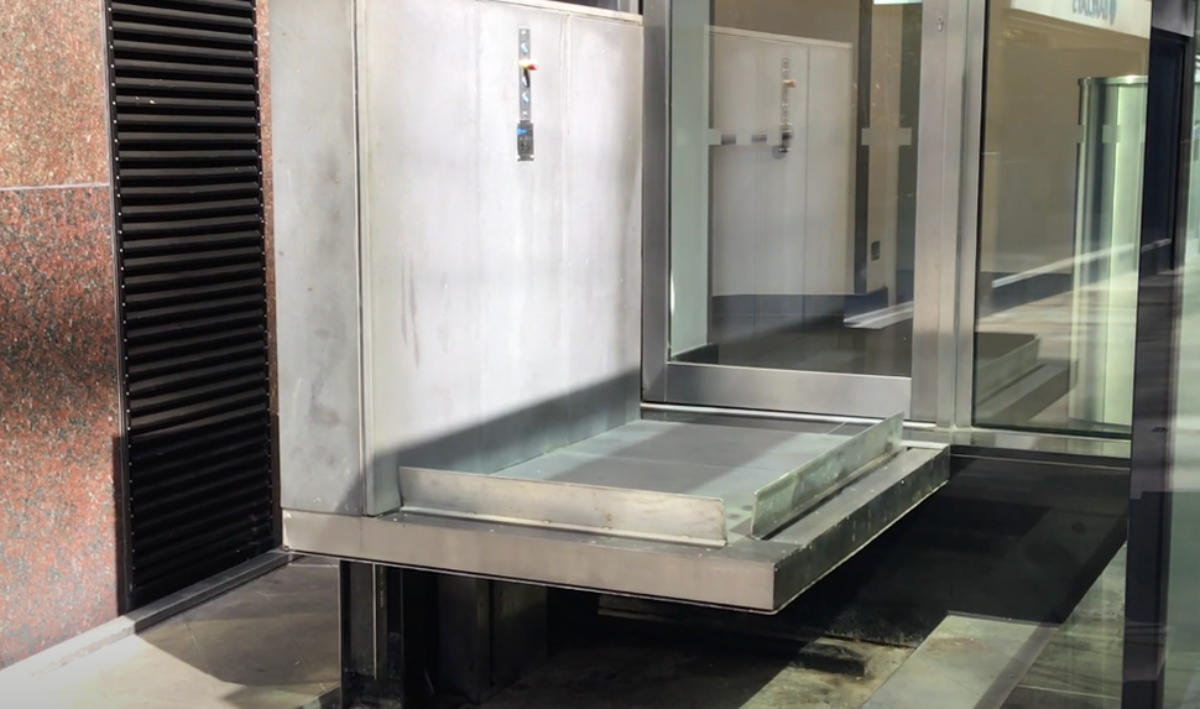
At very shallow depths, lifting mechanisms cannot fully retract below floor level. This forces structural elements to rise and lower with the platform, increasing visibility and mechanical complexity.
At greater depths, even by as little as 100 mm more, entirely different lift architectures become possible.
For a deeper technical explanation of zero-pit and near-zero-pit scenarios, see
Which lift works with no pit depth in a listed building
Why This Is Usually Misunderstood
Pit depth is often simplified as a cost-saving measure: shallower pit equals cheaper lift. In reality, the opposite is frequently true.
A shallow pit does not remove engineering; it displaces it. Structural elements that would normally be hidden below floor level must now travel with the platform. Safety systems, guarding, and tolerances all become more complex.
This is why two lifts serving the same rise can differ significantly in cost, appearance, and usability purely based on pit depth. Understanding this early is the difference between an elegant solution and a compromised one.
Problem: What If Only Around 100 mm of Depth Is Available?
Solution: Ultra-Low Pit Platform Lifts
Where a raised access floor of approximately 100 mm must be retained, solutions such as the Portobello Wheelchair Lift are specifically designed to operate within that limitation.
At this depth, the lifting equipment cannot be fully concealed. A visible vertical framework rises and lowers with the platform. While this can be clad or detailed to suit the interior, it will always be more apparent than deeper-pit alternatives.
These systems are typically:
-
Suitable for seated wheelchair users
-
Protected by electric toe-guard systems rather than full-height barriers
-
Operated with assistance depending on management strategy
As discussed:
“You end up with a forklift-style mechanism where the vertical members rise and lower with the platform.”
Additional concealment measures, such as bellows or shutters, can improve visual outcomes. More detail on this approach is covered in Bellows design for accessibility lifts with limited pit depth
Problem: What If Some Additional Depth Can Be Achieved?
Solution: Low-Profile Platform Lifts with Hidden Mechanisms
If there is flexibility to locally increase the raised access floor or form a shallow recess into the slab (subject to approvals), the lift architecture changes significantly.
At around 200–205 mm of depth, solutions such as the Jubilee Disabled Access Lift allow most of the lifting mechanism to sit below floor level.
This results in a cleaner visual outcome and reduced perceived complexity.
As noted during consultation:
“Once you get to around 205 mm, you see a lot less because the mechanism is largely hidden below ground.”
These lifts remain seated-user systems using electric toe-guards, often with assisted operation depending on the building’s management model.
Problem: What If Independent Use by Standing and Seated Users Is Required?
Solution: Fully Enclosed Platform Lifts
Where independence, clarity, and continuous availability are priorities, fully enclosed systems offer a different balance.
The Trafalgar Access Lift uses full-height barriers, allowing both seated and standing users to travel safely without assistance.
These systems:
-
Can remain powered and available at all times
-
Simplify Part M interpretation and user management
-
Typically require slightly more pit depth than toe-guard systems
Although not the shallowest construction option, they are often the most straightforward operationally.
Problem: How Can Access Be Added Without Removing Existing Steps?
Solution: Traversing Platform Lifts
Where stairs must remain, a traversing or bridging platform lift may be considered.
The Traversing Lift moves horizontally across the stair before lifting, preserving the stair’s primary function.
These systems:
-
Sit within the stair zone
-
Require deeper pits, typically around 260 mm plus finishes
-
Are often mechanically simpler but structurally demanding
Sesame Access developed its own heavily engineered traversing solution after repeated concerns about stability and user confidence in lightweight alternatives.
As explained:
“We were approached to make our own style because of how wobbly some of these systems feel and how uncomfortable people are using them.”
Problem: Can a Platform Lift and Stairs Be Fully Integrated?
Solution: Platform Lifts with Retracting Stairs
For premium projects, Sesame Access can combine systems to preserve architectural intent while delivering access.
By integrating a low-profile platform lift with retracting stair technology, the stair functions normally when not in use and retracts only when access is required.
An example pairing is the Jubilee lift with the Thames Retracting Stair Lift
These systems:
-
Preserve stair geometry and appearance
-
Require staff operation and training
-
Represent the highest level of complexity and cost
Decision Framework: When to Choose and When Not to Choose
| Solution Type | When to Choose | Not Suitable When |
|---|---|---|
| Portobello Wheelchair Lift | Pit depth limited to ~100 mm and seated users acceptable | Standing or independent use required |
| Jubilee Disabled Access Lift | ~200 mm depth achievable and visual discretion is key | Full independence required |
| Trafalgar Access Lift | Standing and seated users need independent access | Pit depth is extremely limited |
| Traversing Lift | Stairs must remain and deeper pit is acceptable | User confidence or stability concerns dominate |
| Jubilee + Retracting Stairs | Architectural preservation is critical | Budget or operational simplicity is a priority |
Common Misconceptions
A shallower pit always means a cheaper lift
In reality, shallow pits increase engineering complexity and cost due to visible and moving structures.
Toe-guard lifts are non-compliant
Toe-guard systems remain widely used for seated users when paired with appropriate management strategies.
All platform lifts can be used independently
Only fully enclosed systems with full-height barriers support unassisted standing use.
Frequently Asked Questions
What is the minimum pit depth for a platform lift?
Some systems can operate within 100 mm, but visual and mechanical compromises increase significantly at this depth.
Can a platform lift be used by standing users?
Only fully enclosed lifts with full-height barriers are suitable for standing users without assistance.
Are these solutions suitable for listed buildings?
Yes. Many are specifically designed to minimise intervention and preserve fabric.
Can existing raised access floors be retained?
Often yes, although even small increases in depth can unlock better solutions.
Conclusion: Designing from Constraint, Not Catalogue
Listed building accessibility is about understanding trade-offs early and engineering deliberately. By explaining what works, what does not, and why, Sesame Access helps teams arrive at solutions that feel intentional, compliant, and respectful of both people and place.
Call to Action
If you are assessing accessibility options for a constrained or listed building, an early technical discussion can save months of redesign.