
Key Takeaways
-
Phase 2 advances the traversing lift from prototype validation into stability-led engineering refinement
-
A single scissor lift architecture enables reduced platform width and improved rigidity
-
Modular construction is introduced to reduce build time and long-term manufacturing cost
-
Safety systems are re-engineered to eliminate crush hazards while preserving a concealed appearance
-
Phase 2 directly responds to the physical and operational learnings established in Phase 1
Introduction
The first phase of the traversing lift development established that a horizontally traversing platform lift could operate discreetly within architecturally sensitive environments while meeting safety expectations.
That work is documented in detail here:
Traversing lift prototype validation and shallow-pit feasibility – Phase 1
Phase 2 builds directly on that foundation. With feasibility proven, the development focus now shifts to improving scissor lift stability, reducing platform width, simplifying construction, and refining concealed safety systems so the lift can progress from prototype toward a repeatable product.
This phase also integrates learning from established Sesame Access systems, including stability engineering in scissor-based lifts such as the Windsor Lift and concealed platform strategies used in the Buckingham Listed Building Lift.
Phase 1 vs Phase 2: What changed?
| Specification | Phase 1 Prototype | Phase 2 Development |
|---|---|---|
| Primary lifting method | Low-profile actuator | Single scissor lift |
| Typical pit depth | Ultra-shallow (prototype-driven) | Deeper pit where available |
| Platform width | Wider to achieve stability | Reduced toward minimum compliant width |
| Stability under load | High end, prototype-limited | Significantly improved through scissor geometry |
| Build time | High due to bespoke fabrication | Reduced through modular construction |
| Safety integration | Proven but space-intensive | Compact, integrated, serviceable |
This comparison is critical for understanding why Phase 2 deliberately trades pit depth for improvements in stability, compactness, and manufacturability.
What problem is Phase 2 solving?
Phase 1 confirmed that the traversing lift concept works, but it also exposed constraints that are common in early prototypes.
The most significant challenges were:
-
Platform width increasing as stability requirements increased
-
Build time becoming the dominant cost driver
-
Limited space for safety edges, bellows, and removable handholds
-
Difficulty balancing rigidity with a visually minimal solution
Phase 2 addresses these issues through targeted engineering decisions rather than incremental tweaks.
Why move to a single scissor lift system?
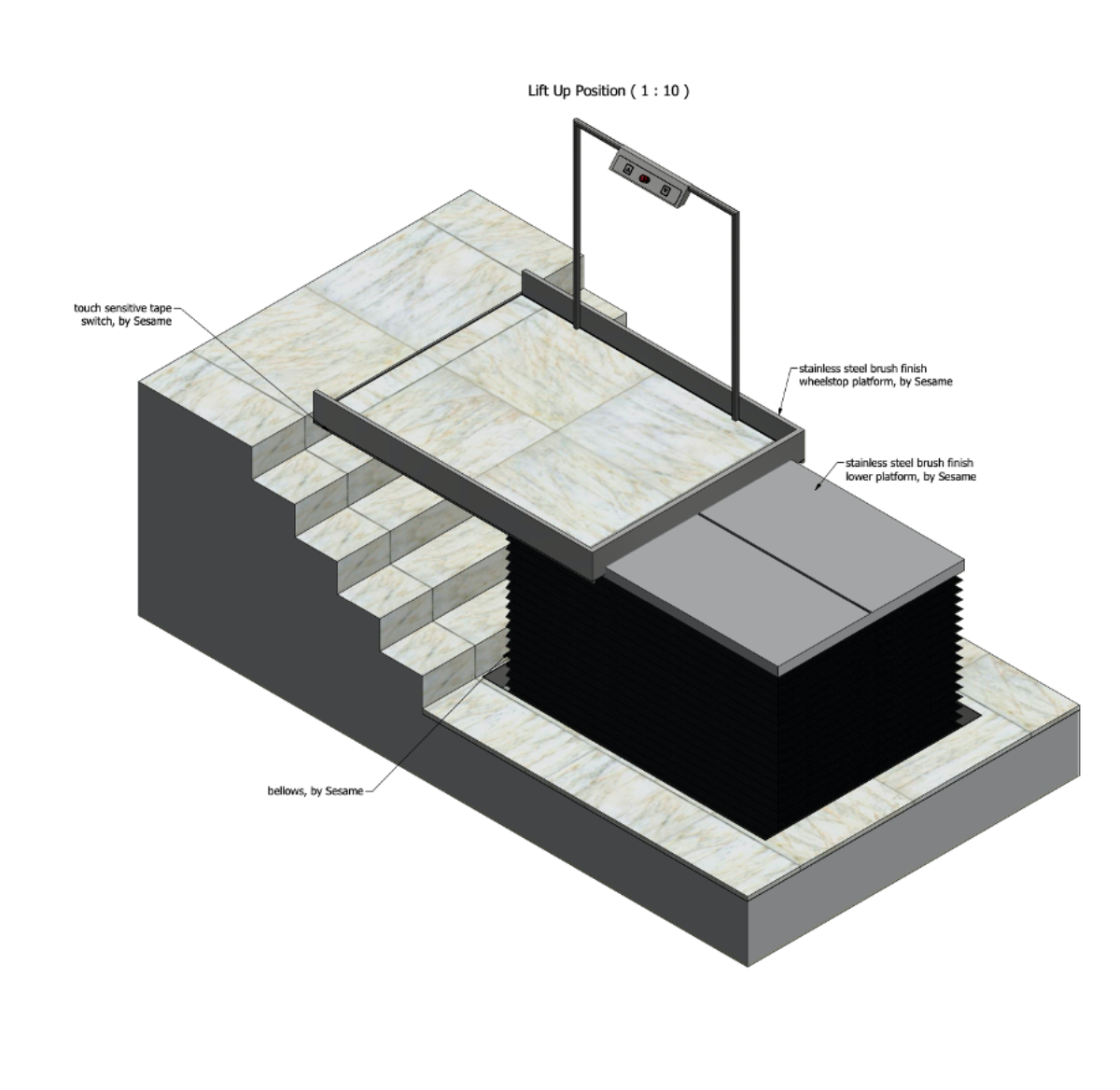
The central design shift in Phase 2 is the adoption of a single scissor lift beneath the traversing platform.
This approach introduces additional pit depth but delivers measurable gains:
-
Improved scissor lift stability at full travel
-
Reduced platform width without compromising load capacity
-
Better distribution of forces during horizontal traversal
-
Clear separation between lifting and traversing modules
Where pit depth can be accommodated, the single scissor system allows the traversing lift to become both narrower and more stable, a combination that is difficult to achieve with ultra-low-profile mechanisms alone.
This stability-first philosophy aligns with proven approaches used in systems such as the Westminster Equality Act platform lift with concealed mechanics.
How does Phase 2 improve stability and user confidence?
Stability is treated as a user experience issue, not just a structural one.
Phase 2 introduces:
-
Tighter tolerance control within scissor pivots
-
Improved wheel guidance to reduce lateral movement
-
Load paths designed to minimise perceived flex
-
Evaluation of hydraulic actuation behaviour during short extension cycles
The goal is a traversing lift that feels calm and predictable at every stage of movement, particularly when raised and traversing simultaneously.
Lessons from stability-critical installations, including those informing the British Library Platform Lift’s concealed load management approach, directly influence this phase.
How are concealed safety systems refined in Phase 2?
Safety remains a non-negotiable design driver.
Phase 2 refines concealed safety systems by:
-
Reducing the spatial footprint of safety edge routing
-
Introducing tighter 90-degree safety edge transitions
-
Protecting all necessary movement voids without exposed gaps
-
Ensuring safety components remain accessible for servicing
Unlike many market alternatives, safety edges and bellows are designed as integral components rather than additions layered onto the finished lift.
This approach reflects long-established Sesame Access principles seen in concealed safety systems used on the Whitehall DDA-compliant lift.
Why modular construction matters at this stage
One of the clearest outcomes of Phase 1 was that fabrication time, not materials, dominated cost.
Phase 2 introduces modular construction to address this:
-
A repeatable scissor lift base module
-
A separate traversing and wheel-stop module above
-
Standardised fixing points and tolerances
-
Reduced late-stage bespoke welding
This modular approach improves manufacturing efficiency, simplifies servicing, and supports future scalability of the traversing lift as a product rather than a one-off solution.
The same modular logic underpins the long-term success of the Traversing Lift system designed for complex access constraints.
Technical Specifications
-
Lifting system: Single scissor lift
-
Collapsed scissor height: approximately 150–280 mm (design-dependent)
-
Typical platform usable width: designed toward 800 mm minimum compliant width
-
Traversing mechanism: hydraulically driven horizontal movement
-
Safety edge response time: <100 ms
-
Safety protection: full perimeter edges and bellows
-
Standards alignment: BS EN 81-41 and UK Equality Act design principles
-
Construction method: modular scissor base with removable top assembly
Product Integration Summary
| Design Requirement | Related Sesame Access Solution |
|---|---|
| Scissor lift stability engineering | Windsor Lift |
| Concealed platform lift design | Buckingham Listed Building Lift |
| Integrated safety edge strategy | Westminster Equality Act Lift |
| Modular concealed platform construction | Traversing Lift |
| Service-friendly concealed systems | Pimlico Lift |
Frequently Asked Questions
How much pit depth does a single scissor traversing lift need?
A single scissor traversing lift typically requires more pit depth than ultra-low-profile systems, with Phase 2 designs targeting deeper pits where available to achieve improved stability.
What is the platform width reduction in Phase 2?
Phase 2 reduces overall platform width by relocating stability into the scissor mechanism, allowing usable widths to approach the 800 mm minimum required by British Standards.
Can a traversing lift work in a 200 mm pit?
A 200 mm pit is generally more suitable for low-profile systems explored in Phase 1; Phase 2 prioritises deeper pits to unlock stability and compactness benefits.
How does Phase 2 improve safety compared to Phase 1?
Phase 2 refines safety edge routing, bellows design, and component integration to reduce crush hazards while improving serviceability.
Is the traversing lift suitable for listed or sensitive buildings?
Yes. The design philosophy focuses on concealed mechanics, minimal visual impact, and reversible construction methods.
Does modular construction affect performance?
No. Modular construction improves build efficiency and servicing without compromising load capacity or stability.
Call to Action
If you are assessing a complex access challenge or exploring whether a traversing lift could work within your spatial constraints, speak directly with a Sesame Access Project Manager.
Book a Teams meeting here:
Book a Teams meeting to discuss traversing lift feasibility and design constraints