Key Takeaways
• Wheelchair access is achievable in front entrances with less than 600mm available depth when retracting stairs and bespoke lift engineering are correctly combined.
• Standard platform lifts often fail in constrained urban entrances due to incorrect depth assumptions and overlooked safety clearances.
• A people-first, engineering-led approach protects accessibility, architectural intent, and valuable internal floor area.
Introduction
Delivering wheelchair access at a constrained front entrance is one of the most demanding challenges in accessibility engineering. Over the past decade, Sesame Access has delivered hundreds of constrained-entrance accessibility solutions across high-value refurbishments, typically ranging from £2M to £15M in construction value. Many of these projects required solutions in entrance footprints up to 40% smaller than standard platform lift specifications allow.
This article explains how retracting stairs, compact rising-barrier lifts, and rigorous engineering logic can transform entrances that initially appear impossible into inclusive, compliant access points without sacrificing aesthetics or lettable space.
The Core Problem: Making Entrances Accessible Without Losing Space
Urban front entrances often combine multiple constraints. Pavement-to-façade depth is limited, stair geometry is fixed, and internal routes cannot be compromised without reducing usable floor area or disrupting building services.
During early feasibility discussions, the brief was explicit:
“We’re spending a lot of money on this building and we want the best wheelchair lift money can buy and to make it look fantastic in the area that it’s in.”
Side access routes, basement corridors, and internal ramps are frequently explored first. In many cases they are rejected because they consume valuable internal space, introduce operational disruption, or trigger disproportionate construction cost.
Why Sesame's Standard Hydraulic Retracting Stair Design Should Be Switched Sesame's Electric Stairs in Tight Front Entrances
Most of our retracting stair lifts rely on hydraulic systems that require significant front-to-back depth. Multi-step entrances typically demand 1200–1400mm to achieve safe travel, barrier clearance, and user circulation.
In tightly constrained entrances, available depth can be closer to 500–600mm from the top step riser to the building line. Attempting to force a standard lift into this space often leads to breaking into the front face of the building.
Why Architects and Specifiers Often Get This Wrong
A common misconception is that stair nosings can be used as the reference point for depth calculations. In reality, building line, barrier sweep, handrail overhangs, and clearance envelopes define the true usable space.
Another frequent assumption is that removing handrails will create compliance. This often introduces new safety risks and regulatory issues rather than solving the underlying constraint.
We are often asked to intervene during value engineering to correct these assumptions and redesign schemes that underestimated the knock-on impact of losing even small areas of reception or circulation space.
The Breakthrough: Electric Retracting Stairs
When depth is the limiting factor, retracting stairs fundamentally change what is possible. By allowing the stair treads themselves to move, space is created only when wheelchair access is required.
The system used in this scenario is the Big Ben electric retracting stair system:
https://www.sesameaccess.com/lifts/big-ben-electric-stairs-
As confirmed during technical review:
“The retracting stairs will fit in here.”
This single decision unlocks accessibility without permanently consuming entrance depth.
Pairing Retracting Stairs With a Compact Rising-Barrier Lift
Once the stairs retract, the wheelchair user must still be lifted safely and protected throughout travel. This is achieved using a bespoke, shortened configuration of the Westminster Equality Act Lift with a three-sided rising barrier system:
https://www.sesameaccess.com/lifts/westminster-equality-act-lift
Standard Westminster configurations typically require around 1750mm of depth. Through bespoke engineering, platform length and barrier choreography can be adapted to fit significantly tighter envelopes while maintaining safety clearances and compliance.
“We can use our experience to make a 1750 lift shrink down to fit the space we’ve got available.”
Mechanical Choreography: Why Depth Alone Is Not the Constraint
In constrained urban entrances, the real engineering challenge is not just depth, but the choreography of moving elements. Retracting stairs, rising barriers, lift travel, and pedestrian safety systems must operate in a precise, verified sequence.
Crush points, handrail overhangs, drainage access, and lateral maintenance routes must all be resolved simultaneously. This is why full-system design, rather than isolated product selection, is essential.
The Role of 3D Staircase Visualisation
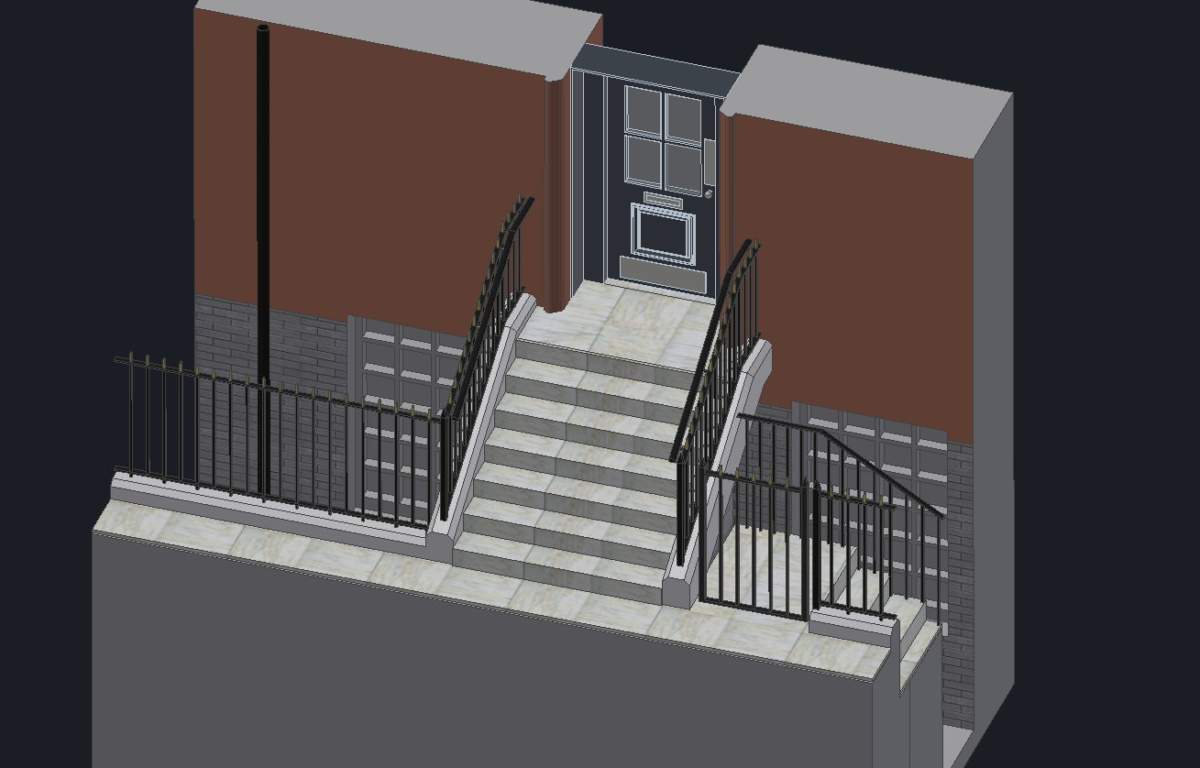
Accurate decision-making depends on understanding the full geometry of the entrance, not just plan dimensions. Sesame Access uses detailed 3D staircase modelling to validate clearances, movement envelopes, and user interaction before fabrication.
This process is explored in detail here:
https://www.sesameaccess.com/knowledge-hub/3d-staircase-visualisation-for-architects
3D modelling allows risks to be identified early and ensures all stakeholders understand how the system will operate in real use.
Safety Engineering in Ultra-Constrained Entrances
Safety is never traded off to achieve compactness. In highly constrained staircases, protection measures typically include integrated safety edges, full-width rising barriers, verified clearance zones, and controlled deployment logic.
Each system is assessed against real pedestrian behaviour, not theoretical minimum dimensions.
Common Engineering Mistakes We Are Asked to Fix
Insufficient rising barrier clearance causing repeated emergency stop activation during deployment.
Inadequate structural load paths beneath retracting stair mechanisms, leading to long-term deflection.
These failure modes are prevented through full-travel 3D clash detection, structural verification, and pre-commissioning logic testing.
When This Solution Is Not the Right Answer
| Constraint | Guidance |
|---|---|
| Pavement-to-façade depth below 450mm | Alternative access routes may be required |
| Rise exceeding retracting stair capacity | Vertical platform lift or internal solution preferred |
| New-build projects with design flexibility | Standard lifts are often more cost-effective |
| Listed buildings | Early conservation approval is essential |
This transparency ensures the correct solution is selected for each building, not simply the most complex.
Cost–Benefit Reality in Prime Locations
While bespoke entrance systems may represent a 15–25% higher equipment cost than compromised internal solutions, clients typically recover this by retaining lettable space. In prime urban locations, the retained floor area often outweighs the additional capital cost within a short operational period.
Product Integration Summary
| Requirement | Sesame Solution |
|---|---|
| Minimal entrance depth | Big Ben Electric Retracting Stairs |
| Equality Act compliance | Westminster Equality Act Lift |
| Visual discretion | Bespoke lift engineering |
Related Sesame systems applying similar principles include:
https://www.sesameaccess.com/lifts/windsor-lift
https://www.sesameaccess.com/lifts/cavendish-platform-lift
https://www.sesameaccess.com/lifts/british-library-platform-lift
https://www.sesameaccess.com/lifts/bespoke-lift
Frequently Asked Questions
Can a wheelchair lift work with less than 600mm of depth?
Yes. Retracting stair systems combined with bespoke lift engineering allow compliant access in spaces well below standard requirements.
Do retracting stairs affect everyday pedestrian use?
No. When not in use, the stairs function as a conventional staircase with no visual or operational compromise.
Are these systems compliant with accessibility legislation?
Yes. When correctly engineered, they meet Equality Act and inclusive access requirements.
What information is needed to assess feasibility?
Accurate surveys, step geometry, handrail positions, and building line measurements are essential.
Call to Action
If you are facing a constrained entrance and need an accessibility solution that balances people, architecture, and commercial value, book a Teams meeting with one of our Project Managers:
https://www.sesameaccess.com/book-a-meeting