
Key Takeaways
Hidden step lifts can deliver inclusive access without making an entrance look “adapted”.
Real users often describe them as more impressive in person than on social media.
Perceived speed and smoothness matter as much as compliance in first-use confidence.
A clear decision framework helps teams choose hidden step lifts for the right scenarios.
Early programme planning reduces installation risk and avoids site delays.
Introduction: What People Notice First at an Accessible Entrance
Many accessibility solutions work technically, but still change the “feel” of a building. Visitors often notice when access has been added as an obvious afterthought.
Hidden step lifts change that dynamic by keeping the entrance visually intact while still providing a smooth, intuitive way in.
One satisfied customer described their experience after seeing a newly installed Sesame lift:
“I had the privilege of working with Sesame to showcase the newly installed lift providing access to the church.”
They also highlighted how expectations shifted when experiencing it first-hand:
“I’ve seen these lifts on social media before, but experiencing one in person was impressive.”
And the detail that matters most to architects and building owners:
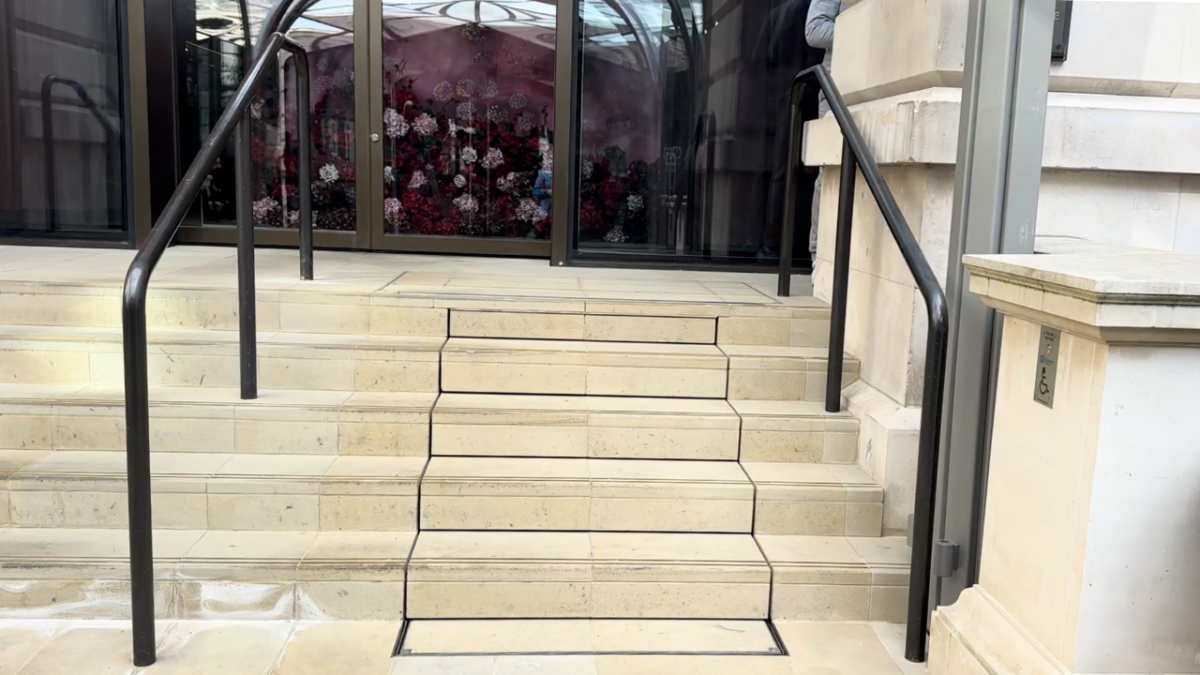
“I love how it is seamlessly integrated with the steps; it doesn’t look out of place at all, and you’d only notice it if you knew it was there.”
For a broader overview of concealed entrance options and typical constraints, see the related guide: Hidden step lift solutions for discreet accessible entrances.
Problem: Why Traditional Access Solutions Can Feel “Added On”
Ramps, visible platforms, and bolt-on adaptations can meet access needs while unintentionally creating a separate “access route” experience. In heritage settings or architectural frontages, that can undermine the entrance’s design intent and sometimes even reduce willingness to use the solution.
The goal of inclusive design is not only to provide access, but to make access feel natural and dignified for everyone.
Solution: A Hidden Step Lift That Blends into the Architecture
A hidden step lift is engineered to look like normal steps when not in use, then converts into a lifting platform when needed. This keeps the entrance visually coherent while enabling wheelchair users and those with limited mobility to enter through the same main approach.
The same customer also noticed another point that frequently comes up in first-use reactions:
“It felt faster than expected, too.”
When a lift feels smooth and quick, first-time users are more likely to trust it and use it confidently without assistance.
For an example of a discreet integrated system designed around entrance aesthetics, explore the Mayfair Stairlift with concealed step integration.
For a tailored approach where each design is engineered around the site constraints, see the Bespoke Lift engineered for complex entrances.
Engineered Insights from the Sesame Access Engineering Team
Hidden step lifts succeed when engineering decisions are made around real-world use, not just the drawing.
Key engineering-led outcomes that influence user perception include:
Minimal visible footprint when parked, so the entrance reads as “normal steps”.
Predictable motion and stable platform feel, improving first-use confidence.
Finishes and geometry matched to surrounding steps, reducing visual interruption.
Site-specific detailing to avoid the impression of an add-on system.
Where project teams want a deeper understanding of coordination and sequencing, this is the practical reference: Lifting plan coordination for bespoke lift installations.
When Hidden Step Lifts Are the Right Choice, And When They Aren’t
Hidden step lifts are often the right choice when
The entrance is visually sensitive and architectural integrity is non-negotiable.
Space is constrained and a ramp would be impractical or intrusive.
The priority is a single, shared entrance experience rather than a separate route.
A discreet solution is needed for front-of-house locations.
Hidden step lifts may not be the best choice when
The site has extremely high throughput and needs continuous, rapid cycling all day.
The vertical travel is better served by a dedicated conventional platform arrangement.
The project brief is explicitly about making accessibility a visible design statement rather than a discreet one.
This is where experience-based judgement helps. Hidden step lifts can be the best answer, but only when the entrance goals and usage pattern fit the solution.
Product Integration Summary
|
Sesame solution |
Typical fit |
What users notice most |
|
Premium or heritage entrances |
It looks like normal steps |
|
|
Landmark-style entrances |
Smooth, confident first use |
|
|
Complex stair geometries |
Natural transition from steps |
|
|
Highly constrained sites |
Designed around the user journey |
What Users Get Wrong, And What Real Experience Shows
Misconception: “Hidden lifts must be slow.”
First-time reactions often say the opposite. As one user put it:
“It felt faster than expected, too.”
Perceived speed is heavily influenced by smooth motion, clear controls, and predictable operation.
Misconception: “They only work in modern buildings.”
Hidden step lifts are often chosen precisely because they respect traditional entrances and avoid changing the visual identity of the façade.
Misconception: “A concealed lift will feel complicated.”
When the interface is intuitive and the platform feels stable, the experience is often simpler than users expect, particularly when the lift is directly where they need it, at the main entrance.
Frequently Asked Questions
What is a hidden step lift?
A hidden step lift is an integrated lifting platform that sits within an entrance stair arrangement and remains visually discreet when parked.
Do hidden step lifts work for heritage or visually sensitive entrances?
Yes. They are commonly selected where the brief requires inclusive access without altering the appearance of the entrance.
Are hidden step lifts slower than visible platform lifts?
Not necessarily. Many first-time users report they feel quicker than expected, especially when operation is smooth and predictable.
What’s the difference between a hidden step lift and a standard platform lift?
A hidden step lift is designed to integrate into steps and be discreet when not in use, whereas standard platforms are typically more visually apparent.
When is a ramp a better solution than a hidden step lift?
Ramps can be better where there is ample space, the rise is small, and the architectural impact is acceptable. In many constrained entrances, ramps are not feasible without major compromise.
What should be planned early to avoid site delays?
Programme planning matters. A coordinated lifting approach, access routes for equipment, and sequencing around finishes can prevent last-minute disruption. The practical planning guide is here: Lifting plan coordination for bespoke lift installations.
Are hidden step lifts suitable for high-traffic public buildings?
They can be, but it depends on cycle frequency, usage patterns, and operational expectations. A quick design review helps confirm fit.
Can the lift be matched to the existing step finishes?
In many cases, yes. Matching surrounding finishes is a key part of making the lift feel like it belongs in the entrance.
Call to Action
If you want to explore whether a hidden step lift is the right choice for your entrance, book a Teams Meeting with one of our Project Managers to review constraints, usage, and a practical delivery plan:
https://www.sesameaccess.com/b...