Key Takeaways: why a 100 mm roll-off guard is not fall protection
A 100 mm roll-off guard cannot be used alone to protect standing users from falling off a platform lift.
A roll-off guard has one designed purpose: preventing wheelchair casters from rolling off the platform edge during travel.
EN ISO 12100 requires risks to be reduced by design and safeguarding before relying on warnings or training.
DS/EN 81-41:2024 does not treat a toe guard as a substitute for landing doors or full guarding where standing users have access.
Danish compliance frameworks place ongoing legal responsibility on owners and require installations to remain safe in all respects.
Introduction: what problem are we solving?
Specifiers often want minimal visual barriers around platform lifts, particularly in design-sensitive interiors and complex refurbishment contexts. The risk is that a “minimal barrier” decision can quietly change a platform lift from a wheelchair-only safety profile into a standing-user fall-from-height hazard.
Sesame Access’s position is consistent across jurisdictions: a 100 mm roll-off guard is a wheelchair caster containment measure, not standing-user fall protection. If standing users can access the platform, the safeguarding strategy must change.
If you also need a Canada-focused approval route perspective for toe guards, see roll-off guard approvals in Canada (CSA B355 and authority expectations). For UK context on how standards are structured and interpreted, see British Standards for accessibility lifts and platforms.
From Sesame: the non-negotiable engineering position
A roll-off guard cannot be “stretched” to become a fall-prevention device for standing users. A 100 mm curb does not isolate a standing person from a fall edge, and it does not meet the safeguarding intent expected by modern machinery safety principles or product standards.
Three short statements that are helpful to include in specifications:
“ A 100 mm roll-off guard cannot be used alone to protect standing users from falling off a platform lift. ”
“ The roll-off guard has one designed purpose: preventing wheelchair casters from rolling off the platform edge during travel. ”
“ That single function does not transfer to, and cannot be stretched to cover, fall protection for a standing human being. ”
Why architects and specifiers often get this wrong
Is CE marking being misunderstood?
A platform CE-marked for wheelchair use does not automatically protect standing users. If standing access is foreseeable, the risk assessment and safeguarding strategy must address that foreseeable use, not just the “best case” intended use. The lift must be switched off when not in use. Only trained personnel can control the lift for wheelchair users, or wheelchair users can control the lift for themselves using their key.
Is aesthetic pressure driving an unsafe assumption?
Clients frequently request minimal barriers for visual reasons, but barrier height and containment are not aesthetic preferences. They are safety controls. A low curb can also create a trip point during reactive movement, adding momentum toward the edge rather than preventing a fall.
Are teams relying on older interpretations?
UK practice evolved in this area. Earlier editions of BS 6440 permitted limited standing accompaniment in certain low-rise situations, but the British Standards committee changed that position in the 2011 version. This is best framed as a deliberate tightening of standing-user assumptions, without speculating about causes unless a verified source is available.
What is a roll-off guard actually designed to do?
A roll-off guard is an edge retention component. Its job is to keep wheelchair wheels and small objects from rolling off the platform during travel.
That is a valid and useful function. It is also a different function from fall prevention for standing users.
A practical way to describe it in plain language for project teams:
A roll-off guard is a wheel-stop, not a person-stop.
The risk that matters: fall-from-height for standing users
When a standing person can access a lift platform, the principal hazard is fall-from-height at an exposed edge, particularly during platform travel, start/stop movement, loss of balance, distraction, or unsupervised use.
A 100 mm curb does not remove that hazard and does not meaningfully isolate the person from it. For standing-user safety, the control must be a containment strategy that prevents reaching or toppling over the edge, typically by full-height guarding, landing doors, or equivalent protection designed into the lift concept.
EN ISO 12100: why warnings cannot replace guarding
EN ISO 12100 sets the hierarchy of risk reduction:
Step 1: inherently safe design
Step 2: safeguarding and complementary protective measures
Step 3: information for use
This hierarchy is sequential. You do not jump straight to signs, labels, or “wheelchair users only” instructions while leaving a fall edge unguarded. Information for use is the least reliable measure and cannot substitute for physical safeguarding.
A 100 mm toe guard does not satisfy Step 1 and does not qualify as Step 2 safeguarding for fall-from-height. It does not isolate the standing user from the hazard.
Giving keys to trained users who will ensure the lift is used by seated users is essential when using platform lift with a roll off guard.
DS/EN 81-41:2024: what the product standard expects
DS/EN 81-41:2024 covers platforms intended for persons with or without a wheelchair, which means the standard’s safety logic must account for different user profiles.
In practice:
Toe guards are treated as platform-edge components for wheel retention and platform containment.
They are not recognised as substitutes for landing doors or full guarding where standing access exists.
Where platforms are not fully enclosed, specific guarding logic applies.
A toe guard can be part of a safe platform lift system, but it cannot be the fall prevention system for standing users.
Danish compliance reality: BR18, BEK 461, and enforcement expectations
In Denmark, lift safety is not just a design discussion. It is a legal responsibility that continues after commissioning.
BR18 relies on EU safety frameworks and harmonised standards, and the core principle is that accessibility must not compromise safety.
BEK 461 places clear responsibilities on owners/operators to ensure installations follow manufacturer instructions and remain safe in all respects, including safe movements and proper working positions.
Arbejdstilsynet enforcement is built around a safety-by-design philosophy, with written workplace risk assessment obligations and powers to require corrective actions.
This is why a standing-user configuration relying only on a toe guard is difficult to defend. It is not aligned with the intent of the standards, and it does not align with the legal responsibility to keep the installation safe for foreseeable use.
Decision framework: when roll-off guards are appropriate vs when they’re not
Scenario | Roll-off guard alone? | Required safeguarding |
Wheelchair user only, no standing access | Yes, for caster containment | 100 mm roll-off guard plus appropriate stability measures and controls strategy |
Wheelchair user plus occasional standing carer | No | Landing doors or full-height guarding designed for standing-user fall prevention |
Ambulant disabled users, staff, public access | No | Full enclosure or full-height guarding strategy |
Heritage or design-sensitive setting | No | Bespoke safeguarding that maintains equivalent protection with minimal visual impact |
Safeguarding selection matrix: user profile vs required protection
User profile likely to occur | What a 100 mm roll-off guard does | What must be added |
Unaccompanied wheelchair user | Prevents caster roll-off | Guarding strategy still required at landings based on standard logic |
Wheelchair user with standing companion | Does not prevent fall | Landing doors or full-height guarding for standing access |
Ambulant disabled user | Does not prevent fall unless seated | Full-height containment strategy and safe operating controls or procedures to sit when travelling |
Staff, visitors, parents with prams | Does not prevent fall | Full-height safeguarding designed around foreseeable use |
Problem–Solution: how to keep the design clean without compromising safety
Problem: the client wants minimal visual barriers
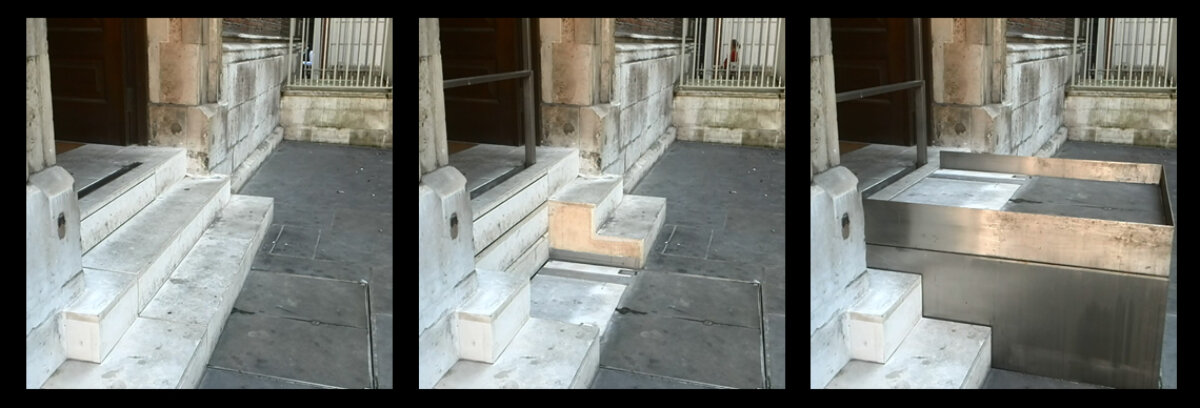
Solution: use automatic hidden rising barriers that rise 1100mm high.
Problem: refurbishment constraints limit space
Solution: engineer safeguarding into the lift concept early. Retrofitting guarding late causes redesign and approval delays.
Problem: different jurisdictions interpret approval routes differently
Solution: align on first principles and document the user profile clearly. For Canada-specific authority routes, reference roll-off guard approvals in Canada (CSA B355 and authority expectations). For UK standards background, reference British Standards for accessibility lifts and platforms.
Variance and Equivalency in Context
Where prescriptive guarding requirements conflict with architectural constraints, formal equivalency documentation may be required. A detailed United States example of manufacturer-level variance submission under ASME A18.1 is explored in ASME A18.1 Permanent Variance: Docket 24-V-358 Analysis. For broader context on ASME A18.1 compliance engagement in US jurisdictions, see UK Platform Lifts USA AHJ ASME A18.1 Guide. European liftway scope boundaries under EN 81-41 are explained in Liftway Definitions and EN 81-41 Scope.
Sesame product integration summary
Sesame’s work typically involves solving safeguarding and architecture together in a single engineered concept. The following product pages are often relevant when discussions touch platform lift guarding, design sensitivity, or complex constraints:
Bespoke Lift designed for complex safeguarding requirements
Traversing Lift concept-led solutions for unusual constraints
Westminster Equality Act Lift as a reference point for duty-of-care access
Seattle ADA Lift for international compliance expectations
Richmond Rising Platform Lift for platform and barrier strategy discussions
Windsor Lift for design-sensitive and heritage-style access approaches
Frequently Asked Questions (FAQ)
Can a 100 mm roll-off guard be used as fall protection for standing users?
No. It is designed for wheelchair caster containment and does not isolate a standing person from a fall edge.
Does “wheelchair users only” signage make a toe guard acceptable?
No. EN ISO 12100 requires hazards to be addressed by design and safeguarding before information for use is considered.
If standing access is foreseeable, what is the minimum safeguarding approach?
A safeguarding strategy designed for standing users, typically involving landing doors, full-height guarding, or equivalent containment performance based on the standard and local requirements.
Why do some designs still specify toe guards for standing access?
Common reasons include aesthetic pressure, misunderstanding of CE marking scope, and outdated assumptions from older guidance.
How do Canadian approvals compare?
Approval route and authority expectations can differ, but the safeguarding logic for standing-user fall prevention remains. See roll-off guard approvals in Canada (CSA B355 and authority expectations).
Where can I see the UK standards context?
See British Standards for accessibility lifts and platforms.
What is the fastest way to confirm the right safeguarding strategy before tender?
A short pre-tender safeguarding review to confirm user profile, travel, guarding concept, and approval route.
Book a Teams meeting
If you want a quick, spec-ready answer on guarding strategy for your platform lift, book a Teams meeting with one of our Project Managers here: Book a meeting with Sesame Access